Showing posts with label images. Show all posts

Monday, April 22, 2013

More on Mary's manifestation and Stewy's streetart

Just over a month ago,  Mary manifested!  Overnight Wollstonecraft appeared outside Newington Green Unitarian Church, courtesy the street artist Stewy.

Mary on the Green, the group campaigning for a statue, and Andy Pakula, the minister of the church at the heart of the village that changed the world* (and expanded Wollstonecraft's life), both bask in the reflected glory of the rather lovely life-sized image.

In the weeks since International Women's Day, the stencil on the wall has attracted a lot of publicity, as well as pilgrims and visitors. Here's a round-up (including interviews with yours truly):


There’s something about Mary, Hackney Post, Rachel Bayne

On a Stoke Newington corner, astride the New Unity Church railings, a banner proclaims ‘The Birthplace of Feminism’. In this small, Unitarian congregation beats a radical heart. Here, amongst the pews more than 250 years ago, sat Mary Wollstonecraft.

Last weekend, a mysterious portrait of the radical feminist appeared on the wall of the Church. The stencil, designed by graffiti artist Stewy was put there on International Women’s Day to celebrate the palpable influence Wollstonecraft made on the Newington Green community and far, far beyond.

Stewy’s painting also acts as a ghost-like trace, spearheading the path for a more lasting tribute in Stoke Newington. Roberta Wedge, local activist and member of the ‘Mary on the Green’ campaign, represents that hope with plans to build a statue of the feminist on Newington Green.
“I always say to people, if you were raised by a woman who could read and vote and work, then you owe something to Mary Wollstonecraft,” says Wedge.


Mysterious Banksy-style graffiti welcomed by Newington Green statue campaigners, Islington Gazette

The mural, which is the work of street artist Stewy – whose identity is unknown – emerged as events were staged in Newington Green to raise money for the statue and to celebrate International Women’s Day, which was last Friday.

Andy Pakula, minister of the New Unity congregation based at the chapel, said: “I hope we can leave it here because we think it’s fabulous. There’s different issues about street art, but she’s our guiding spirit. You’ve seen in the US where images of Jesus appear on toasted cheese sandwiches, well for us this is about the best that could happen to have Mary show up. She’s inspired us to work for justice in the world and we absolutely support the campaign for a statue. We would like to see a Mary Wollstonecraft centre for feminist studies in Newington Green one day.”

Writer Bee Rowlatt, 41, who is backing the campaign and recently published a chapter about Wollstonecraft in a new book titled 50 Shades Of Feminism, said: “It’s just unbelievable that there’s no permanent memorial to this incredible woman. The mural is really inspiring. She’s right there life-size on a building where she used to go. We feel like she’s appeared among us and we hope this is a small step towards getting the memorial.”


‘Apparition’ of 18th-century women’s rights campaigner Mary Wollstonecraft appears on church, Islington Tribune, Amy Smith

A MYSTERIOUS apparition on the side of the New Unity church in Newington Green caught the eye of passers-by when it appeared overnight. But it is not the “Mary” that some might expect. Instead, it’s a graffiti stencil of Mary Wollstonecraft, the influential 18th-century author and staunch advocate of women’s rights who was inspired by sermons at the church.

As a young school­mistress Wollstonecraft used to attend the New Unity church and its radical sermons were integral in shaping her political stance. Street artist Stewy was inspired by her message to create the piece. “I’ve been aware of Mary Wollstonecraft’s connection with the Unitarian Church for many years,” he said. “The placing of the image, where she may have walked, was important to me and I decided to make a small edition of 25 screen prints taken from the stencil to help raise money for ‘Mary on the Green’.” 


Mary Wollstonecraft "appears" in street art on her 18th C spiritual home! N16 magazine

New Unity Minister Andy Pakula said ‘This is a mysterious apparition of the mother of feminism - a daring figure who continues to inspire us in the fight for freedom and justice for all people. Without her spirit, it is unlikely that we would have stood forward so boldly for equal marriage, as we have in recent years. Mary's spirit has been with us always. Now her image is as well!’


Newington Green graffiti celebrates Wollstonecraft, Islington Now, Sarah Graham

Fans of famous feminist Mary Wollstonecraft are celebrating her surprise appearance in the form of graffiti on the side of a church in Newington Green. The stencilled image of the 18th century “mother of feminism”, by street artist Stewy, is a bonus for a local campaign to get a statue of Ms Wollstonecraft erected in the borough.

Islington-based movement Mary on the Green tweeted a photo of Stewy’s artwork, saying: “What a boost to the campaign! Mary manifests on NG church @newunity.” Newington Green Action Group set up the initiative in 2011 to make her life and work more accessible to local people.

Campaigner Bee Rowlatt said: “[Ms Wollstonecraft] is an internationally renowned champion of women’s rights and there’s no statue to her anywhere." Ms Wollstonecraft, author of A Vindication of the Rights of Woman, lived locally and attended the “radically-inclusive” New Unity church during her lifetime.


and even in the the newsletter of the National Museum Directors' Council

Street art evens up London’s representation of famous women: The image is clearly based on the John Opie picture of Wollstonecraft, which is on display in the National Portrait Gallery.  Mildmay’s Labour councillor Kate Groucutt says “I absolutely want it to stay. We’ve had confirmation from Hackney Council and they can’t remove it without checking with the owner, and that’s the church.  It’s not going to be painted over, we have secured that.” There are only a handful of statues to women among the hundreds in London. 


And the image is to be found as far afield as the United States UU World magazine: 
British Unitarians rally to save faith from extinction  by Donald E. Skinner

Unitarians in London gathered next to an image of 18th century Unitarian writer Mary Wollstonecraft. The image was created recently on the side of the Unitarian Chapel in Newington Green in north London, where efforts are underway to raise money for a statue of Wollstonecraft.

*************************
*The Village that Changed the World is the title of the beautifully illustrated little history produced by the Newington Green Action Group. It's available directly from the charity and no doubt from the online mega-retailer of your choice.
The photo above is, for a change, by me, of a pair of warm churchgoers on a cold day.

Monday, April 8, 2013

Simon Schama admires

It's not often that Mary Wollstonecraft appears on television. My British readers have until Saturday to catch her on iPlayer here; the DVDs can be ordered worldwide and indefinitely, I believe.

Simon Schama, the historian and art historian, is probably best known for his BBC2 television project A History of Britain, produced about ten years ago. By series 3 he had worked his way to the late eighteenth century. Its first episode is "Forces of Nature", a curious title, as it deals with very human passions. Why did the British "prove immune to the siren call of liberty, equality and fraternity", as the blurb puts it?

First, twenty minutes of context and back story: 
Richard Price, Tom Paine, Edmund Burke. The Glorious Revolution of 1688 was referred to in 1789 with the fall of the Bastille. Liberty and reform were in the air. But the conservatives were afraid of revolution in Britain, and counter-attacked. You can tune in at 23:15, when the camera settles on the dining table of publisher Joseph Johnson, "one place where dangerous thoughts were positively welcome", as were "articulate, intelligent, impassioned women":
Among those women, the most striking was Mary Wollstonecraft. She was the spirit of the time and a one-woman revolution. Living a hand to mouth existence as a writer, Mary burst into print in outrage at Burke's Reflection. She also noticed that the rights of man weren't worth much if they excluded the other half of human society...

There was nothing she saw in her nature that disqualified her from being a full citizen.
The problem with filming history is that they're all dead. So mostly we get paintings, and close-ups of the title pages of books, and Simon Schama lecturing to us as we sit on the sofa. But there are also scenes featuring silent (and, as far as I can tell, uncredited) actors, in groups, pretending to listen to each other, or alone, sucking their quills in thoughtful anticipation of another burst of literary genius. When the action cuts to Paris, the picture editors go crazy for moody black and white shots of the bridges over the Seine:
To begin with, Mary shared the company and the optimism of expatriate Irish, English, Americans, and Scots at White's Hotel. But then, as the despotism of the Crown was replaced by the despotism of a police state, doubts began to creep in.
Schama stands in the Jardin de Luxembourg and recounts how, when Tom Paine was imprisoned there, he narrowly escaped his meeting with the "national razor". The Mary-actor, still with too much hair, sits by a solitary candle, looking scared, writing a letter to Johnson. The 1793 war between Britain and France made everything so much worse.

Mary must have felt it would be her turn any day. Salvation appeared in the good-looking shape of an American businessman and property speculator, Gilbert Imlay, who registered her as his American wife, and thus free from the taint of being one of the enemies of France. Nursing their baby in a quiet garden on the outskirts of Paris, Mary the feminist had been saved from the revolution by motherhood. 
But it was not to be a happy ending. As Mary became more devoted, Imlay's business trips became mysteriously prolonged. When she followed him as far as London, she found a new mistress.
And thus to the Putney Bridge plunge.

But she was not to be allowed her poetic suicide; a boatman pulled her out. She was 37 and she seemed to have lost everything except her child: her faith in revolution, in the virtue of the people, her belief in the possibilities of an independent woman's life, the goodness of nature, must have seemed a cruel joke.
But then, Schama says, she got a second chance: she met Godwin, and "Mary's fire burned bright enough to melt his icy principles." This is where the camera shots get a bit icky: they sit in armchairs on either side of a fireplace. He is reading, not aloud but silently; she sits with her hands clasped over her belly (Look! I am carrying his child!), no book within reach, gazing at her husband in doubly mute adoration.
Though they'd agreed not to cohabit, the sworn enemy of matrimony and the feminist were wedded at St Pancras Church. As her months of pregnancy passed, the two found themselves relaxing into conjugal cosiness to the point where Godwin was prepared, at least privately, to admit the force of emotion as well as thought. Which is what made the end so unbearable.
And then it all gets rather graphic - in Schama's choice of words, not in the images (no puppies, thank goodness). I can't decide if this brutality of expression is the sort of honest dealing that Godwin intended with his Memoirs, or if it is just gruesome titillation:

When the time for her labour came, Mary called a local  midwife. But after the baby was born, another girl, the placenta remained firmly lodged somewhere at the top of the birth canal.  
Obstetric opinion at the time held that unless the placenta was promptly expelled, there was a lethal danger of infection. So a doctor from Westminster Hospital was summoned and he stuck his hand up Mary and pulled. The placenta came away in pieces as Mary lay in agony, hemorrhaging.
She had been through so many terrors, so many ordeals, had come so close to death, and had somehow managed to survive. This time, with so much to live for, there would be no escape. She died a week later of septicemia.
Schama does a good job describing Godwin's immediate reaction, his heart-torn letters that day. And then he concludes these twelve minutes of Mary Wollstonecraft:
She is rightly remembered as the founder of modern feminism, for making a statement remarkable for its bravery and clarity, that the whole nature of women was not to be confused with their biology. But nature, biology, had killed her.
Sic transit. The episode rolls on to other defenders of freedom. The whole series is worth watching; it's as good an overview as you're likely to find, and equally relevant to our American cousins, up until our paths diverge.


Wednesday, March 20, 2013

London immortals

There is no statue to Mary Wollstonecraft anywhere in the world. There is, however, a sprinkling of public memorials to prominent women in central London. The local chapter of United Nations Women organised a walking tour of half a dozen of them last Saturday. Despite the persistent rain, a goodly crowd assembled, including a pair of self-possessed twelve year olds. Each statue had its designated champion, telling us about their chosen person, from national heroine to forgotten obscurity. Here is the group, listening to the story of Edith Cavell, at the impressive memorial outside the National Portrait Gallery. I even found the opportunity to expound for the benefit of Mary on the Green.

The walk started in Bloomsbury at Tavistock Square, wandered via Lincoln's Inn Fields to the Strand, along to Trafalgar Square, then Pall Mall and Whitehall and finally Parliament, a satisfying circuit through literary, legal, and legislative London.

The full list was:
Louisa Aldrich-Blake (1865-1925), the first female surgeon in Britain.
Virginia Woolf (1882-1941), a writer at the forefront of British Modernism.
Margaret MacDonald (1870 – 1911), a feminist and social reformer. 
Edith Cavell (1865-1915), a pioneering nurse more famous for her death. 
Florence Nightingale (1820-1910), not only a pioneer of nursing but also of statistics.
Women in World War II, the only sculpture not of a specific person. 
Emmeline Pankhurst (1858-1928), the leader of the suffragette movement. 

There are others: Time Out lists Violet Szabo and Sarah Siddons. The labour of love that is London Remembers provides endless browsing fascination; here's their page on the military monument. And the Victorian Web is very good between 1837 and 1901, as e.g. with Florence Nightingale

I've spent ages and ages making a Google Map, Statues of prominent women, with links and everything. Do have a look


Friday, March 15, 2013

Hidden re-appears


With the kind permission of the artist himself, Red Saunders.

Red Saunders created Mary Wollstonecraft and the Dissenters of Newington Green 1781 as part of his Hidden from History series. Thanks to the Socialist Worker, I am pleased to report that it is visible once more, this time in the People's History Museum, until the end of September. I wrote about the creation of this elaborate photomontage here.

[This is my 200th post, over two and half years. Not bad going.]


Tuesday, March 12, 2013

Mary manifests!

Mary Wollstonecraft has appeared on the side of Newington Green Unitarian Church, on Mothers' Day and on the extended weekend of International Women's Day.

No sign of her on Saturday, when the walking tour got to hear her story at the beginning of "Feminist Hackney - Or Is It?". But when the congregation arrived on Sunday morning, she had (to their delight) manifested quite serenely and beautifully on the exterior west wall. This is the church that radicalised Mary Wollstonecraft, that helped this unpublished 25 year old schoolteacher, with no family or money or even a proper education herself, realise that she could make a mark on society. This is the community that introduced her to a wider intellectual sphere, and to the publisher who nurtured her for her ten brief years of productivity. This is, as the local history says, The Village that Changed the World.

Church Walk is now an alley, but in her day would have been a lane through a mile of farmland to Stoke Newington and the resolutely non-Dissenting St Mary's Church. All these fields were swallowed up by the relentless Victorian sprawl of London, but those with eyes to see can spot the history under our feet.

The image is clearly based on the last John Opie painting, when she was pregnant with her second daughter, known to history as Mary Shelley.  You can see the head and shoulders in the National Portrait Gallery, thanks to Bob Lamm liberating her from basement interment, or indeed in the nearest pub to the church, larger than life in the Dissenting Academy, but if you want to see the full-length version in the fresh air, I'd advise you to hurry. Who knows how long Hackney Council will allow her to stay? I've heard they take a dim view of street art, unlike neighbouring Islington. We shall see.

The wall stencil is signed STEWY. I hoped it might be a culinary reference; I was cycling into an unseasonably bitter wind and snow flurries this morning, so my thoughts naturally turned to well-seasoned eighteenth century winter stews. Apparently Stewy is a man, albeit a shadowy one. He has given a few interviews over the years, from which I glean that he trained as an illustrator, was influenced by Banksy and Blek Le Rat and their rodents, and decided to do 26 indigenous animals: F for fox, P for pigeon, etc. His politics are of the Billy Bragg variety* (with an extra dose of charmingly naive idealism) and his imagery is simple, full of character rather than narrative. His bare-bones tumblr is here.

From animals Stewy graduated to people, putting Quentin Crisp near Canal Street in Birmingham, Tracy Emin in Margate, and John Cooper Clarke in Salford. (For those not familiar with them: England's stateliest homo, no-longer-YBA enfant-terrible EMINence grise, and punk performance poet.)
I wanted to do something different so I had this idea like the [English Heritage] blue plaques.... I would only spray my people where they had an association, where they lived or were born or worked or died. And most of them that I have put up have remained which is great because they are obviously relevant to the people who live in the area, there is a sort of respect.
That was from the interview by Ken McGregor of the Australian Metro Gallery. (Mary Wollstonecraft has several plaques in London, including one on Newington Green.) Stewy went to a Manchester pub with Tom Balderstone and expounded some more:
I deliberately do underdogs or the people hidden or just behind the scenes. The people who haven’t really become famous....[With one of his images] loads of people come up asking who he is, not their fault, so it’s kind of educational; almost historical/geographical. In school I had an interest in both but I couldn’t do history, got a B in geography and I liked art, so it all came full circle and now I’m pulling that all together. I might do a map one day, and try to plot it all. But by then the pictures might have gone.
He also spoke to Joe Bill of Kent News about the future of street art, it becoming a positive force in society. "It’s not about me. The work highlights people or eccentrics who made a difference - changed how we approach art, music or writing - pushing the boundaries in Britain and shaking things up a little."

Stewy calls his combination of people in their context "psychogeography". So now we have a psychogeographic Mary Wollstonecraft, back in her old neighbourhood, looking straight at us. "Like a ghost across the street", a line from Blek. There she is. Thanks, Stewy.

***************************************************************
*Note to self: the Bard of Barking might be interested in Mary Wollstonecraft: 
that ancient port was where she formed her first memories. 

Wednesday, February 6, 2013

Namechecked on Newsnight

Mary Wollstonecraft (but not, alas, Frances Blood) was mentioned yesterday on Newsnight, one of the BBC's leading current affairs programmes. Last night the House of Commons voted in favour of same-sex marriage. A lot of MPs were all, "Oh, teh churchez", and in fact the Church of England is specifically excluded in legislation, with a kinky sounding quadruple lock. BUT! Some religions want in: the Quakers, the liberal Jews, and the Unitarians. So a crew was sent to the little church that radicalised Mary. Here's Allegra Stratton's report:

Many Conservative rebels feared that religious organisations, due to have to opt in if they want to hold gay weddings, would actually feel coerced. One Unitarian church up in North London is already gung-ho.
Up here in Newington Green, historically outside the City of London, they have always made up their own rules. Mary Wollstonecraft worshipped here; so too did Tom Paine and people like Benjamin Franklin. And now, 300 years on, they'd like to be able to let gay couples marry.
David Cameron may think he's more in the mould of somebody like Wollstonecraft's rival, Edmund Burke, but in this he is a radical. David Cameron wants gay couples to be able to marry precisely because he's a Conservative, not despite being one.
As I've often said, marriage is the least queer option. I wonder if the two young schoolteachers in this special village would have chosen marriage, had it been available to them in 1785. They had more or less run away to set up a new life, living and working together, offering education to girls and a refuge to an abused wife, Mary's sister. To anyone who says marriage is an eternal institution that the state shouldn't interfere with, I have two words: marital rape. Remember how recently that was outlawed; prior to 1991, it was just part of the legal bargain, sexual access for financial support. Or for a point roughly equidistant between Mary's time and ours, the Married Woman's Property Acts (1870 and 1882), before which every penny a woman owned and every article of clothing on her back belonged to her husband. No wonder that other Famous Dead Bisexual near Mary's first grave decided to spend her life with a woman by her side and not a man. Much safer. Times change.

Who'll be the first same-sex couple to marry in Mary's church? Will they be conservatives or radicals, or both?
...

Friday, August 24, 2012

Mary at the Dissenting Academy

Mary Wollstonecraft has her portrait hanging in the new Dissenting Academy. It's not a school, college, or seminary, but a pub, and a very nice one too.
Throughout history, Newington Green has been a destination for free-thinking people who have challenged conventional ideas and changed society. The most famous dissenting academy in the land was located here, and it is from this exceptional establishment that our pub takes its name and its desire to challenge conformity. Today's Dissenting Academy celebrates purveyors of non-conformist art and music, and provides an inspirational environment in which to enjoy good beer, tasty food and brilliant company.
It opens today, and so far I've not had a chance to speak with manager Ben King. In time...

Wednesday, August 8, 2012

Action Philosophers

With the permission of the evil twins from Action PhilosophersFred Van Lente for the words and Ryan Dunlavey for the art. Two graciously ink-stained wretches!

Monday, March 5, 2012

Mary on Doodly


Created by, and reproduced with the kind permission of, Telling Tales. The original is here and more about Doodly - still in beta - is here. Telling Tales (domain name telling-tails: I like the wordplay) has also written about the Vindication anniversary, and Judy Chicago's vision of Mary Wollstonecraft. It turns out that she worked on the 100th anniversary of International Women's Day in London, which got quite a splash, and which of course was the date of the unveiling of the latest plaque to MW. And she appears to be Canadian: bonus points.

Tuesday, January 31, 2012

Les Goddesses


Addendum: Saturday 18 and Sunday 19 August, 3pm, at the ICA London. Tickets.

Another artistic interpretation of Mary Wollstonecraft. Somehow I missed this when it was at greengrassi in London a few months ago, but here comes another opportunity: Moyra Davey's Les Goddesses will be shown at the Glasgow International Festival of Visual Art, 20 April to 7 May this year. The previous (longer?) manifestation of this, her third film, was was well and comprehensively reviewed by Gareth Bell-Jones in Art Agenda, with lots of stills: "With precise observation, this psychological self-portrait is a series of clues with no conclusion." Paul Teasdale of Frieze described the work in detail, saying it switches "between autobiography and historical inquiry". He found it:
disquieting in its simplicity. Using little more than a video camera and voice recorder, Davey films herself walking around her apartment with one earphone in, as she listens to and simultaneously repeats pre-recorded passages. At just over 100 minutes long, it’s the most sustained of her films and perhaps the richest. The set-up is clear: Davey recounts the lives of the writer and political activist Mary Wollstonecraft, her daughters Fanny Imlay and Mary Wollstonecraft Godwin (later Mary Shelley), and their stepsister Claire Claremont (the piece is fastidiously researched: errata appear twice as subtitles to correct factual errors). These then segue into reminiscences about Davey’s own family.
It's all here on the website of the Glasgow Festival.
Moyra Davey’s latest film “Les Goddesses” (2011) focuses on the life story of Mary Wollstonecraft, her daughters and her lovers. Wollstonecraft was an Eighteenth-century British writer, philosopher, and advocate of women’s rights and her daughters were Fanny Imlay, Mary Wollstonecraft Godwin (later Mary Shelley) and their stepsister Claire Claremont, nicknamed ‘Les Goddesses’. The daughters were all at some point romantically linked to Percy Bysshe Shelley leading to the tragic suicide of Fanny at 22, and in 1795 Mary Wollestonecroft also attempted suicide with laudanum following her failed romance to Fanny’s father Gilbert Imlay.

Sitting on the floor and pacing around a sunlit bedroom with a voice recorder and video, Davey adopts the tone of a researcher, recounting the biographies of the female lead Mary & her daughters with a forensic attention to detail. Gradually, however, narrative associations are introduced between the lives of the characters and the artists own family, as Davey divulges into anecdotes of her own youth and figures from her past. Whilst narrating Wollenstonecroft’s story with a cool objectivity, the artist punctuates the film with Black and white photographs of herself and her sisters as young women dressed in punk rock clothes, leading us to suspect that it is Davey who may be the true subject here.

In her own writing Davey has cited the ‘muse’ as an important idea and catalyst in her work and previous films, be it a person, a book, a place, or in Davey’s words “a floating abstraction that reveals itself unpredictably”. In this film the muse manifests in itself in all these forms, as Davey weaves together the characters who inhabit her external and inner worlds, both real and imagined, and her literary inspirations - at one point blowing the dust from books on her shelf by Anne Sexton, Mary Kelly and Sylvia Plath. Slowly through the piecing together images and language, and through the act of reading itself, a psychological portrait of the artist emerges.
It was Aaron Burr, sometime vice-president of the United States of America, latterly a wanderer in Europe, who gave the three girls of the Godwin household the collective label "les goddesses": Claire Clairmont, the earlier daughter of the second Mrs Godwin, Fanny Imlay, abandoned by the American adventurer, and Mary later Shelley, whose birth cost her mother's life. His epithet is a fortuitous link: tomorrow our attention turns to the United States.
--------------
Image courtesy greengrassi.

Monday, January 9, 2012

Liberating Mary


I would like to think that Mary Wollstonecraft attracts the right sort of visitor, certainly to the city where she spent most of her life, and possibly elsewhere. Last week we met literary pilgrim Alexis Wolf (and a few days ago I met her in the flesh in Newington Green, for a visit to the Unitarian church and then coffee at the Belle Epoque). This week we have another American in London, whose adventures date back decades. The tale of how Bob Lamm "liberated Mary" from the bowels of the National Portrait Gallery first appeared in Ms. Magazine in 2004, when he was called "an intrepid male feminist". So, with his kind permission, I reprint his essay in full.


[The image he is referring to is the last one of her, when she was pregnant with Mary. It is by John Opie, and can be seen on the NPG site. The Cornish sensation had painted her c. 1790 as well; that portrait is held by the Tate.]
*********************************

No visit to London can really begin for me until I go to the National Portrait Gallery, near Trafalgar Square, and pay my respects to a lovely painting of Mary Wollstonecraft that I helped liberate from the gallery’s “dungeons.”

The seeds of my rescue began in the late 1970s, when I visited the gallery but couldn’t find a painting of Wollstonecraft. 
A few years earlier, my men’s study group on early feminist literature had devoted six months to the life and work of the inspiring English writer of the late 18th century, best known for A Vindication of the Rights of Woman

I subsequently lectured at women’s studies classes about this eloquent crusader who offered challenging political insights and was bold enough to attack in print some of the most famous men of her time, among them Burke, Rousseau and Talleyrand. Because of my great admiration for Wollstonecraft, she was on my mind when I walked through the National Portrait Gallery and then stopped at the gift shop.

In a most unlikely place — the “G” section of the postcards — I suddenly recognized a postcard of her labeled “Mary Godwin (née Wollstonecraft).” [Dreadful, but not unprecedented. See the Camden Council placard in St Pancras churchyard, detailed here. -- Ed.] In her 30s, Wollstonecraft had married the British philosopher William Godwin but had continued to use and write under her own name. The National Portrait Gallery either hadn’t noticed or didn’t approve. The postcard indeed featured a portrait of Wollstonecraft, but where was the painting itself?

At the information desk, I learned that the portrait (by John Opie, circa 1797) was currently housed in the storage area. The gallery’s walls included few paintings of women — most of whom were best known for some biological or romantic connection to a famous man. At the same time, there was apparently no room for a portrait of England’s feminist pioneer. The story might have ended there, but the woman at the information desk volunteered that a visitor could request to see any painting not on display. The timing was right, a guard was found and I was soon down in a storage room standing before Opie’s striking portrait.

The painting shows Wollstonecraft in simple clothing — a black beret and a loose white blouse — without any of the lacy feminine frills of that era. She seems intelligent, serene, hardly the dangerous radical so vilified by her enemies. 
Against a dark background, a single light source brilliantly illuminates Wollstonecraft’s face and blouse, as if the artist saw Wollstonecraft’s burning feminist spirit as a beacon of truth amid the prejudice and ignorance around her.

During visits to London over the next few years, I retraced these steps to see Opie’s portrait and lamented that others wouldn’t get that opportunity. In early 1984, however, I quite literally encountered an obstacle: A guard said I couldn’t see the painting because there was “something in the way.” The assistant registrar, Andrea Gall, was called in and countered, “So let’s move it!”

We did, and as we admired the portrait together, we wondered why it was not on display. The time had come to protest Wollstonecraft’s imprisonment. I requested a meeting with Jacob Simon, the new curator for the gallery’s 18th-century collection. When we spoke in his office, I urged him to find room for the painting and to label it just as she is remembered, Mary Wollstonecraft. He was polite but noncommittal.  Later that year, Mr. Simon sent me a carefully worded letter stating that the Wollstonecraft portrait would soon go on display — but only for four months, to take the place of a painting of Wordsworth on loan to another museum.

Thrilling as this news was, I was also saddened because I wouldn’t be in London again during those months and thus would never see the fruits of my protest. Then, shortly thereafter, I learned that the portrait had been cleaned, given an impressive new frame and was now hanging for all to see … under the name of Mary Wollstonecraft!

Now I regretted even more that I’d never see the portrait on the gallery’s walls. But when the Wordsworth painting returned to its home in early 1985, I received stunning news and Jacob Simon became a true hero. Despite his original plan, he never took down the portrait of Wollstonecraft, and it has remained on display ever since.

She can be found today in a small room with stained wooden floors, along with portraits of her husband, William Godwin, and their daughter Mary Shelley. (Wollstonecraft died in 1797 shortly after giving birth to the younger Mary, best known as the author of Frankenstein.) Wollstonecraft and her loved ones look out proudly at an illustrious array of companions: Percy Shelley, Wordsworth, Keats, Byron, Coleridge, Blake and Austen. 
Virginia Woolf wrote of Wollstonecraft, “One form of immortality is hers undoubtedly: She is alive and active, she argues and experiments, we hear her voice and trace her influence even now among the living.”

And, I’m delighted to say, we see her portrait as well.


Originally published in the United States by Ms. Magazine in their fall 2004 issue, pp. 72-73.

Thursday, December 29, 2011

London remembers, with modesty

There's an excellent site I have not yet written about: London Remembers, with the broad brave ambition, touchingly modestly worded, of "aiming to capture all memorials in London". The page on Mary Wollstonecraft gives a brief biography, with dates, categories ("seriously famous" - love it!), a picture*, and a list of places where Our Lady is commemorated. Note: not places she is associated with, such as the church of her baptism, or, at a stretch of the imagination, the Women's Library. To populate the website with the associations of historical figures would cast the net unfeasibly wide; I quite see that. So only three memorial places appear: the newest plaque, at Newington Green; the oldest, at Somers Town; and the nearby mural on the school wall.  St Pancras Church and churchyard do not feature: graves per se don't fall within the project's purlieu, or it would become impossibly unwieldy. (It is plain gravestones that don't count as memorials: impressive memorials do, hence Soane's family tomb, and so does the St Pancras sundial-spire commemorating the churchyard's other Famous Dead Bisexual Woman, Angela Burdett-Coutts.)

The page has an embedded Google Map (another blogstuff thing I've been meaning to do for a year), and, perhaps the most intriguing box, "Related Subjects". It turns up both gems and puzzles -- alluring, distracting, a way to while away an hour very happily indeed. Frances Mary Buss, of Miss Beale and Miss Buss, the pioneering educators of girls, I can totally understand, but William Johnson Cory? Why -- because his name includes "Johnson"? The Royal College of Opthalmologists? Mary didn't even wear glasses. Call in the algorithm-tweaker! (Now *there's* a necromancer's modern trade!)

London Remembers has its lacunae (not all the MW plaques, for instance -- Southwark is missing) and some teething problems limitations (why are comments restricted to Facebook and Hotmail users?), but it can only grow in strength. It's another great resource for exploring one of the world's greatest cities, even if you are in the Kenyan rainforest or the Vietnamese snow, both places pulling me in this grey dim winter.

*Opie, credited only to Spartacus, which is weird.
-------------------------
Update, mid-January. The more I nose around this site, the more I find to fascinate. I love its sense of humour! "Caveat: Be aware that London actually has more cars, more rain and less sun than our photos show." And, as above, its humility: "we don't think we will ever achieve but we will enjoy the attempt" of trying to find all the memorials. I've tweaked the entry above, to reflect changes made, and to correct my own ignorance. London Remembers is deliberately a work in progress, "doomed to remain incomplete (where does London stop?) but certainly will grow and grow", and "so far we have found 9,744 subjects (people, events, etc.) on 2,321 memorials, at 1,815 sites." The site is not new at all, as I had originally thought, but about ten years old, with a wealth of data collected. It is newly relaunched, and I have only just discovered it.


From the page "Do we need your help?":
By now you either think we are crazy to be doing this or you're fascinated and would love to help. In the past we have thought we’d like an army of volunteers doing all the desk research, leaving us free to get out on the streets and do what we really enjoy – finding the memorials and in the process getting to know this cranky old city. But organising people, teaching the system, the house style, etc, it all takes time, and we’ve come to the conclusion that it's best for us to do the whole job. But if you can provide information for any of the war dead about whom we know nothing then we would be delighted. Pictures especially welcome.

Who are these crazy people anyway?
It probably doesn't need stating, but this website is not a commercial concern; it is a hobby. We started collecting data about London memorials in 1999, because we enjoyed walking and cycling around the city, finding out about its history, geography and architecture. We plotted them on maps because we find maps endlessly fascinating and enjoy using them.
The team behind London Remembers is a mysterious "we", but bound to be small: I am utterly in favour of amateur endeavours, and Mary values modesty. They are so much not a commercial endeavour that the site is entirely free of ads. Charming, compelling, educational, visually appealing, easy to navigate... I could go on. I am reminded of what Robert Louis Stevenson said affectionately of Modestine at the end of  his Travels with a Donkey in the Cevennes - "Her faults were those of her race and sex; her virtues were her own." The faults of London Remembers  are those quirky oddities we all recognise in a labour-of-love website; its virtues are its own.

Friday, December 23, 2011

Portraits & quotes on Tumblr

In trying to get to grips with Tumblr, I came across a compilation of images of Mary Wollstonecraft and her daughter. If you like portraiture, have a look. That is one person's curation. Another place offers a list of posts, mostly quotes, tagged with "Mary Wollstonecraft". Someone else has written about the Mary on the Green Parliamentary projection. And oh look, now I have a Tumblr too. But do I really want one? What is it all for? That is the question.

Thursday, November 17, 2011

Mother of feminism, mother of Parliaments

Mary Wollstonecraft illuminated the Houses of Parliament on Wednesday evening, and London didn't know what had hit it. Mary on the Green, the campaign to raise a fitting memorial to the foremother of English feminism, was out in force, leafletting on Westminster Bridge.

I think I'll let the pictures tell the tale. NB there were two images, which the projectionists cycled between. Is the caption clear enough? That's www.maryonthegreen.org.


Photos by Neil Wissink, who says he's "happy for anyone to use the photos with due credit". 


Tuesday, November 15, 2011

Mary on the Houses of Parliament


This is a mock-up! Reality will be even better.
There is so much going on that I hardly know where to start. Mary Wollstonecraft will be beamed across the Thames onto the Houses of Parliament in the early dusk of November 16. The rumour that I quashed about the abseiling lesbians and the whisky chocolate cake is as nothing to the glorious truth: a giantic projection will wow the crowds from 4-6pm on Wednesday, and will pop up all over the media in the days to come. This is the kick-off to serious fundraising for the Mary on the Green campaign I wrote of last month.

Another piece of good news is that the NatWest CommunityForce scheme has, as a result of your support, awarded £6275 to the campaign to raise a memorial to Our Lady. That is a serious kick-start.

My address to the Fawcett Society last week went well, and next week will be adapted for the Newington Green Action Group's annual Friends Evening. All welcome! As indeed all are welcome to the Girlie Show, a Mary on the Green fundraiser to be held at Snooty Fox, a pub in Newington Green. Somehow I think the overlap between the two events will be ... choice. Possibly only me. That's OK.

If you recognise Mary Wollstonecraft's contribution to the life you lead now, I invite you to consider whether and how you might wish to get involved in the campaign to create a sculpture in her honour.  Remember, there is no substantial memorial to her, anywhere in the world.  (There is a lecture, a lecture hall, a hidden house, and several plaques, but nothing really big and tangible.) Your contributions would be valuable. If you can, please donate. Aside from money, there is much else to do: we need lots of people to spread the word, for example. (On Twitter, look out for and use the hashtag #marybigben.)  If you have other ideas of how you might help, please let me know, in the comments or by email.

Image from http://maryonthegreen.org/latestnews.html 

Thursday, October 27, 2011

Follow up on dress up


The recent post about Paper Doll Dress-Up got some attention on Twitter. The concept of a 2D representation of Mary Wollstonecraft and her wardrobe seems to have sparked controversy: Oxford Classics called it an "absolute gem / atrocity of a find", which about sums it up. Lots of people have retweeted the link; I can't judge the proportion amused or horrified.

Nor do I know which side of the fence I come down on. But I have to remember that the paper dolls were not made for me; I am merely peering over the fence. "Think of the [intended] audience." Presumably, little girls. (And irony-clad hipsters?) So, it comes down to this: is it better that children be exposed to names and images that they otherwise would not experience, even if there's nothing but the bare name, and the images are dubious? We can hope that their curiosity might be tweaked, to find out more. And of course Wikipedia is only clicks away (and the Mary Wollstonecraft cycle is stuffed full of Featured Articles). Or is it essentially misleading, to provide impressionable young minds with a bland doll who doesn't look Mary, with clothes that I doubt she ever wore, and a bizarre context? I mean, a fan,of all possible items to carry? No books or writing implements? No biography, however sanitised? Visual representations of her do exist, after all.


Paper Doll Heaven got in touch and offered to let me use the image. I think that defines graciousness. (Or, you know, "no publicity is bad publicity". I can be so cynical. Sigh.) It is gracious to allow others to use one's work, when they have expressed less than adulation. So: tips to popularisers - with your pared-down info, include a way to find out more. And take some trouble over accuracy. 

Sunday, October 23, 2011

Paper doll dress up

This is too weird. A ready-to-print Mary Wollstonecraft in underclothes, with a selection of dresses to cut out and try on. I don't recall any detailed description of her wardrobe, so presumably the inventive people at Paper Doll Heaven have just chosen  vaguely 1790s clothing. Having recently toured Sands Films, the costume makers, I must say I set my eyes higher when it comes to Mary: the Movie.

PS Follow up on dress up here, with an actual image, by kind permission.

Saturday, October 15, 2011

Rumour quashing

The mixture of absinthe and HP sauce, in the presence of lesbian activists, does not automatically lead to abseiling. Absinthe makes the heart grow fonder*; if it leads you - alcoholicly and alliteratively - to abseiling, that is not my fault. If devoted best friends Mary and Frances, living and loving and working together, strike you as lesbians within the current remit of the term, well, that is a subject for a future essay. If abseiling and lesbians give you a frisson of radical nostalgia for protests of yore, then I congratulate you on your knowledge of recent Parliamentary history. But I can categorically assure you that Mary on the Green is not an abseiling type of organisation. The rumour is quashed here, as dead as those foxes Otis Ferry likes to hunt.

(If you dream tonight of Mary abseiling into the Commons, or of her as a suffragette smashing windows - "Votes for Women! Justice for one half of the human race!" - , or of her gigantic statue the size of both Buddhas of Bamiyan rolled into one, with pilgrims abseiling off her thoughtful nose, blame your dream on intellectual indigestion, literary late-night snacking on Ben Gunn's toasted cheese. Blame not this blog for your imaginings. I wash my hands of you.)

_______________________________________________
*If, with the literate, I am
Impelled to try an epigram,
I never seek to take the credit:
We all assume that Oscar said it.

Dorothy Parker, of course. Credit where credit is due, and cash when they really get anxious. (I said that.)

What the heck is that picture about, I hear you asking? When I did a Google Image search (I was going to write "when you do a Google search", but sadly (?) those impersonal days of stable shared search results are over, and without even knowing it, we wear the goggles of the Filter Bubble) on "abseiling lesbian", I got three categories of images: nothing NSFW; a few pictures of people abseiling, who on inspection of the source pages could not be guaranteed to be lesbians, and thus the use of these images might contaminate the carefully guarded honour of this blog; and a photo of some gingery-looking dark cake, sliced. So I went to Wikimedia Commons, was not surprised that "abseiling lesbian" turned up nothing, and looked for "cake slices" instead. This is how my mind works, slipping sideways by association. Some call it genius; some, madness. Frankly, I'd just like a slice of that chocolate-whisky concoction. By FotoosVanRobin, CC-BY-SA-2.0 (www.creativecommons.org/licenses/by-sa/2.0).

Saturday, October 8, 2011

Hidden photomontage in Bradford

If you missed "Mary Wollstonecraft and the Newington Green Dissenters, 1784" when it was at the Museum of London, fear not! Hidden, the magnificent series of photo-montages by Red Saunders, is up once again. This time it is at the Impressions Gallery in Bradford, the other side of Yorkshire from Beverley, where Mary spent happy childhood days (and fell in love with Ardent Jane and her library).


Here is our previous post about Hidden, and the artist's thoughts on the history not taught at school.


PS And there's an article by Paul Furness in the Socialist WorkerHidden: Illustrating the secret history of workers’ resistance, describing Mary wearing her rosette for the French Revolution.  He also lists three new photomontages: Captain Swing, the agricultural riots in the 1830s; Hilda of Whitby,  a 7th century nun "who insisted that girls had as much right to education as boys", and:

Then we meet the Grindletonians. These were mainly women from the Yorkshire Pennine village of Grindleton who challenged the accepted world view in the run up to the English Civil War. They argued that a new way of living was possible in this old world if only the people living in it would seize it back from those who run it. 

The picture shows a gathering of radical soldiers and villagers seated together in a clearing at dusk. They listen intently to a woman who tells them that a new world is not just possible but is within their reach if only they would stand up as one and take it.It was little gatherings like this that mushroomed into the Civil War—in fact a revolution where the king’s head came off.

Image kindly provided by Red Saunders.

Friday, September 23, 2011

Heroine of the high seas

Battery at Holmen, Risør -1814
In early summer I had the repeated pleasure of meeting Bee Rowlatt, who calls herself a "proper Wollstonecraft geek", and I wrote briefly of  her Scandinavian pilgrimage with baby under one arm and book proposal under the other. Remember the episode in Mary's life, when she returns to London from revolutionary France, babe in arms, to find the faithless Imlay shacked up with an actress? The American adventurer rescued her from a suicidal overdose of despair. She said, "What can I do to prove my devotion?" He said, "Well, there's this ship of mine that's gone missing, full of silver from French aristos who were liquidating their assets to stay a step ahead of the guillotine. Why don't you have a look for it? Last spotted in a Hanseatic port." (I paraphrase.) 


Bee's evocative and lively travel piece has finally appeared in The Telegraph:
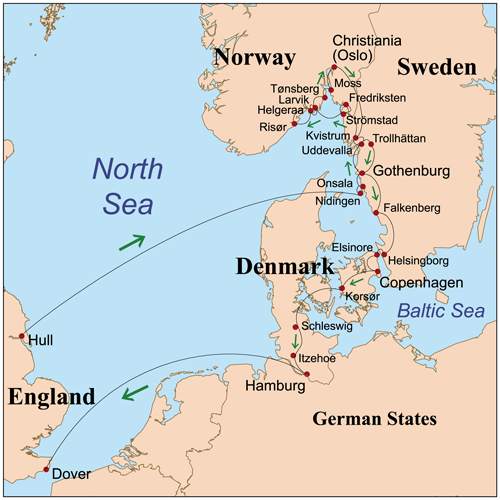
Wollstonecraft Letters map. Kmusser [CC-BY-SA-3.0]
She is a broken-hearted treasure-hunting single mum philosopher on the high seas, and I think I am a bit in love with her. So I am retracing her steps, on the part of her journey where she pursues a notorious Norwegian captain down the rocky coastline of the Skagerrak. Wollstonecraft undertook the voyage with her baby and a trusty maid. I am bringing my baby and a large rucksack but alas, no maid.
(I did offer my services, Bee, even before meeting your baby, and having done so, would gladly offer again.) Mother and infant journey from port to port:

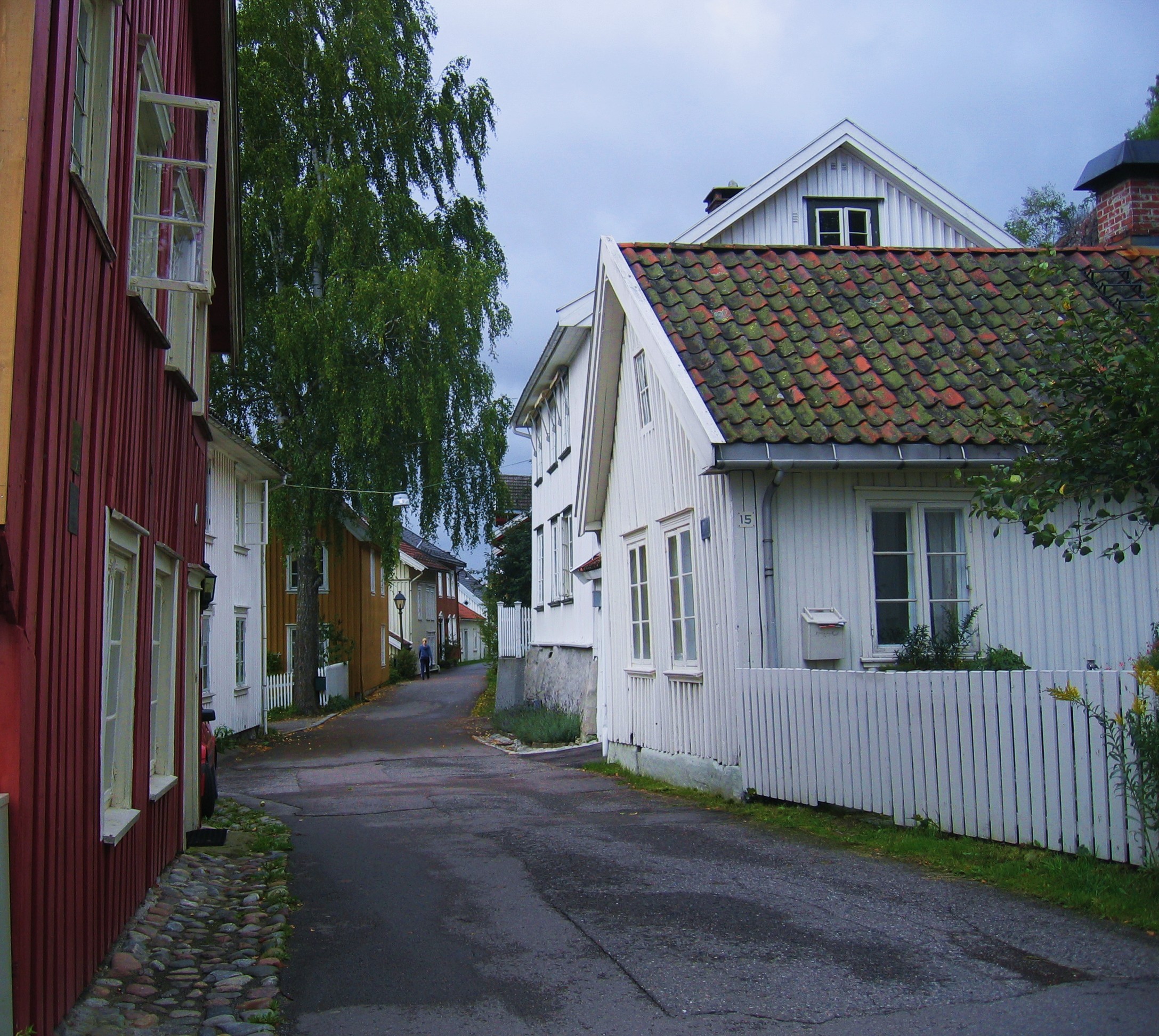
Tønsberg,by Karl Ragnar Gjertsen Krg.
[GFDL or CC-BY-3.0]
We begin in Tønsberg, a coastal town to the south of Oslo where Wollstonecraft made a base for her treasure hunt. It's a pretty town, a jumble of coloured wooden houses that look like attractive garden sheds.
(Some things have changed: in Mary's day there were about 1500 inhabitants, and now there are almost 40 000.)
With a delightful local guide, Ursula Houge, I visit the places where our heroine relaxed, posted many letters to the undeserving Imlay, and dined out with Tønsberg's finest.
Kragerø, Norway
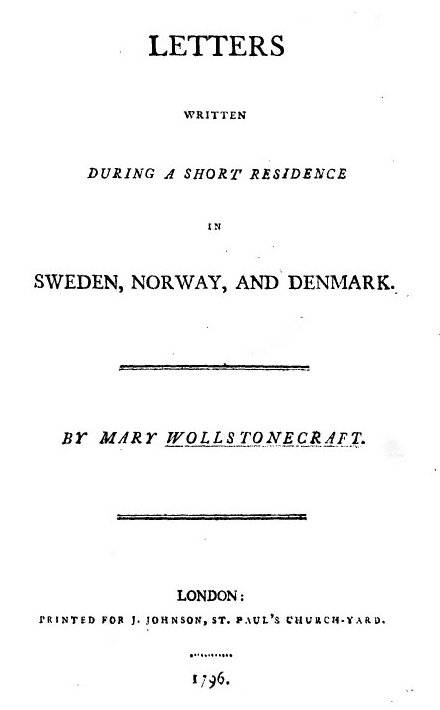
Some the ink spilled here became Letters Written in Sweden, Norway and Denmark, arguably Mary's best-known book after A Vindication of the Rights of Woman (though I suppose A Vindication of the Rights of Men ranks up there too). Bee told me that she discovered Mary through the Scandinavian letters. I've tended to come across feminists and democrats who know Mary through the more political angles to her life, but there must be many readers who found her first as a proto-Romantic. (And, of course, many would know her only as the mother of Mary Shelley, or, even more commonly, mistake her for the author of Frankenstein.) 
Wollstonecraft exclaims: "Norwegians enjoy all the blessings of freedom," but it's not just Norway's political possibilities that inspire her. Nature is hugely important. She responds to the sublime in the wilderness around her with abandon, and a lot of exclamation marks. Her new way of travel writing profoundly influenced subsequent Romantic writers; Coleridge's "Kubla Khan" has clear echoes of the book.
Let us not forget that those exclamation marks made William Godwin her husband: the anarchist philosopher had written against the institution of marriage, and was acquainted with Mary only somewhat unwillingly, but he fell head over bachelor heels on reading the newly published Letters. The only line of his that I can quote from memory is: "If ever there was a book calculated to make a man in love with its author, this appears to me to be the book." Phwoar! That's about as racy as dearest Wm ever got. Bee named her travelling companion William, by the way:
Will (the baby) and I are staying in a hostel just below the brow of the hill on which Wollstonecraft often sat, overlooking the town and the surrounding sea. She wrote: "the white sails… turned the cliffs, or seemed to take shelter under the pines which covered the little islands that so gracefully rose to render the terrific ocean beautiful. The fishermen were calmly casting their nets; whilst the seagulls hovered over the unruffled deep."
By Bilden är tagen av en amatörfotograf.Pihlbaoge
Doesn't it sound idyllic? 

Wollstonecraft travelled mostly by boat, heading westward in pursuit of the Norwegian captain who did a runner with Imlay's cargo of silver. I've enlisted the help of Gunnar Molden, a local historian and Wollstonecraft enthusiast, whose dogged research into this treacherous tale spans decades and countries. From Kragerø, Molden has arranged for a boat to take us on to Wollstonecraft's final stop. The moment we meet, we set about speculating on the missing silver and the Norwegian captain. Mick, the skipper, hadn't heard of Wollstonecraft's adventures here, but he's soon drawn in. We eat sugared cinnamon buns and I count jellyfish as we set sail. The sun is dazzling, there's a fair wind, and I'm so excited I can't sit still.

The article was months delayed by terrorist shooting and polar bear attack. By now the great British public has forgotten what a bad summer it has been for teenagers camping in Norway, and can turn again to the holiday fantasies of classic children's books, made real in the unreal blueness of Scandinavian seas
The lure of these islands is strong; there is magic in the notion of a miniature world, of setting foot on a child-sized kingdom. Watery adventures from childhood books spring to mind: Swallows and AmazonsThe Famous FiveThe Wind in the Willows.
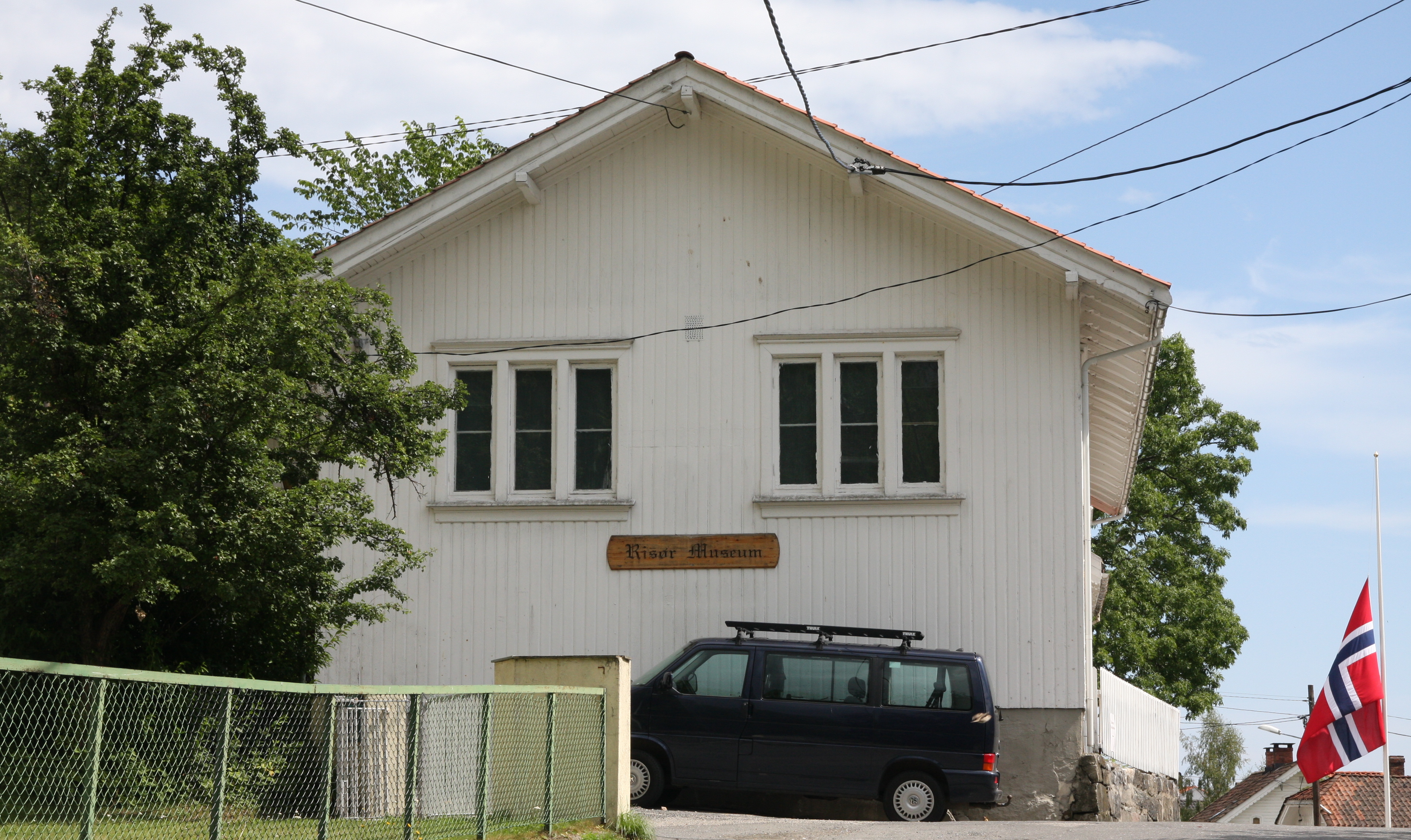
Visor Museum, by Jarvin - Jarle Vines [GFDL or CC-BY-3.0]
Book your holiday now, but do be aware that:
Norway is expensive.... Wollstonecraft remarked that "my bill at Tønsberg was ... much higher than it ought to have been" and the intervening 216 years have done nothing to change this. 
Speaking of dosh, Bee has very kindly donated her payment for Norway and Mary Wollstonecraft: My heroine of the high seas  to the campaign to raise a memorial statue. (I'm on the working group and have written about the project here.) In fact, Bee is offering more of her talents than mere money, and Mary on the Green can only benefit from her energy and enthusiasm. "She is a warm-hearted multi-mum writer/producer on the high seas, and I think I am a bit in love with her."


All images from Wikimedia Commons.