Showing posts with label Mary Shelley. Show all posts

Sunday, June 30, 2013

The Two Marys, in more radical company

The two Marys, mother Wollstonecraft and daughter Shelley, are to meet in conversation this week, at the radical booksellers of Kings Cross. Joseph Johnson will doubtless be there in spirit, at Housmans Bookshop at 7pm on Wednesday, peering around and reflecting on the changing face of publishing over the centuries.

The Two Marys: A Conversation Piece, accompanied by cello, were heard at the Camden Archive Centre in March; my review is here. They will be reprising the piece, which was first performed in the National Portrait Gallery on 14 September 1997, marking the bicentenary of the death and birth. The change of venue is apt, wrenching the pair from history to current politics. "For the fifth year running Housmans will be giving over our summer events programme to a season of talks and book events celebrating radical aspects of the capital’s social history." Have you ever visited Housmans, in bricks and mortar or online? (I believe they dropped the apostrophe when Kings Cross did.)

Independent bookshops struggle; Charing Cross Road now sells pizza and Chinese medicine; the Amazon river has deluged us all; but there's always a place for specialist booksellers, which invariably attract knowledgeable and passionate people as both staff and customers. From its website:
Housmans is London’s premier radical bookshop – it’s one of the last remaining such shops, as well as having been one of the first (originally opening in 1945). ... Whilst acknowledging its roots in the peace movement – and, specifically, in the radical pacifist end of the movement – it aims to be a broad-based, non-sectarian shop, encouraging the dissemination of a wide range of progressive and alternative ideas. As the shop’s founders recognised, opposing injustice and oppression and the degradation of our planet are prerequisites of a more peaceful society.
You may remember that we popped into Housmans, with the Japanese historian and the Swedish theatre designer. We had just found the Wollstonecraft plaque in Somers Town and were about to board the bus to St Paul's, where Johnson had his publishing house, on our quest for the plaque in Southwark. Kings Cross is handy for transport connections, and was so, even in eighteenth century.

From the official description of A Conversation Piece:
Two months after Shelley’s death, Mary Shelley fights off her anguish for the sake of her remaining child. She clings to her books: Shelley’s poems; the works of her father, the philosopher William Godwin; the feminist writings of her mother, Mary Wollstonecraft, who died shortly after giving birth to her.
In her despair, the young Mary pours her heart out in a letter to an English friend who was her mother’s first pupil. If only she could conjure up her mother from the past, if only she could speak to her for an hour...


Wednesday, March 13, 2013

The Two Marys: A Conversation Piece

Last night saw an encounter between Mary Wollstonecraft and Mary Shelley, a rare one-off performance of The Two Marys: A Conversation Piece.  Sasha Hails played the mother, speaking with the wisdom of the afterlife, and Victoria Ross the daughter, still in the first grief of her widowhood in her mid-20s.

The setting was the very undramatic Camden Local Studies & Archives Centre. (The Centre is also hosting a temporary exhibition on historical religious buildings within the borough, some still extant, others demolished; this is exactly the sort of display that needs to be thoroughly preserved in the etheric afterlife. Roll on, digital humanities.) The Polygon, where Wollstonecraft spent the last period of her peripatetic life, and where her equally travel-hungry daughter began hers, lies within Somers Town, and of course St Pancras plays a key role for both writers, so Camden has a legitimate claim on them.

The two Marys were accompanied by David Cherniak's cello obligatto. The author herself was there: Judith Cherniak is an American long settled in London, who stamped her mark on the culture of the capital by setting up Poems on the Underground. (There's a celebration this Sunday at Keats House.)

I found the music mournful and the performance poignant. It begins with the young widow writing to Mrs Mason, her mother's former pupil who in turn offered maternal care to the Shelley entourage when they reached Pisa. (We've looked at before at this Lost Daughter, who started life as Margaret King.) She bemoans her fate and describes her distress, all alone without a friend in the world, or so it seems to her. The depths of her mourning embarrass those around her, both the English and the Italians. If only she could speak with the mother she never knew! And so the elder Mary arises from the chair in the corner, and approaches her daughter. They converse. They explain their lives to each other. They bond. And the audience sees the strong similarities between these strong women who never met.

Apparently the two-handed show first saw the light in September 1997, the bicentary of the Marys' birth and death, at the National Portrait Gallery. Wouldn't it be marvellous to put this on again? Maybe somewhere a little more atmospheric than the municipal library. Newington Green Unitarian Church, for example, site of the miraculous manifestation.

From yesterday's programme:
September 1822, Genoa
Two months after Shelley's death, Mary Shelley fights off her anguish for the sake of her remaining child. She clings to her books: Shelley's poems; the works of her father, the philosopher William Godwin; the feminist writings of her mother, Mary Wollstonecraft, who died shortly after giving birth to her. In her despair, the young Mary pours her heart out in a letter to an English friend who was her mother's first pupil. If only she could conjure up her mother from the past, if only she could speak to her for an hour...

Tuesday, March 12, 2013

Mary manifests!

Mary Wollstonecraft has appeared on the side of Newington Green Unitarian Church, on Mothers' Day and on the extended weekend of International Women's Day.

No sign of her on Saturday, when the walking tour got to hear her story at the beginning of "Feminist Hackney - Or Is It?". But when the congregation arrived on Sunday morning, she had (to their delight) manifested quite serenely and beautifully on the exterior west wall. This is the church that radicalised Mary Wollstonecraft, that helped this unpublished 25 year old schoolteacher, with no family or money or even a proper education herself, realise that she could make a mark on society. This is the community that introduced her to a wider intellectual sphere, and to the publisher who nurtured her for her ten brief years of productivity. This is, as the local history says, The Village that Changed the World.

Church Walk is now an alley, but in her day would have been a lane through a mile of farmland to Stoke Newington and the resolutely non-Dissenting St Mary's Church. All these fields were swallowed up by the relentless Victorian sprawl of London, but those with eyes to see can spot the history under our feet.

The image is clearly based on the last John Opie painting, when she was pregnant with her second daughter, known to history as Mary Shelley.  You can see the head and shoulders in the National Portrait Gallery, thanks to Bob Lamm liberating her from basement interment, or indeed in the nearest pub to the church, larger than life in the Dissenting Academy, but if you want to see the full-length version in the fresh air, I'd advise you to hurry. Who knows how long Hackney Council will allow her to stay? I've heard they take a dim view of street art, unlike neighbouring Islington. We shall see.

The wall stencil is signed STEWY. I hoped it might be a culinary reference; I was cycling into an unseasonably bitter wind and snow flurries this morning, so my thoughts naturally turned to well-seasoned eighteenth century winter stews. Apparently Stewy is a man, albeit a shadowy one. He has given a few interviews over the years, from which I glean that he trained as an illustrator, was influenced by Banksy and Blek Le Rat and their rodents, and decided to do 26 indigenous animals: F for fox, P for pigeon, etc. His politics are of the Billy Bragg variety* (with an extra dose of charmingly naive idealism) and his imagery is simple, full of character rather than narrative. His bare-bones tumblr is here.

From animals Stewy graduated to people, putting Quentin Crisp near Canal Street in Birmingham, Tracy Emin in Margate, and John Cooper Clarke in Salford. (For those not familiar with them: England's stateliest homo, no-longer-YBA enfant-terrible EMINence grise, and punk performance poet.)
I wanted to do something different so I had this idea like the [English Heritage] blue plaques.... I would only spray my people where they had an association, where they lived or were born or worked or died. And most of them that I have put up have remained which is great because they are obviously relevant to the people who live in the area, there is a sort of respect.
That was from the interview by Ken McGregor of the Australian Metro Gallery. (Mary Wollstonecraft has several plaques in London, including one on Newington Green.) Stewy went to a Manchester pub with Tom Balderstone and expounded some more:
I deliberately do underdogs or the people hidden or just behind the scenes. The people who haven’t really become famous....[With one of his images] loads of people come up asking who he is, not their fault, so it’s kind of educational; almost historical/geographical. In school I had an interest in both but I couldn’t do history, got a B in geography and I liked art, so it all came full circle and now I’m pulling that all together. I might do a map one day, and try to plot it all. But by then the pictures might have gone.
He also spoke to Joe Bill of Kent News about the future of street art, it becoming a positive force in society. "It’s not about me. The work highlights people or eccentrics who made a difference - changed how we approach art, music or writing - pushing the boundaries in Britain and shaking things up a little."

Stewy calls his combination of people in their context "psychogeography". So now we have a psychogeographic Mary Wollstonecraft, back in her old neighbourhood, looking straight at us. "Like a ghost across the street", a line from Blek. There she is. Thanks, Stewy.

***************************************************************
*Note to self: the Bard of Barking might be interested in Mary Wollstonecraft: 
that ancient port was where she formed her first memories. 

Wednesday, March 28, 2012

Learn with Lyndall Gordon

An Oxford study day near Mary Wollstonecraft's birthday. Ironic that she does not really appear in the title -- Revolutionary Lives: the Godwins and the Shelleys. Biographer Lyndall Gordon, whose talk on Mary and the Unitarians I attended in May 2011, will be presenting 75 minutes of "A New Genus". The day, Saturday 28 April 2012, recapitulates the quadrille played out in the exhibition at the Bodleian, Shelley's Ghost (aka Our Mary, Her Husband, Their Daughter, and the Tousle-hair'd Poet), which I visited with Chihiro Umegaki, and which has recently been rehung at the New York Public Library

Wednesday, March 7, 2012

IWD: maternal mortality

International Women's Day is celebrated on March 8 every year. What would Mary Wollstonecraft make of it? Last year was its 100th anniversary, and so it got more of a media splash in the UK than it has done for some time. 2011 also saw the unveiling of the most recent plaque commemorating a place where "England's first feminist" lived or worked. This year, again, there is a corporate-sponsored website aiming for comprehensive coverage of events. (They do things differently in France.) Let's focus on two themes: maternal mortality and girls' education. Today, the first.

Mary Wollstonecraft died in childbirth. Two graphs "about this cause of avoidable mortality in women", pulled together by Ben Goldacre, the doctor who likes statistics, famous for his Bad Science columns, blog and books. One is the UK, 1880 to 1980. The other is international, 2005. Do you want to guess the worst time and place? It was about three times as bad in Afghanistan a few years ago as it was at its iatrogenic peak in the UK in the 1890s. With adjustments for population: for every woman who dies in childbirth in El Salvador, more than ten die in Afghanistan. For every woman who dies in Canada, more than twenty die in El Salvador. Logarithmic scales of difference, in our world, here, today. Almost a thousand women die every day of pregnancy-related reasons, according to Women Deliver. I'l repeat that, louder: A THOUSAND DEATHS A DAY.

Ruth Franklin, stimulated by the arrival of Shelley's Ghost in New York, asks in The New Republic if Frankenstein was really about pregnancy and childbirth. It's not a novel argument. A cursory acquaintance with a few biographical facts makes it evident that, as she puts it, "not only was Mary Shelley pregnant during much of the period that she was writing Frankenstein, but she had already suffered the birth and death of an infant." A later miscarriage brought her close to death. What Franklin doesn't explore is the impact of motherlessness (or, conversely, that of the Wicked Stepmother) on young Mary. Had the obstetrician washed his hands, the world might have had decades more of paradigm-shifting political writing, but we would not have had Frankenstein. That is a book that could only have been written by someone who knew that her birth had killed her mother.*

The perils of maternity was not the lesson taught by Mary Wollstonecraft's life but that imposed on her legacy. The death of artistic creativity after childbirth, famously summarised by Cyril Connolly as "the pram in the hall", was supposed to be so much worse for women. Instead of one type of creativity feeding the other, they were seen to cancel each other out. There was no point in educating girls, because they disappeared into multiple motherhood, or died in the effort. Or they went mad - the wandering womb - The Yellow Wallpaper. The lucky and exceptional ones, exceptionally educated, could aspire to become men, like Elizabeth I.

The lesson explicitly taught by Mary Wollstonecraft was the value of education. Tomorrow, on International Women's Day itself, we'll explore what that means in 2012. In the meantime, for inspiration, check out this eclectic collection of IWD 2012 posters.  

---------------------------
Logo from Education International"the world's largest federation of unions", 
representing "organisations of teachers and other education employees across the globe".
*This brings to mind "Each man kills the thing he loves." Happily married Oscar Wilde had his views on pregnancy too. 

Tuesday, February 28, 2012

Mary & Mary on stage, on tour

Here's a new play entitled Mary Shelley, with - it would appear - an emphasis on that young woman's ghostly relationship with her dead parent:

Having lost her mother, feminist Mary Wollstonecraft, at an early age, young Mary finds comfort in reading the family memoir written by her father, the radical philosopher William Godwin. However, his free-thinking account of her mother’s suicide attempt, extra-marital affair and birth of her illegitimate elder daughter are regarded by society as shocking....Delving into Mary Shelley’s turbulent personal history this striking production sheds light on the life of a bold young woman....
(From The Morley Observer.)  However, the West Yorkshire Playhouse,  where Mary Shelley launches its "world premiere tour", doesn't mention Our Lady:
This powerful new play explores Shelley's remarkable life: her controversial philosopher father, her scandalous elopement aged 16 and how she wrote a novel, so radical in its ideology, that in 1817 she changed the literary landscape forever.
We shall see. The company is Shared Experience, the playwright Helen Edmundson, the director Polly Teale. Mary Shelley is a co-production between the company and the Nottingham and West Yorkshire Playhouses, in association with the Oxford one. It launches in Leeds from 16 March to 7 April, tours half a dozen cities, landing finally at the Tricycle in London 12 June to 7 July.

[Addendum: some thoughtful comments in an interview between Catherine Noonan and Polly Teale on "Female-led theatre in an imperfect world".] [And a review from la petite feministe anglaise, Sarah Graham.]


------------------------------------
Kristen Atherton as Mary Shelley.

Friday, February 24, 2012

Mary reaches the NYPL

Opening today is another opportunity to see the very notes Mary Wollstonecraft penned to William Godwin, while labouring to deliver the future Mary Shelley. Readers will remember the excursion with Japanese historian Chihiro Umegaki to the final days of the exhibition entitled "Shelley's Ghost: Reshaping the legacy of a literary family". Here's my review of the enduring aspects of the exhibition (website, book, etc.)  It was put on at the Bodleian in collaboration with the New York Public Library, home of the Pforzheimer Collection of Shelley and His Circle, and now has reached that institution, under the title "Shelley’s Ghost: The Afterlife of a Poet".

Those interested in Mary Wollstonecraft should note the change of focus: the official website says "The exhibition, curated by Stephen Hebron, was shown in a slightly different form at The Bodleian from December 2010 to March 2011."  I called the English version Our Lady, Her Husband, Their Daughter, and the Tousle-hair'd Poet. It seems that in Manhattan, the parents are downplayed, and the young 'uns bigged up.

There is another confirmation that most people who have heard of Mary Wollstonecraft have done so only because they think she wrote Frankenstein:
"It's very exciting for people who don't know Shelley so well, people who are getting a first introduction to his poetry and Mary and his parents," curator Elizabeth Campbell Denlinger said in an interview about the exhibit, which delves into the radical politics that both Shelley and his wife identified with.
I very much doubt that Delinger said "his parents", but that is what the reporter heard, or what her editor "corrected" her copy to. That quote is from Frankenstein's Monster Alive at NYPL Shelley Exhibit

It's at the NYPL till Jean Baptiste Day, in the Sue and Edgar Wachenheim III Gallery of the Stephen A. Schwarzman Building. Love those American philanthropists!

Friday, December 23, 2011

Portraits & quotes on Tumblr

In trying to get to grips with Tumblr, I came across a compilation of images of Mary Wollstonecraft and her daughter. If you like portraiture, have a look. That is one person's curation. Another place offers a list of posts, mostly quotes, tagged with "Mary Wollstonecraft". Someone else has written about the Mary on the Green Parliamentary projection. And oh look, now I have a Tumblr too. But do I really want one? What is it all for? That is the question.

Sunday, September 25, 2011

Mother and daughter

Two mentions of Mary Wollstonecraft in today's Observer: an interview with Claire Tomalin, author of The Life and Death of Mary Wollstonecraft (1974), and a piece by Mark Kermode, a regular (resident?) Guardian/Observer film writer. Rachel Cooke does a good job with her life-spanning interview, in which Tomalin's life-changing book gets a mention:
...with her new baby in a basket beside her, she began work on her first biography, a life of Mary Wollstonecraft. She started to feel a little happier. [...] She was by now in her 40s, the period she thinks of as her youth: liberated and busy. The Mary Wollstonecraft book came out and was a huge success, so in 1977, she left the Statesman, thinking she would be a full-time writer.
Cooke asks if "work was a balm", and Tomalin responds, "Yes, absolutely. That's what I do. If I'm upset about something, I go into my study and I work." A room of one's own....


Kermode, however well he knows his cinematography, and despite being billed elsewhere as a feminist, misses a vital historical detail: he commits the all too frequent error of mistaking daughter for mother:
Those of us who had the gall to praise Frankenstein for its gloriously overcooked melodramatic aesthetic (a quality entirely in keeping with Mary Wollstonecraft's source novel) were laughed out of court by those toeing the consensus line. 
Perhaps it was merely a slip; perhaps it can be blamed on an anonymous sub-editor. But this renews my determination to establish Mary Wollstonecraft more firmly in the public imagination.


(Is it overkill to post twice in a day? The previous item was queued; this one's spontaneous.)

Marki Shalloe’s Promethea Unlaced

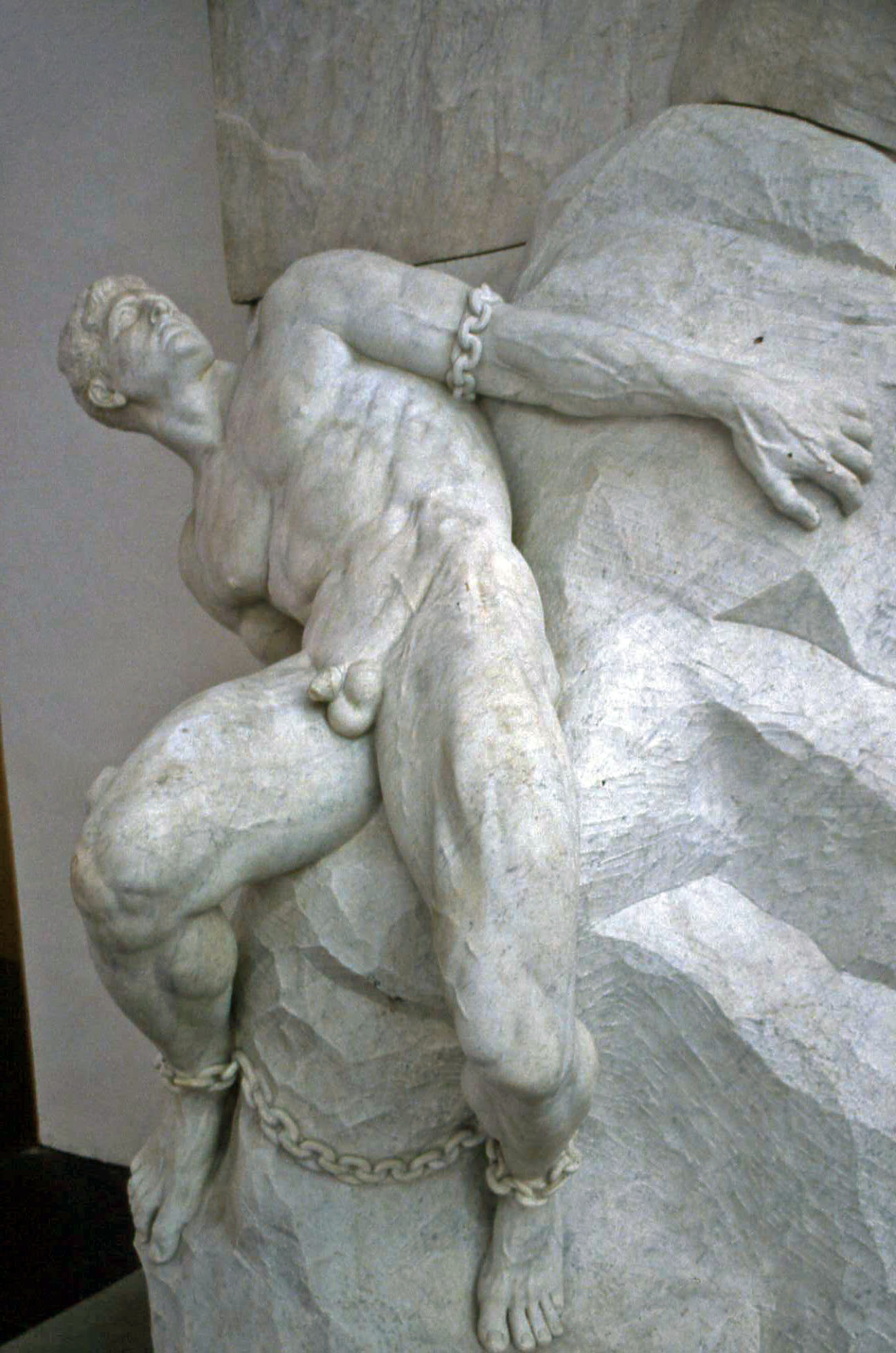
Prometheus Bound by Reinhold Begas. 
Photo by 
James Steakley [CC-BY-SA-3.0
(www.creativecommons.org/licenses/by-sa/3.0)
or GFDL (www.gnu.org/copyleft/fdl.html)],
via Wikimedia Commons
I promised myself not to get distracted, and particularly, not to let this blog get waylaid by Mary Shelley and her monster. Today's post is on the cusp, as it deals with the death of the woman known by that point as Mary Wollstonecraft Godwin, and with the birth of the girl introduced to the world by the same trinomial.

According to the Decator Minute, on Tuesday and Wednesday there will be dramatic readings in Georgia. (Not a million miles from North Carolina, which in 2009 put on a play called Rights and Wrongs.)
Atlanta playwright Marki Shalloe’s Promethea Unlaced, the story of the birth of Mary Shelley and the birth of her famous novel, Frankenstein. Shalloe is a local playwright with a penchant for finding stories in unusual places. “Of daydream and nightmare, always choose the nightmare. It makes the better tale,” says Shalloe in Promethea.

Shalloe said that once her research landed on Mary Shelley’s mother – Mary Wollstonecraft – everything changed. According to Shalloe, “This woman fought for the emancipation of women in the 18th century, believed in free love before anyone really knew what that was, and knew the most irreconcilable sin is the sin against oneself or self betrayal.” Shalloe knew then the story that needed to be told: the legacy of immortality through written expression.

Thursday, July 14, 2011

Breaking news

Ironically, it is on Bastille Day that we break the week's series on Mary and France to bring you exciting news of an Oxford study day next spring featuring Mary Wollstonecraft. Ironic, also, that she does not really appear in the title -- Revolutionary Lives: the Godwins and the Shelleys. Biographer Lyndall Gordon, whose talk on Mary and the Unitarians I attended in May, will be presenting 75 minutes of "A New Genus". The day, Saturday 28 April 2012, recapitulates the quadrille played out in the exhibition at the Bodleian, Shelley's Ghost (aka Our Mary, Her Husband, Their Daughter, and the Tousle-hair'd Poet), which I visited with Chihiro Umegaki.

Wednesday, June 8, 2011

Shelley-Godwin Archive gets $300 000

The (U.S.) National Endowment for the Humanities has just given $300 000 to the Shelley-Godwin Archive. This is a treasure trove dedicated to the study of Mary Wollstonecraft, her husband William Godwin, their daughter Mary Shelley, and the tousle-hair'd poet Percy Bysshe. One of the main partners is the Pforzheimer Collection, which was so supportive of the exhibition I reviewed at the Bodleian, "Shelley's Ghost: Reshaping the image of a literary family", covering the same foursome. (A version is due to be exhibited at New York Public Library in February 2012, apparently, although their website provides little information.)

It is a valuable project, showcasing the best of digital humanities, but it appears to repeat the limitations of the exhibition. As I wrote in March, "My main criticism of Shelley's Ghost is that, while attempting to tell the story of a literary family, it shortchanges the mater familias. There just wasn't enough about MW." The Archive project will start with the other three members of the family:
While this project is just the first phase of the Archive, it will in itself constitute a rich stand-alone resource. In this initial phase, project partners will also digitize copies of Shelley’s major philosophical poem, Queen Mab, with his extensive reworking; the first two volumes of Mary Shelley’s journals; and manuscripts of two novels by William Godwin, Fleetwood and Cloudesley.
That was from the NYPL press release. There is a slightly different take on it from the Maryland Institute for Technology in the Humanities:
Humanities scholars, curators, and information scientists are partnering from MITH, the New York Public Library (NYPL), the Bodleian Libraries of the University of Oxford, the Houghton Library of Harvard University, the Huntington Library, Art Collections, and Botanical Gardens, and the British Library, to put manuscripts and early editions of these Romantic writers online and freely accessible to the public. MITH Director Neil Fraistat, renowned scholar in both the digital humanities and Shelley studies, will serve as co-Principle [sic] Investigator along with Elizabeth C. Denlinger, Curator of the Pforzheimer Collection of the New York Public Library.  
This is the cutting edge of digital humanities (or so I am led to believe):
Tools and functions will include the ability to collate texts, overlay images of the original manuscripts and view them side by side, search the complete text, and tag content with user annotations. 
The stated focus is Romanticism, rather than the Enlightenment: 
MITH, in addition to its partners, seeks to cultivate and further the Shelley-Godwin Archive as a comprehensive, accurate and accessible digital resource for British Romanticism scholars, in order to provide the platform for an intellectual journey into nineteenth-century verse, history, and letters. 
I wish them all luck, and have signed up at the Archive for updates, so I will add more news to this blog, if and when the team turns its talents to Mary Wollstonecraft.

Wednesday, April 6, 2011

Mary in St Pancras

This is the second in a series of Wednesday walks. The first took in Mary Wollstonecraft's life in Somers Town.

From the Polygon plaque it is a five-minute stroll to St Pancras Old Church, allegedly the second oldest site of Christianity in England. (Not to be confused with the almost-Ancient-Greek caryatids of St Pancras New Church on the Euston Road.) The building itself is a little gem; Victorian Web calls it "a small church with a big history". The churchyard too is rich with cultural and literary references;  Dickens name-checked it in A Tale of Two Cities as the site of night-time "fishing" (body snatching).

According to Chesca Potter's 1990 booklet Mysterious Kings Cross, the church was "only open to the general public on the Sunday nearest to St Pancras Day, May 12th", but that has now changed: the main doors are open almost every time I walk past, and glass ones behind cleverly signal open-ness. The small building is buzzing with life. The venue is listed in Time Out, and when we wandered in a band was rehearsing, presumably Porcelain Raft. The spiral staircase was unlocked, so we explored the library upstairs, with its overstuffed armchairs, and its pamphlets on the history and spiritual significance of aspects of both the church and the churchyard.

St Pancras Church was substantially rebuilt in the middle of the C19, and we tried to figure out what Mary would have recognised: the C6 altar stone, for a start, and an C18 font cover. Here she and Godwin married, something that soon drew disapproval: in declaring herself "a spinster of this parish" she was admitting that there had been no ceremony between her and Imlay, and thus that her first child was a bastard; and Godwin had written against the institution of marriage as it existed, so he was perceived as going against his principles. 

And then outside, to try to find Mary's memorial. It is doubtful how much she would have recognised: some items (especially gravestones) have moved, and many (especially tombs) post-date her death, viz the Burdett-Coutts memorial sundial, the image to the left. (The "richest heiress in England" was another woman devoted to her female companion, even unto death. A couple of years after Hannah Brown died -- "my poor darling, the companion and sunshine of my life for 52 years" -- Angela B-C married a man, eliciting scandalised raising of eyebrows. When I was showing a queer activist around town, she called this the Famous Dead Bisexuals Corner.)

The churchyard was much bigger in the C18, and was surrounded by fields (cf St Martins in the Fields, the church at Trafalgar Square). When the Midland Railway was being built in the 1860s, the line decided upon ran right through the cemetery, so the bodies, or whatever remained of them, had to be respectfully moved. The chap deputed to do this was none other than the young Thomas Hardy, who, after completing this distasteful task, decided to pursue a career in literature instead. He left to posterity not only the books by which he is so well known, but also the Hardy tree.  Other highlights of St Pancras Churchyard are the Soane Monument, for its design (which is supposed to have inspired the iconic red pissoirs telephone boxes), and, for their associations, the Rhodes family tomb and the grave of the last survivor of the Black Hole of Calcutta. All of these are post-Mary, though she may have seen Soane's early work on the Bank of England, so near her publisher at St Paul's Cathedral.


The stone bearing Mary's name is not what the unwary might expect. First of all, it is not hers alone. Godwin erected it soon after her death and, demonstrating an accurate judgement of how history would remember her (a judgement so singularly lacking when he rushed into publication of the too-much, too-soon Memoirs), he had it inscribed thus:

Mary Wollstonecraft 
Godwin 
Author of 
A Vindication 
of the rights of Woman 
Born 27th April 1759 
Died 10th September 1797

When Godwin died, nearly four decades later, he was buried in the same place, and his entry was carved on another face of the square, rationalist marker. His second wife survived him by five years, and she too gets one surface. (The final face is left blank; had he needed a third spouse, there was space.) With so many divorces nowadays, will we see a trend for multiple occupancy burial sites?  Polyamorous posterity?

(Mary Jane Clairmont, nee Vial, deserves a word. She comes down to us as yet another of history's wicked or at least unlovable stepmothers; young Mary cordially disliked her, poor Fanny committed suicide, and her own daughter ran away from home to seduce a celebrity. But she was "the only female publisher of substance in the London literary world of the early 1800s" and "in her business acumen, something of a bulwark against the financial improvidence of her husband", according to the University of Pennsylvania's Frankenstein project. It is too easy to dismiss or forget her. Had Mary lived, they would have been neighbours, and moved in similar literary circles. It is not hard to imagine them collaborating on a children's library.)

The second surprise, for those who haven't done their homework, is that Mary does not lie here. Her bones (and those of Godwin, but not, as far as I know, of his second wife) were moved to Bournemouth. Why Bournemouth, I hear you ask? What possible connection did Mary have with the South Coast? Well, precisely none. Field Place, near Warnham, West Sussex,  was the ancestral home of her tousle-hair'd son-in-law. The poet's conventional and unliterary son (MW's only grandchild) eventually inherited the estate, but chose to purchase and extend Boscombe Manor, near to Bournemouth and soon surrounded by the growth of the seaside resort. His ailing mother and genteel wife both got along well, and since Mary Shelley wanted to be buried with her parents, and Jane and Percy judged St Pancras entirely unsuitable as a resting place (the church was in a sad state by the mid C19, surrounded now by slums instead of fields), the solution hit upon was to move the distinguished ancestors. Hence Mary Wollstonecraft and William Godwin were whisked away from the insalubrious air of Dickensian Kings Cross and reburied amid the bracing, albeit incongruous, sea breezes of Bournemouth, where the whole happy family can be visited at the Shelley family tomb at St Peter's Church.  

(The connection between the Marys intrigues me. One died, and the other was born, with the same name: Mary Wollstonecraft Godwin. The daughter called herself Mary Wollstonecraft Shelley for much of her life, clinging on to her mother's name even after discarding her father's. What did that mean to her?) 

Beyond being removed from the parish of her happy final months, there's a further indignity Mary suffers. The church no longer is responsible for the churchyard, having passed the grounds to Camden Council, who run it largely for the benefit of dogwalkers. Next to the rather magnificent and seriously underappreciated gilded gates sits a placard explaining the gardens. It gives Mary only parenthetical mention, as Wife Of Important Man. I think another campaign would not go amiss...

Now it is time for tea and a sit down.There are two ways out of the gardens: return the same way, walk to the near (rear) end of St Pancras Station, and cross through it (not along it), coming out the other side; OR, out the smaller ungilded gates on the other side of the gardens, turn right under the huge railway bridge, passing Camley Street Natural Park on your left (which abounds in delightful places to sit down but is entirely devoid of tea, unless you had the foresight to bring your own thermos), and walk parallel to the railway lines.

In either case you will find yourself within a few minutes at the German Gymnasium. This 1865 brick building is now the marketing suite for Kings Cross Central, who are overseeing the enormous changes in the area. There is a small display on C19 radicalism in the neighbourhood, a terrifying maquette of future developments, and, best of all, the structure itself, bearing a distinct resemblance to the engravings here.

Nothing to do with Mary? True, it was built long after her death, in the blaze of German-philia that accompanied Queen Victoria's consort, along with Christmas trees from the Teutonic forests. But surely she who wrote "I wish to persuade women to endeavor to acquire strength, both of mind and body" would have rejoiced at the purpose and management of the building, for, according to the KCC website"the German Gymnastics Society adopted a forward thinking approach to women’s exercise, with classes taking place here from as early as 1866." Upstairs there are sometimes exhibitions, and if not, you can imagine exhibitionists flinging themselves acrobatically from the stupendous rafters.


Now: tea. Quick march: through Kings Cross mainline, out the front, turn left, cross the lethal York Way very carefully, march along Pentonville Road ignoring bang bang bang McDonalds Starbucks Pret, turn left into the warren of refurbished warehouses phoenix'd as trendy offices, walk past the Spanish-ish tapas place and its decorative barrels that I cynically bet never held sherry, out the other side past the beautiful but ill-sited labyrinth on the wall (I like the melted computer keyboard), turn immediately left and up the steps to Drink Shop Do. You have arrived. If you need the loo, it's downstairs, shared with the neighbouring well-lit and friendly gay sex shop. NB amusingly worded warning notice on the door, for the benefit of the ladies with hairdos who are passing time till their train back to Yorkshire. 

When you are refreshed, the next Wednesday walk takes us to St Paul's and Southwark.
Tomorrow: Mary's sons and daughters

Photo credits: all by Asa Norling, except the Camden Council placard, by Chihiro, 
the two engravings of the German Gymnasium, by kind permission of Kings Cross Central,  
and the Burdett-Coutts memorial sundial, by Jacqueline Banerjee, of the Victorian Web.

Thursday, March 24, 2011

Shelley's Ghost, once the flesh melts away

A few days ago I went to Oxford to commune with Shelley's Ghost, the exhibition soon closing at the Bodleian, and wrote about my impressions. The website and catalogue will be ghosts of the ghost, I suppose, in that they will continue into the future, even when the corporeal body of the exhibition has been disassembled and returned to its dusty caskets.

The website
The website is good, as is de rigeur. It is available within the exhibition room on two terminals, which appear to be entirely internet-live and normal, except that they are missing their keyboards. With only a mouse for access, there is no chance that visitors might be tempted to ski off piste. Only now have I discovered the website's online contest: video yourself reading your favourite work by one of the quartet, and win the catalogue! The competition closed weeks ago, but the clips can be viewed here

Another feature that I hope more of the GLAM sector will take on board is a sort of layered presentation. In Shelley's Ghost, most items get a description, which sets facts in context; some get a transcription, if the handwriting warrants it; a list of owners, thus giving the chain of provenance, often a succession of Barons Abinger; references -- I'm not completely sure what this means -- perhaps the scholarly works in which the item was first made public or was most thoroughly described; and, crucially and to me innovatively, a tab inviting comments. I took advantage of this last, and am rather torn, in that I was the first to do so for all the pages I was interested in.  I suppose that made me the first of a new genus! Certainly I felt I was treading in virgin snow.

Social media
The website seems to make excellent use of social media, with Facebook and Twitter buttons at the top of each page, and in addition another button labelled "share", which pops out to reveal scores of ways to tell the world what you think of the content, from A1- Webmarks to Zootool. On the other hand, you could argue that the website makes zero use of social media, in that the pages I looked at said Tweets 0, Share 0. Those who put the time into designing the site, and those who argued in committee meetings for the inclusion of social media, might well say that you can lead a horse to water but you can't make it drink. I would counter that putting buttons on a site isn't enough; you have to make yourself known on social media with an active campaign. I am thinking here of poor William Godwin and his dire diaries, of which more another time. Anyway, this is a Wollstonecraft blog, not a website critique blog. (Bodleian, if you want me to handle your next social media campaign, just ask.)

Classroom materials
There is a series of pdf downloads of classroom materials that tie in to the National Curriculum, prepared by Oxford University's Classics Outreach Officer. (I suppose the Cambridge equivalent is Mary Beard.) (Geek joke.) My favourite of these sheets is "A Vindication of A Vindication", which asks the pupils to "read a passage of the Vindication of the Rights of Woman. Rewrite it as an article for the national media, from the point of view of a modern feminist."

I was also quite taken with A defence of 'poesie':
Many people have written about poetry in order to defend it as a meaningful genre and explain why it remains valuable to the author’s time. Reading Mary Wollstonecraft’s ‘On Poetry’ and Percy Shelley’s ‘A Defence of Poetry’. How well do these work as a defence of poetry? Write your own piece to defend poetry. You should write either a short poem (under 20 lines) or a comment piece in newspaper style (maximum 200 words).
I'd love to read some of their responses. Rhetorical styles are so different, and legal and social battles have been won; it takes effort and imagination to make her meaning clear to today's generation.

The book
The catalogue is primarily by Stephen Hebron, the British Romanticist, with one chapter by his co-curator Elizabeth Campbell Denlinger, of the New York Public Library's Carl H. Pforzheimer Collection of Shelley and His Circle. The official synopsis of the book states:
Few families enjoy such a remarkable reputation for their contribution to the literature and intellectual life of Britain as the Godwins and the Shelleys. Yet this reputation was shaped in a subtle way by the selective release of literary manuscripts into the public realm and the suppression of others. This book explores the lives and posthumous reputations of Percy Bysshe Shelley, his wife Mary Shelley, and Mary's parents, William Godwin and Mary Wollstonecraft.
The Times Higher review by Duncan Wu calls it indispensable and unputdownable. It tells "a story that is astonishing in its eccentricity and could have only originated in Victorian England which, seen through its prism, looks like the maddest place on Earth." Most of this story desribes how and when material about the Shelleys was concealed, altered, or revealed; there was relatively little to hold back in the case of Wollstonecraft, as the grieving widower had spilled most of the beans in the tell-all 1798 Memoir.  The book does refer to "amateur astrologer Richard Garnett, erstwhile panjandrum of the British Museum and spiritual adviser to Lady Shelley" -- the Garnett who helped the biographer of the first full-length biography of Wollstonecraft, as I became aware last yearElizabeth Robins Pennell thanked Garnett by name in her brief preface in 1884.  

Wednesday, March 23, 2011

Shelley's Ghost, in the flesh

Monday, finally, to Oxford, to catch the exhibition at the Bodleian in its final week. (I went with the most fortuitous of companions, who deserves and will have an entry of her own.) Shelley's Ghost is subtitled "Reshaping the image of a literary family", though I wish it were "Mary, her husband, their daughter, and her lover (and their friends)". It examines how the Victorian Shelley descendants tried to protect, manipulate, and burnish the reputations of this quartet of ancestors, mainly by selectively withholding or publishing the documents in their possession. Brand reputation management, C19 style.

I must confess that I was exceedingly tired at the beginning of my visit, and not best able to absorb a huge amount of detail. But the exhibition was so well curated that I pulled myself together to appreciate it.


Physical objects
Most of the display cases are full of letters and manuscripts, which have all been published in one form or another; their content is no surprise. It was good to see the portraits up close, and a novelty to contemplate the silver-topped bottles of Mary Shelley's toilet set, arrayed in its velvet case. How the other half lived! I doubt if her mother ever owned anything similar. There was Shelley's guitar, too -- in the days when guitars had connotations other than rock 'n' roll. Previously, my understanding of Sir Percy, the only surviving child of MS and Shelley, and thus the only grandchild of MW, was as a huntin', fishin', and shootin' squire. Shelley's Ghost confirms that he was not literary, but apparently his enthusiasms were cycling (a new-fangled hobby), amateur dramatics (his life lacked the real thing), and ... sailing (which killed his father).

For me the highlight was, not surprisingly, the small case devoted to Mary Wollstonecraft. (Referring to someone as "our " is an indicator of familiarity, and often of family ties, in some English dialects. Here, amidst the plethora of Mary Shelley memorabilia, I want to say "my Mary" to differentiate mother and daughter. But I resist.) Two items in particular took hold of my attention and imagination. 

On Poetry
One was the first page of the manuscript of her essay "On Poetry"
A taste for rural scenes, in the present state of society, appears to be very often an artificial sentiment, rather inspired by poetry and romances, than a real perception of the beauties of nature. But, as it is reckoned a proof of refined taste to praise the calm pleasures which the country affords, the theme is never exhausted. Yet it may be made a question, whether this romantic kind of declamation, has much effect on the conduct of those, who leave, for a season, the crowded cities in which they were bred. 
I have been led to these reflections, by observing, when I have resided for any length of time in the country, how few people seem to contemplate nature with their own eyes. I have "brushed the dew away" in the morning; but, pacing over the printless grass, I have wondered that, in such delightful situations, the sun was allowed to rise in solitary majesty, whilst my eyes alone hailed its beautifying beams. The webs of the evening have still been spread across the hedged path, unless some labouring man, trudging to work, disturbed the fairy structure; yet, in spite of this supineness, when I joined the social circle, every tongue rang changes on the pleasures of the country.
I found this oddly moving. My companion and I played paleographer, getting into the idiosyncrasies of the handwriting, piecing out the text, finding the rhythm of the sentence, and speaking the words aloud.  Our effort and our soft audible voices made tangible precisely what MW was arguing -- personal experience is what counts. You actually have to get up in the morning to see the sunrise; praising its beauty without having seen it is mere prattle. This realisation alone made the trip to Oxford worthwhile. The train ride provided just enough time in nowhereland to reflect and talk, and thus to allow these epiphanies to bubble to the surface.

Notes to Godwin
The second display that captured me was the series of three notes to Godwin, written while MW was in labour with the future Mary Shelley. (Husband and wife lived in nearby apartments, and had convenient anonymous servant girls to run errands, including the delivery of letters. Like text messages, but cheaper.) I've read these notes before, of course, but to see in front of me some of the very last words she ever wrote, on torn and stained scraps of paper...it was special. (NB Each note is dated in full, Aug 30, 1797, but no time is stated.)

I have no doubt of seeing the animal to day; but must wait for Mrs. Blenkinsop to guess at the hour – I have sent for her – Pray send me the newspaper – I wish I had a novel, or some book of sheer amusement, to excite curiosity, and while away the time – Have you any thing of the kind? 
Mrs. Blenkinsop tells me that Every thing is in a fair way, and that there is no fear of the event being put off till another day – still, at present, she thinks, I shall not immediately be freed from my load – I am very well – call before dinner-time, unless you receive another message from me – 
Mrs. Blenkinsop tells me that I am in the most natural state, and can promise me a safe delivery – But that I must have a little Patience
Does anything else like this exist? A written record of those moments of tedium, excitement, and enforced patience, from one literary figure to another? (In our day, we have women -- or more often their partners -- live-tweeting labour & delivery.) These notes are unbearably poignant. I end my Twitter project of telling MW's life over #38days with reassurance from the midwife. "She promises me a safe delivery." What a loss!

What a loss
The death of Mary Wollstonecraft had deep and multifaceted effects. It was the loss of mother and wife: her grieving widower Godwin ("This light was lent to me for a very short period, and is now extinguished for ever!") ;  the toddler Fanny, who was to grow up without either birth parent; newborn Mary, farmed out to a wetnurse, I believe. It was the loss of sister and daughter-figure, to those who depended on her for protection, younger siblings, the Bloods in Ireland. It was the loss of a writer in the full strength of her powers, with her pen ever at the ready to tilt against injustices. It was the loss of a woman through the most womanly of activities, child-bearing, and thus a confirmation of the prejudices of many, who remained convinced that there was no point in educating girls, because they would just succumb to motherhood one way or another. It was the death of the movement for women's rights for a generation. 

My main criticism of Shelley's Ghost is that, while attempting to tell the story of a literary family, it shortchanges the mater familias. There just wasn't enough about MW. It's not their fault, necessarily: all exhibitions depend on what they have, and what they can borrow.  Related to this, there are a few items I'd expect to find that I didn't see. Evidently the National Portrait Gallery hadn't been persuaded to lend the Opie portrait, for example.  I didn't see (though I may have simply missed) the illustration of young Mary and her lover, meeting surreptitiously at MW's grave. "Over my dead body!" I hear her growl to the tousle-hair'd poet. "She's only 16, and you're married. Cease and desist!" But the sonnets won the day.

Here is a BBC Oxfordshire audio slideshow of the exhibition, mostly an interview with the curator. I'll review the website and catalogue shortly (here).

Sunday, October 31, 2010

Two women elope

I don’t want to stray too much into Mary Shelley territory -- indeed, she can be a hindrance in searches - but I have just read that she aided two women to elope! In Intimate Friends: women who loved women (1778-1928), Martha Vicinus tells the story of Mary Diana Dods (1791? -1830?) the illegitimate daughter of an aristocrat, who disguised herself as a man, changed her name to Walter Sholto Douglas, and married her pregnant friend Isabella Robinson. Mary Shelley, already a friend, helped the two women get passports and escape to Paris. MS’s help was discovered by Betty T. Bennett, an American academic, who compiled her letters in the 1980s.

MS had, famously, eloped with Shelley when she was 16 and he was married to another woman (with whom he had also eloped when she was that age: the poet had form).  Did this dispose MS favourably towards the couple's elopement? Presumably she knew of her mother's passionate devotion to Fanny (and before her, Ardent Jane). Did this dispose her favourably towards the two women, devoted to each other?
Intimate Friends mentions Mary Wollstonecraft in the introduction, but only once in the index, and does not explore her story. Nonetheless, the daughter cannot be understood without knowing the mother.