Showing posts with label women's rights. Show all posts

Wednesday, March 20, 2013

London immortals

There is no statue to Mary Wollstonecraft anywhere in the world. There is, however, a sprinkling of public memorials to prominent women in central London. The local chapter of United Nations Women organised a walking tour of half a dozen of them last Saturday. Despite the persistent rain, a goodly crowd assembled, including a pair of self-possessed twelve year olds. Each statue had its designated champion, telling us about their chosen person, from national heroine to forgotten obscurity. Here is the group, listening to the story of Edith Cavell, at the impressive memorial outside the National Portrait Gallery. I even found the opportunity to expound for the benefit of Mary on the Green.

The walk started in Bloomsbury at Tavistock Square, wandered via Lincoln's Inn Fields to the Strand, along to Trafalgar Square, then Pall Mall and Whitehall and finally Parliament, a satisfying circuit through literary, legal, and legislative London.

The full list was:
Louisa Aldrich-Blake (1865-1925), the first female surgeon in Britain.
Virginia Woolf (1882-1941), a writer at the forefront of British Modernism.
Margaret MacDonald (1870 – 1911), a feminist and social reformer. 
Edith Cavell (1865-1915), a pioneering nurse more famous for her death. 
Florence Nightingale (1820-1910), not only a pioneer of nursing but also of statistics.
Women in World War II, the only sculpture not of a specific person. 
Emmeline Pankhurst (1858-1928), the leader of the suffragette movement. 

There are others: Time Out lists Violet Szabo and Sarah Siddons. The labour of love that is London Remembers provides endless browsing fascination; here's their page on the military monument. And the Victorian Web is very good between 1837 and 1901, as e.g. with Florence Nightingale

I've spent ages and ages making a Google Map, Statues of prominent women, with links and everything. Do have a look


Thursday, March 14, 2013

The little girl who said "That's not fair!"

This morning I had the pleasure and privilege of presenting Mary Wollstonecraft to a whole primary school. The children were a delight to meet, and asked such sharp questions. I bet Islington's most influential educator would have loved to know them. She was the first to call for boys and girls to be educated together, the rich and the poor to spend years in each others' company: a national education in the truest sense.

First, I told the story of Mary Wollstonecraft, mostly of her childhood, anecdotes of standing up to bullies. Afterwards, I spoke to two of the oldest classes, one after the other, very different in flavour. I answered their questions and went where the discussion took us:
When was feminism invented? [N.B. I never used that word.]
Why couldn't girls go to school? [Because it had always been that way, and things needed to change.]
What did Mary die of? [The doctor not washing his hands. Cue a whole piece on maternal and infant mortality in Britain and in poor countries.]
What happened to the baby? [She was named Mary too, and grew up to write Frankenstein. Any bored kids at the back sat up straight.]
One class tenaciously tried to find some living relative:
What happened to her first baby? [I skated over that, lacking the skill to introduce suicide safely to pre-teens.]
The other Mary, did she have any children? [Yes, and all died except one.]
Did they have any children? [One by adoption, but none by birth.]
What about the big brother, the bully? [Ned became a lawyer. His son and daughter left England, ashamed of MW's reputation, and moved to Sydney.]
Some of the most acute questions came from girls wearing the hijab; some other hijabis were silent. The children who spoke were all completely fluent little Londoners, but of course I don't know about the ones who didn't speak, how long they've been here, how much they understand. One of the boys, who hadn't been paying much attention, said, "So was she just about rights for women then?" and my heart sunk a little, because I'd been saying just the opposite for the previous hour. "No, she wanted rights for everyone, for everyone treat each other decently."

Aside from that, though, it was all thought-provoking and enthusiastic. Another boy asked, "She said going to school was important. Why is it important?" I said, "That is such a wonderful question that I'm not going to answer it; I'm going to let the whole class tell us what they think." And we heard quite a range of answers: to learn to read and write, for respect, to get a job, to get a good job, to get inspired.

I forgot to ask the headteacher's permission to name the school, so I won't, but let's just say an inner London primary, responsible for hundreds of junior balls of energy, ranging from about five to eleven years old. The beautiful building has a pair of large interconnecting assembly spaces which double as the dining room and gym, so first I spoke with the youngest half of the school and then was whisked through a door into the other room to repeat myself for the older lot. Key stages one and two, as they are known in England.

My host teacher offered me music as an intro, to cover the classes walking in, and happened to have a CD of Tracy Chapman. I leapt at the chance to play "Fast Car": it wouldn't mean anything to the kids, but the teachers might get it. "You see my old man's got a problem/ He live with the bottle that's the way it is/ He says his body's too old for working/ I say his body's too young to look like his."

And this is how I began the story:
I'm going to tell you a story about a little girl who said THAT'S NOT FAIR. Have any of you ever said THAT'S NOT FAIR? Maybe you said it to your mother or father, or sister or brother, or teacher or classmate. Maybe yesterday or even this morning! Can you say THAT'S NOT FAIR? Let's practise.
Always a good idea to have a bit of interactivity, a phrase for the audience to shout on cue. Now for the setting. I don't know to what extent these modern children can imagine such a long-ago world:
This little girl's name was Mary, but before I tell you about her, I have to tell you about where she lived. It was very far away from us, not in place but in time. She lived in London, but London a long long time ago, when almost everything was different...
So, in this once-upon-a-time London, there was a family with a mum and a dad and a big brother and a little girl called Mary, and lots of little brothers and sisters. Sometimes Mary's family was quite happy together, but a lot of the time they were not very happy at all.  
One reason was because the parents worried about money, and the father went to the pub and drank with his friends. He drank a LOT. And he came home drunk and in a BAD mood, and he would shout at Mary and her brothers and sisters, and he would shout at Mary's mother, and sometimes he would hit the children and hit his wife too. What do you think about that? THAT'S NOT FAIR!
Alcoholism and domestic violence, as child-appropriately as possible. I was acutely aware that some children in the room may never have witnessed an adult slap a child, that the very notion might be shocking to them, while others may experience drunken mayhem in their own homes on a regular basis, and that no adult might actually have told them that what they are living through is wrong, it's not their fault, and it's not normal. I want the lucky ones to have some inkling of how lucky they are, and the unlucky ones to know they aren't alone. I wonder what the kids told their parents when they got home from school.

My main anecdote was about the ship in the storm, and how Mary stood up to the captain, and insisted he rescue the sailors in danger, no matter what flag they sailed under, because we are all human beings and must help each other. (Why am I surprised that telling these tales swiftly becomes so didactic?) And I concluded:
Eventually Mary came back to London and decided to be a writer. She wrote a book for teachers and parents, and a book of stories for children, and she wrote for magazines, and she translated from other languages into English (maybe some of you can speak other languages), and then she wrote two famous books. She looked around the world and she saw so many things that were wrong. She said THAT'S NOT FAIR!  
In the first book she said that everyone should have rights, that fairness is important, that we should all share power and responsibility. In the second book she said that women and men are equally clever and equally important, and that girls and boys both deserve to learn to read and write. Going to school is so important that all children should be allowed to, and their dads and mums can't stop them. 
So if we look around now, we can still see things that are wrong. Sometimes we still see one person hurting another, or taking more than their share. And we can say THAT'S NOT FAIR! and try to change things for the better, like Mary did.
Mary with the IGNITE crowd: sex and suicide and searching for silver. With the London Socialist Historians: radical international politics. With the WI (more hipster than hip replacement): women's rights. With primary school children: standing up to bullies, valuing education. Next on my wishlist: telling the Frontline Club about England's first war correspondent and first salaried journalist. (First female? First ever? I'd better do my research.)

**********************************************
Painting: "Sister and brother" by Pál Balkay (1785–1846) 
[Public domain], via Wikimedia Commons

Monday, March 11, 2013

Fifty Shades of Feminism

Mary Wollstonecraft inspired one of the entries in the newly released Fifty Shades of Feminism. "There's Something About Mary" is Bee Rowlatt's paean, and a taster of her book to come. On Saturday night, there she was at the Clore Ballroom in the Southbank Centre, being introduced by Sandi Toksvig. The readings were done in pairs: Bee read from the entry by Martha Spurrier, and the human rights lawyer returned the favour.
Mary Wollstonecraft was a woman so far ahead of her time that we are still living in her dust trail. She was a worldwide troublemaker, and a sea-faring single mother. 
The audience lapped it up. "What would Mary do?" is the new motto. 
The Virago website is (at time of writing) oddly unhelpful, but Amazon (for better or worse) has the regular description and GoogleBooks has what looks like a full list of contributors. Trusty Foyles was there on the Southbank spot, selling the elegant grey hardback. Behind the stage curtains, the contributors were all signing each others' copies.

The Women of the World festival, a three-day extravaganza over the past weekend, was definitely the biggest and glitziest of those events we rounded up for International Women's Day. But the others were good too, and there is still the sculpture walk to look forward to on 16 March.

********************
Photos: the top one is from gracious activist Kamila Shamsie.  Apologies for poor resolution, but the atmosphere is clear. "Bee with tea" is courtesy the author herself.

Wednesday, March 6, 2013

A round-up for International Women's Day

Time for a round-up of International Women's Day events that feature Mary Wollstonecraft.

There's "The Two Marys: A Conversation Piece", created by American writer Judith Chernaik, founder of Poems on the Underground. This one-off performance is sponsored by Camden Council, representing the place that embraced the end of the mother's life and the beginning of the daughter's. In a neighbouring borough there is a multifaceted celebration with a lot of music and an hour on Mary Wollstonecraft, by historian Clare Midgley, performance academic Anna Birch, and myself, reprising my IGNITE story-telling. That's organised by the Islington Unitarians in their post-Blitz hidden edifice on Upper Street. Their sister congregation in Newington Green, the church that nurtured Mary as a young schoolteacher, will be opened for the beginning of the Feminist (Or Is It?) walk by Hackney Tours. Simon Coles has chosen to offer the event as a fundraiser for Mary on the Green, the campaign for a statue, as has Hilary King, who is running an Alexander Technique taster session that afternoon. Stand tall, Mary Wollstonecraft fans!

Most of these are listed on Internationalwomensday.com, the corporate-sponsored "global hub for sharing International Women's Day news, events and resources". (Banner ad: "Discover BP's feminine side".) They provided the logo above, and straplines such as "The advancement of women is of prime importance to the economy, business and society. The support of corporate organisations supporting women is critical." I would argue that the support of copy editors is also critical, but I digress....

There are well over 1000 events on the IWD database, with more still being added; hundreds are happening in Britain. The search facility seems to be broken, so I can't see if any others list Mary Wollstonecraft as an inspiration, but one that intrigues me is a walking tour of "sculptures of remarkable women ... from Louisa Blake to Emmeline Pankhurst", led by the UNWomen UK London Committee:
We are the local representative, voice and champion for UN Women (formed in January 2011 from the amalgamation of UNIFEM and three other UN gender bodies) and support the work of UN Women in its mission for gender equality and the empowerment of women.
If only the tour could end up at a commemoration of England's first feminist!

Perhaps the most significant event will be the launch of Fifty Shades of Feminism, a compilation brought together by Lisa Appignanesi, Rachel Holmes and Susie Orbach. It features a chapter entitled "There's Something About Mary" by none other than Bee Rowlatt, no stranger to this blog. The launch is part of the three-day extravaganza on the Southbank, WOW, the Women of the World festival. Sometimes there are good reasons to love London.

Last year for International Women's Day I wrote on the importance of education and on maternal mortality, in the eighteenth century and now, here in the Wealthy West but also in the Wider World. The year before that, on the 100th anniversary of IWD, Mary Wollstonecraft got yet another non-blue plaque, situated most fittingly on a school. Islington Council was behind that nod of appreciation.

If you need more inspiration, have a look at these wonderful posters for IWD 2013.

Thursday, March 8, 2012

IWD: education above all

Mary Wollstonecraft was above all an educator, and her Vindication of the Rights of Woman is a plea for good education. We have free education for all - the battle has been won. Right? In honour of  International Women's Day, yesterday we looked at maternal mortality, i.e. her death, and today we turn our attention to girls' education, her life, because the struggle continues, not only globally and but also right here in her heartland.

Education in the eighteenth century is perhaps better understood now by the word "upbringing"*. Mary Wollstonecraft worked as a teacher and a governess, set herself up as the proprietor of a boarding school, and cut her writer's quill on pedagogy. Her first book, Thoughts on the Education of Daughters, was aimed squarely at fellow educators, parents and teachers both; her second, Original Stories from Real Life, was intended to be used with children. Later she compiled A Female Reader, just in the nick of time for the Austen girls' home schooling.


A Vindication of the Rights of Woman is predominantly an educational treatise -- after all, she was responding in part to Talleyrand's proposals for the education system of the new France. Gladstone read and annotated her magnum opus, and re-read it in the years of the British debate over the establishment of national education. She is credited as one of the first educationalists to call for all classes and both sexes to learn together in their first years. Here's an excerpt of what she thought on the subject.

Aside from her writings, she inspired others on a personal basis too: her employer dismissed her from her post as governess after a year because her pupils loved the visiting Englishwoman more than they did their own mother. (This aristocrat was the very model of Lady Bertram, lapdogs and all - more proof that Jane Austen was a Lost Daughter - and the eldest girl, Margaret King, went on to be quite the rebel herself, even naming her final incarnation in honour of her inspirational governess.)

So why do we need to be concerned with girls' education now, when they often outperform the boys? Two reasons: one here in the Wealthy West, and one in the Wider World. In all the English-speaking countries I know, girls and young women still tend to avoid the subjects that can lead to lucrative and engaging careers. Remember "Math is hard. Let's go shopping!" brought to you by the Barbie Liberation Organization? (The culture jamming reached the New York Times, while the resulting snowclone is tracked down by Language Log.) Look at this 2010 report from the Institute of Education: Bright girls less likely to want to study maths and physics at A-level than bright boys.

The second is that no woman is an island. Many children around the world do not complete a basic education; most of those are girls. Take Pakistan as an example - a country with strong ties to Britain, not least in that a substantial number of British schoolchildren have roots there. Statistics from its Ministry of Education (the date isn't clear, but probably around 2002) state that the male literacy rate was 61% - pretty bad. And the female? 37%. "Left out/ out of school children": 5.5 million. NB not disaggregated by gender, but you take a guess. That country is one of many where girls don't get the beginning of a chance at a fair education, and this has multiple ramifications.

As I say to both men and women, if you were raised by a woman who could read and work and vote, you owe something to Mary Wollstonecraft. It is salutary to remember that many girls and boys around the world do not have the privilege of an educated mother.

If you want more information, just released is the very resource: The UNESCO World Atlas of Gender Equality in Education (i.e. gender inequality). There's the United Nations Girls Education Initiative too. And again - this eclectic collection of IWD 2012 posters.  

---------------------------
Logo from Education International"the world's largest federation of unions", 
representing "organisations of teachers and other education employees across the globe".
*A line from the recent Montreal film Monsieur Lazhar stuck. The uptight parents of an uptight pupil are speaking to the eponymous teacher: "We would rather you concentrated on teaching our daughter; we will bring her up." 
Enseigner vs. eduquer.  French preserves the wider meaning that English has largely lost

Wednesday, March 7, 2012

IWD: maternal mortality

International Women's Day is celebrated on March 8 every year. What would Mary Wollstonecraft make of it? Last year was its 100th anniversary, and so it got more of a media splash in the UK than it has done for some time. 2011 also saw the unveiling of the most recent plaque commemorating a place where "England's first feminist" lived or worked. This year, again, there is a corporate-sponsored website aiming for comprehensive coverage of events. (They do things differently in France.) Let's focus on two themes: maternal mortality and girls' education. Today, the first.

Mary Wollstonecraft died in childbirth. Two graphs "about this cause of avoidable mortality in women", pulled together by Ben Goldacre, the doctor who likes statistics, famous for his Bad Science columns, blog and books. One is the UK, 1880 to 1980. The other is international, 2005. Do you want to guess the worst time and place? It was about three times as bad in Afghanistan a few years ago as it was at its iatrogenic peak in the UK in the 1890s. With adjustments for population: for every woman who dies in childbirth in El Salvador, more than ten die in Afghanistan. For every woman who dies in Canada, more than twenty die in El Salvador. Logarithmic scales of difference, in our world, here, today. Almost a thousand women die every day of pregnancy-related reasons, according to Women Deliver. I'l repeat that, louder: A THOUSAND DEATHS A DAY.

Ruth Franklin, stimulated by the arrival of Shelley's Ghost in New York, asks in The New Republic if Frankenstein was really about pregnancy and childbirth. It's not a novel argument. A cursory acquaintance with a few biographical facts makes it evident that, as she puts it, "not only was Mary Shelley pregnant during much of the period that she was writing Frankenstein, but she had already suffered the birth and death of an infant." A later miscarriage brought her close to death. What Franklin doesn't explore is the impact of motherlessness (or, conversely, that of the Wicked Stepmother) on young Mary. Had the obstetrician washed his hands, the world might have had decades more of paradigm-shifting political writing, but we would not have had Frankenstein. That is a book that could only have been written by someone who knew that her birth had killed her mother.*

The perils of maternity was not the lesson taught by Mary Wollstonecraft's life but that imposed on her legacy. The death of artistic creativity after childbirth, famously summarised by Cyril Connolly as "the pram in the hall", was supposed to be so much worse for women. Instead of one type of creativity feeding the other, they were seen to cancel each other out. There was no point in educating girls, because they disappeared into multiple motherhood, or died in the effort. Or they went mad - the wandering womb - The Yellow Wallpaper. The lucky and exceptional ones, exceptionally educated, could aspire to become men, like Elizabeth I.

The lesson explicitly taught by Mary Wollstonecraft was the value of education. Tomorrow, on International Women's Day itself, we'll explore what that means in 2012. In the meantime, for inspiration, check out this eclectic collection of IWD 2012 posters.  

---------------------------
Logo from Education International"the world's largest federation of unions", 
representing "organisations of teachers and other education employees across the globe".
*This brings to mind "Each man kills the thing he loves." Happily married Oscar Wilde had his views on pregnancy too. 

Wednesday, February 8, 2012

Vindication: new resources

If I estimate that perhaps one in a hundred Britons could tell you who Mary Wollstonecraft is, not one in a hundred of those cognoscenti would know that the Vindication that she is remembered for was her second. Fourteen months before, she had published A Vindication of the Rights of Men, a response to Edmund Burke's essay attacking her mentor Richard Price, the minister to the Dissenters of Newington Green. It was that book that made her an intellectual celebrity, placing her name firmly on the map of lettered London, and hence A Vindication of the Rights of Woman, published exactly 220 years ago, was received with interest and widely read; even if many disagreed with its conclusions, they paid the book and its author the respect of engaging with the arguments.

Now for some resources not covered in our recent recap: Taking Liberties, "the 900-year struggle for Britain's freedoms and rights in key documents", was the winter 2008/09 temporary exhibition at the British Library. It situates the Vindication in what it calls the human rights group, stretching back to 1690 Locke's Treatises, via the Minutes of the Committee for Effecting the Abolition of Slavery (1787),  and forward to the 1948 UN Declaration of Human Rights (an obvious choice) and, its last entry, the 1957 Wolfenden Report (a braver choice). The exhibition website (as good in its way as the one of Shelley's Ghost) describes the Vindication thus: "The firmly-argued book, written in the tumultuous period following the French Revolution, was one of the first great works of female emancipation - but the goals she advocated took many decades to attain."

A Vindication draws on the parallels between women's position and that of slaves. It is worth mentioning the environment in which the author developed these ideas. The 1787 committee had a dozen members, all men: nine Quakers and three Anglicans, including William Wilberforce. A non-denominational (or multi-denominational) pressure group was thought to be more effective than one composed exclusively of those outside the establishment: Quakers could not stand for Parliament, and suffered other civil disabilities. It is only fair to remember, however, that abolitionism began with the Society of Friends - a lesser known committee, entirely of Quakers, preceded this famous one by three years. Not surprisingly, some of its members, such as Joseph Woods senior and Samuel Hoare junior, lived at Stoke Newington, a village popular with that sect and due north of the City of London, an easy journey for merchants who wanted the benefit of fresh country air for their growing families. It also happens to be the neighbouring village to Newington Green. This was the environment in which Mary was radicalised; from her childhood she knew that the world could be a harsh and unjust place, but there she learned to see its injustices through political eyes.

One final resource: the avid readers at A Year of Feminist Classics devoted January 2011 to reading A Vindication, and their comments are preserved. Their year proved so productive that they are continuing into 2013, according to the reading list.

Coming up are some interpretations -- or, you could say, translations -- of A Vindication of the Rights of Woman.

Tuesday, February 7, 2012

International Women's Day, New York


Whether it is consciously for International Women's Day, I don't know, but on 9 March, the New York Public Library is hosting a lecture by Kathleen Lubey: Late Eighteenth-Century Feminisms: Mary Wollstonecraft and her Contemporaries. Need I remind you that the NYPL, and specifically the Pforzheimer Collection, provided much of the content for the exhibition at the Bodleian, Shelley's Ghost: Reshaping the Image of a Literary Family.
Kathleen Lubey, a researcher at the Library’s Wertheim Study and Assistant Professor of English at St. John’s University, will contextualize Mary Wollstonecraft’s radical calls for gender equality within the intellectual traditions of English women writers in the decades preceding her feminist treatise A Vindication of the Rights of Woman (1791).[sic]

Wollstonecraft’s most visible legacies—her daughter Mary Shelley, and modern feminism itself—make her recognizable in our time as a harbinger of democratic and egalitarian ideals.  But in her own time, Wollstonecraft’s calls for total equality for women, as well as her sympathies with French republicanism, alienated her from her female contemporaries and immediate predecessors, who envisioned more subdued programs for women’s improvement and social action.  Frances Burney, Hester Chapone, Anna Barbauld, and the women intellectuals known as the Bluestockings, while recognized as part of a proto-feminist lineage, recoil from the polemical tactics undertaken by Wollstonecraft, offering instead a varied spectrum of strategies for women’s social advancement, such as marriage, publication, private learning, and self-improvement.

Professor Lubey is author of articles on sexuality, pornography, and eighteenth-century culture in Eighteenth-Century Studies, Eighteenth-Century Fiction, and differences. Her book Excitable Imaginations: Eroticism and Reading in Britain, 1660-1760 is forthcoming from Bucknell University Press.  “Late Eighteenth-Century Feminisms” is part of a new book project she is writing in the Wertheim Study, examining the relationship between private manuscript and published writing in eighteenth-century literary culture.
 Tomorrow: a second look at the second Vindication. 

Monday, February 6, 2012

Vindication: a recap of resources

We are approaching the 220th anniversary of the publication of Mary Wollstonecraft's A Vindication of the Rights of Woman, generally agreed to mark the start of the struggle for women's rights, at least in the English-speaking world. It seems a good moment to recap the resources around this land-mark book.

Some modern readers still praise the vigour and directness of her writing, but it is fair to say that many others, unused to eighteenth century literary conventions, find it convoluted. One readability calculator estimated that you'd need 32 years of formal education before you could understand her 1792 magnum opus on first reading. High school and undergraduate students are understandably put off by this, as I can attest after a few years on Twitter, running a permanent search for her name. A typical tweet is along the lines of: "Essay due tomorrow. I hate Wollstonecraft." I reach out, as @1759MaryWol1797, linking to this blog: "Madam, you called my name. Are you more interested in my life (link) or my book (link) ?" Which often provokes responses rich in initialisms: "OMG Mary Wollstonecraft is on Twitter LOL!!!"

Fortunately, alternative versions of  A Vindication of the Rights of Woman are available. I tried to "translate" an excerpt, and one of my readers kindly pointed out in the comments that the exercise has been done before, and more thoroughly. Thus did I discover the delights of the erudite and benevolent Jonathan Bennett, who is donating his retirement to the world by translating Early Modern philosophy, including the Vindication. He doesn't simplify or shorten the classics, though; he limits his blue pencil to modernising the written style. Throughout February, I will be bringing you other versions, some of them quite ... drastic.

If you prefer your Vindication on video, we've looked at an amateur version of the Three-Minute Philosophy series, and the professional 30-minute Dutch Humanist "Dare to Think" episode. For those who haven't read the text itself, or who perhaps would like a refresher, I recommend Ian Johnston's 1998 lecture, kindly released to the public domain*. He is very strong on context, and on the intellectual relationship with Rousseau. He lays out the case for her as a liberal feminist -- and as a radical socialist: " I would not put it beyond the realm of possibility that Wollstonecraft is a radical wolf in the guise of a liberal sheep." He devotes the final long section to her attitudes towards sexuality.
 
There are conferences on two continents commemorating the 220nd anniversary of the publication. One, in the United States, looks broadly at Mary Wollstonecraft's legacies. The keynote speaker is was going to be biographer Janet Todd. The other, in Sweden, focuses more specifically on her philosophy, and not just that of women's rights. Sandrine Berges, this blog's resident philosopher and zombie-chaser extraordinaire, will be speaking there. (As she was at last summer's knowingly titled Man and Nature: From Descartes to Wollstonecraft.)

As I've said before,  I am very glad to see Mary Wollstonecraft's work, including books other than the second Vindication, given the light well beyond the field of women's studies. It is good to see modern philosophers engage and a Nobel Prize winner, addressing lawyers on international human rights, call her "the most neglected thinker of the Enlightenment".

Tomorrow: a heads-up for International Women's Day, in New York. And, over the month, several more entries on the Vindication.

-----------------------------------------------------------------------------------------------------
*I admire the breadth of work and the huge generosity behind Ian Johnston's offer:
This section lists the texts of various introductory and public lectures and supplementary notes prepared for college courses, particularly for Liberal Studies at Vancouver Island University (once Malaspina College). These are not scholarly studies of the works listed but rather initial introductions designed for readers who are encountering these texts for the first time. These materials are in the public domain and may be used, in whole or in part, by anyone without permission and without charge, provided the source is acknowledged.
I note that his visible site stats claim over 17 million page views, and am reminded of Cory Doctorow's dicutm that while it may be difficult to monetise fame, it is impossible to monetise obscurity. This university instructor is giving away a large chunk of of the fruits of his labour. An awful lot of people value what he has to offer, and that means a lot of eyeballs on his site. There are a few discreet Google ads, which did not distract from my enjoyment of the content. I hope they generate enough revenue to keep the author in first editions, if not second homes. Win, win, win.

Tuesday, November 1, 2011

Formal Fawcetts fall for first feminist

The Fawcett Society wishes to find out more about Mary Wollstonecraft, and you are all invited: a week today, Tuesday 8 November, 7pm at Newington Green Unitarian Church, where Mary was radicalised. Dress warmly. The official announcement of this free, open, public meeting is here.

Technically, it is not Fawcett itself that will be soaking up the Wollstonecraft atmosphere that evening, but the East London branch, possibly with their North London sisters. (No doubt they will all take turns, sitting in Mary's pew.) Why do I call the Fawcetts "formal", aside from my woeful weakness for alliteration and allied alphabetical amusements? (And MW wasn't strictly speaking the first feminist.) Because they are the respectable face of British feminism, so much so that they don't even use the f-word. "Fawcett is the UK’s leading campaign for equality between women and men. Where there's an inequality gap between women and men we're working to close it." They lobby Parliament -- effectively. They wear suits and ballgowns, metaphorically and for all I know literally, and they Get Things Done. All power to them. 


As consummate campaigner and secular saint (enough already! - Ed.) Peter Tatchell pointed out, street activists recognise the value of committed negotiators who can get inside the establishment and talk to the power brokers in language they understand. What those who risk arrest don't like is when the besuited intermediaries ignore or belittle their contribution. Without OutRage! noisily and creatively demonstrating, Stonewall wouldn't have had its phone calls to MPs returned, or so went his argument. OutRage! acknowledged this interdependence but Stonewall didn't, or so he said, way back when. See Animal Liberation Front and RSPCA; see Black Power and the civil rights movement; see toffee-hammer-wielding suffragettes and patriotic patient persistent (I said stop! -Ed.) suffragists. I don't know the precise parallel to gender issues -- Riot Grrrls got co-opted into commercial music*, Guerrilla Girls never made it to the National Gallery -- but at any rate, Fawcett is the Stonewall of feminism, and they do what they do very well. "We make real differences in women’s lives by creating awareness, leading debate and driving change. Our lobbying power means we have real influence right at the top of UK politics and among those who make decisions."


The Fawcett ethos is one of liberal reform: "Our vision is of a society where women and our rights and freedoms are equally valued and respected and where we have equal power and influence in shaping our own lives and our wider world." I like to think its members would sit well with the Rational Dissenters of Newington Green, the ones who opened a young schoolteacher's eyes not to the injustices of the world -- she was well acquainted with them already - but with the political dimensions to these injustices. "We campaign on women’s representation in politics and public life; on equal pay, on pensions and poverty; valuing caring work; and the treatment of women in the justice system."

I'll do my show and tell (as I did a year ago at Ignite -- so sad to be missing this autumn's version! -- but if you haven't got tickets by now, you have no chance anyway, so might as well come along to Newington Green). We'll certainly cover the latest developments with Mary on the Green, and perhaps trade campaigning tips. The quiz on Mary (and democracy, and wonderful women worldwide) which I devised for my visit to the neighbouring Stoke Newington WI will not, after all, be reprised -- or not on this night. There is another event coming up, however...stay tuned.

The final reason for my fondness for the Fawcett Society is historical: "We trace our roots back to 1866, when Millicent Garrett Fawcett began her lifetime’s work leading the peaceful campaign for women’s votes."  This was the woman who wrote the introduction to the centenary edition of A Vindication of the Rights of Woman, cleansing Mary's memory and claiming her as a forerunner of the suffrage movement:
The remarkable degree in which she was ahead of her time is shown on almost every page of "The Vindication." She claims for women the right to share in the advantages of representation in Parliament, nearly seventy years before women's suffrage was heard of in the House of Commons. She knows that few, if any, at that time would be found to sympathise with her, but that does not prevent her from claiming for women what she felt was simple justice. She also perceives the enormous importance of the economic independence of women, and its bearing on social health and disease.
I claim MGF as a Lost Daughter.


--------------------------------------
*Oh. Oh no. Riot Grrrls has had its domain squatted by a lifestyle brand, with stockists. Don't look. Oh if you really have to look. Whereas the Guerrilla Girls were media savvy from 1985, and keep a firm hold of their brand name.

The 1891 intro is here. This version (held by Keele) seems to start mid-essay, 
and I can't find anything better at the moment.  Images from the Fawcett Society , 
One War Art for the Riot Grrrl Manifesto, John Gray's blog for the stamp, 
and Guerrilla Girls for the satirical movie poster.

Thursday, July 7, 2011

Lost daughters in the young United States

By DevinCook [Public domain],
 via Wikimedia Commons
One of the contentions of this blog is that Mary Wollstonecraft had a significant effect between her death and her rediscovery in the 1970s, and that she has some unexpected friends now. To that end, I am digging up the bones of her lost daughters and sons: so far we have looked at Nobel Prize winning economist Amartya Sen, eternal reinventor Ayaan Hirsi Ali, Victorian prime minister William Gladstone, American anarchist Voltairine de Cleyre, Mary's ghostly almost-stepdaughter Claire Clairmont, and Irish radical Margaret King. Today, as part of the week in the shadow of the Fourth of July, we look at early American activists for women's rights, many of whom drew on her work explicitly. "Without the revolutionary thoughts of Mary Wollstonecraft, who knows upon which philosophy these women... would have based their movement?" Or so says Megan Winkler

She bases her assertion on the paper I alluded to earlier, Botting and Carey's “Wollstonecraft’s Philosophical Impact on Nineteenth-Century American Women’s Rights’ Advocates”.  They remind their readers that A Vndication of the Rights of Woman was "reprinted many times in America between 1792 and 1891". They give a plethora of women who drew on Mary.


Hannah Mather Crocker, (born 1752, Boston – died 1829, Boston) was an American essayist and one of the first advocates of women's rights in America. She was born into the illustrious Mather family of Boston, and heir to its long history of Puritan activism.... Before her marriage, she set up a school for women to show that they had the same intellectual capabilities as men, if they had the same educational opportunities. After raising her children, she took up a career in writing. Her most important contribution was Observations on the Real Rights of Women, with Their Appropriate Duties, Agreeable to Scripture, Reason and Common Sense (1818), in which she argued that education was crucial to the advancement of women. This included a courageous defense of Mary Wollstonecraft, who, in Boston society, was viewed as a libertine.


Lucrecia Coffin Mott (January 3, 1793 – November 11, 1880) was a Quaker,abolitionist, social reformer, and proponent of women's rights. [She co-organised the Seneca Falls gathering of women's rights activists, of which more tomorrow.]


Sarah Moore Grimké (November 26, 1792 – December 23, 1873) was an abolitionist, writer, and suffragist. The Internet Encyclopedia of Philosophy says cautiously, "Throughout Sarah’s and Angelina’s writing, their arguments for women’s rights is based on the moral authority of the reasoning person – similar to the arguments that they both made for natural rights for African Americans. In this they may also be reflecting some of the arguments that they had read in Mary Wollstonecraft’s 1792 Vindication of the Rights of Women [sic]." [Grimké and her sister grew up as the children of a slave-owning plantation, but "ran away" to become Quaker leaders and speakers.]


Sarah Margaret Fuller Ossoli, commonly known as Margaret Fuller, (May 23, 1810 – July 19, 1850) was an American journalist, critic, and women's rights advocate associated with the American transcendentalism movement. She was the first full-time American female book reviewer in journalism. Her book Woman in the Nineteenth Century is considered the first major feminist work in the United States. [George Eliot compared her to Mary in an essay in 1855.]

Elizabeth Cady Stanton (November 12, 1815 – October 26, 1902) was a social activist and leading figure of the early woman's movement. Her Declaration of Sentiments, presented at the first women's rights convention held in 1848 in Seneca FallsNew York, is often credited with initiating the first organized woman's rights and woman's suffrage movements in the United States. Before Stanton narrowed her political focus almost exclusively to women's rights, she had been an active abolitionist. Unlike many of those involved in the woman's rights movement, Stanton addressed various issues pertaining to women beyond voting rights. Her concerns included women's parental and custody rights, property rights, employment and income rights, divorce laws, the economic health of the family, and birth control. She was also an outspoken supporter of the temperance movement.

Susan Brownell Anthony (February 15, 1820 – March 13, 1906) was a prominent civil rights leader who played a pivotal role in the 19th century women's rights movement to introduce women's suffrage into the United States. She was co-founder of the first Women's Temperance Movement with Elizabeth Cady Stanton as President. She also co-founded the women's rights journal, The Revolution. She traveled the United States and Europe, and averaged 75 to 100 speeches per year. She was an important advocate, leading the way for women's rights to be acknowledged and instituted in the American government.

All quotes in Courier font  are from each individual's Wikipedia biography, unless otherwise stated. Tweaked for brevity.

Friday, July 1, 2011

Statues in Canada


By D. Gordon E. Robertson (Own work) [CC-BY-SA-3.0
(www.creativecommons.org/licenses/by-sa/3.0) or GFDL
(www.gnu.org/copyleft/fdl.html)], via Wikimedia Commons
Happy Canada Day! Today we begin a series of weekly posts about statues and other outdoor public art that might serve as inspiration to Mary on the Green, the project to raise a memorial to Mary Wollstonecraft on Newington Green. The first item in this series is a tea party in Ottawa, which is not at all like the Tea Party in Washington D.C. (Will and Kate, that nice young couple whose recent nuptials were attended by a few zombies, happen to be in Canada for a few days. "The divine right of husbands, like the divine right of kings, may, it is hoped, in this enlightened age, be contested without danger."


The Famous Five
By Eugene M. Finn / National Film Board of Canada [Public domain],
 via Wikimedia Commons
Let us contemplate the example of the Famous Five. It should be noted that most of these activists had views on subjects other than women's rights, including the sort of views that make biographies multi-faceted and celebration problematic. Eugenics, anyone? Quite common at the time. But all of that strays too far from Mary Wollstonecraft, so we shall thankfully skate by, and focus on examples of stimulating public art commemorating remarkable women.

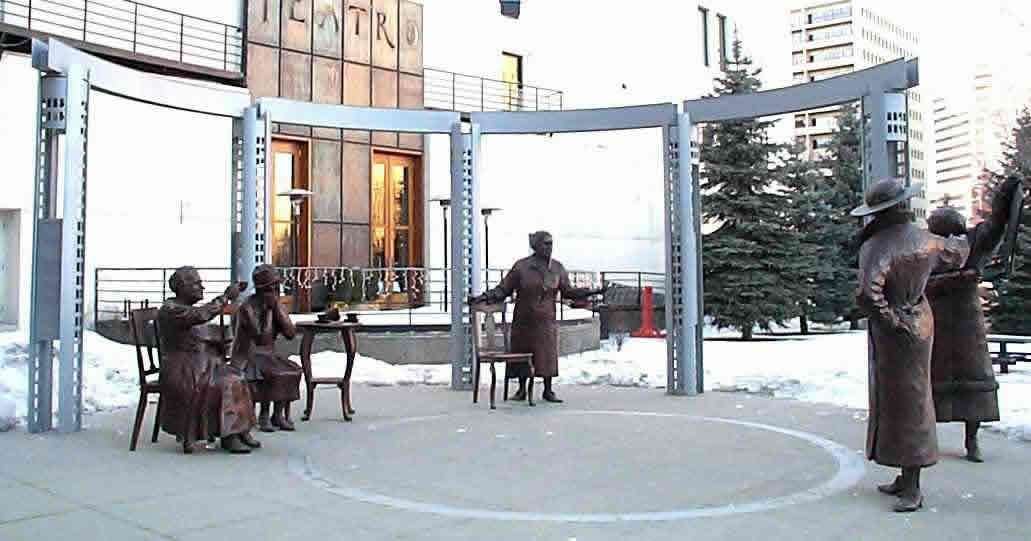
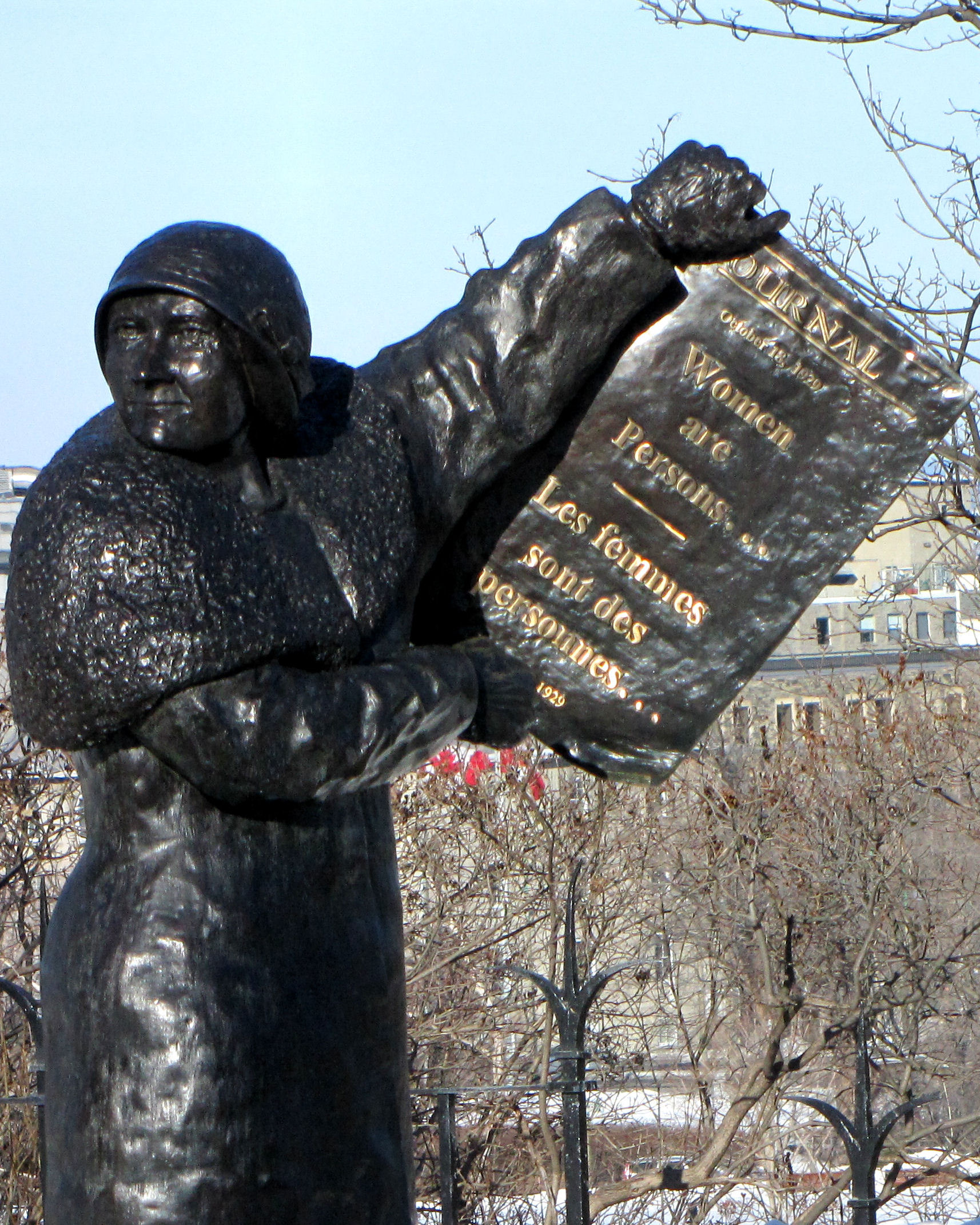
These Famous Five are not the protagonists of the children's adventure stories by Enid Blyton. These Five were activists for women's rights in the early part of the twentieth century. These women, also known as the Valiant Five, took the so-called Persons Case all the way to the Canadian Supreme Court in 1927, and then, when the ruling was not what they wanted, over the water to the British Privy Council. The Justices weighed the evidence and, in October 1929, decided that "women are persons" under the meaning of the relevant act, thus granting them the right to full participation in the political life of their country. It took only a decade for them to be recognised with the plaque depicted here.On the 80th anniversary of the ruling the Five were named Honourary Senators.

The statues in situ
A bronze sculpture of the Five was created by Barbara Paterson, showing them standing and sitting, talking and taking tea. Two 1 and 1/4 life-sized copies exist, one on Parliament Hill in Ottawa and one in downtown Calgary. Last year, a similar group of statues by Helen Granger was unveiled in Winnipeg, outside the Manitoba Legislature.

By Philip Tellis (originally posted to Flickr as Tea Party)  [CC-BY-SA-2.0 
(www.creativecommons.org/licenses/by-sa/2.0)], via Wikimedia Commons. 
The wooden surface on which the figures stand is level; the seasickness is trick photography.
Here is what the MPs, Senators, researchers, assistants, advisors, lobbyists, librarians, security guards, caterers, cleaners, tour guides, other parliamentary staff, and reporters pass on their way to work in Ottawa. No doubt schoolchildren are taken on pilgrimage, and certainly many tourists make their way there, by accident or on purpose.

When I came upon the group on Parliament Hill for the first time, knowing of the landmark legal case but not of the existence of the statues, they were a lovely surprise. They were being polished by two of the park custodians, with their portable litter bins and hi-viz jackets. I found it poignant to see the two men giving such care and attention to these five women.

The image below is from Olympic Square in Calgary, unveiled in 1999. The young royals are going there too -- to the city, but I doubt if they will be shown the statues.

By User Thivierr on en.wikipedia [Public domain], via Wikimedia Commons

Less well documented is the set of statues in Winnipeg. (There is an article and photo of its unveiling in the Winnipeg Free Press, 18 June 2010.)

The artistic process
Paterson's work is represented by Willock and Sax, the Banff National Park Gallery of Fine Art and Photography. If I understand correctly, the sculpture project was spear-headed by the Famous 5 Foundation, which exists to celebrate leadership in women, and runs events and programmes, many targeted at youth. It is based in Alberta, as were the Famous Five. A few words on the artistic and administrative process from the gallery website:
In order to secure the commission for the Famous 5 monuments, being one of nineteen people approached to submit a proposal, Barbara tendered drawings as well as recommendations (final size 1 1/4 lifesize, ground level, interactive), which were taken up by the jury. The three 'finalists' from the first round presented maquettes (in the wax stage) at 1/4 size of the final 1 1/4 lifesize monument. 
It was decided by the Monument Project Jury that Barbara's concept was the one that best encapsulated the idea of the five women who became known as the Famous 5. When Barbara's maquette secured her commission that work was cast in bronze, which travelled across Canada to generate interest in the Monument project.... 
In 1999 the first monument was installed in Calgary (Olympic Square) and in 2000 the second monument was installed east of the Centre Block of the Parliament Buildings in Ottawa. Remember that the monuments are 1 1/4 lifesize, so when you sit on Emily's Chair think of Alice in Wonderland. 

The women themselves
The Five were Famous for good reasons individually as much as collectively. Three of the sculpted figures are standing, starting with the woman granted the central position in the artistic composition. The one holding the declaration, Nellie Mooney McClung, is probably the most famous Canadian suffragist, below:


By D. Gordon E. Robertson (Own work) [CC-BY-SA-3.0
(www.creativecommons.org/licenses/by-sa/3.0)
or GFDL  (www.gnu.org/copyleft/fdl.html)], via Wikimedia Commons


The figure with her hand on the (Alice in Wonderland) chair is Emily Murphy, the first female judge in the British Empire:


By en:User:Montrealais (Own work)
[GFDL (www.gnu.org/copyleft/fdl.html)],
 via Wikimedia Commons


The woman with her arm outstretched and her other hand on her hip is Irene Parlby, a farm women's leader who became the first female cabinet minister in Alberta:


By User:Thivierr (Digital camera photo taken by uploader)
[GFDL (www.gnu.org/copyleft/fdl.html) or CC-BY-SA-3.0
 (www.creativecommons.org/licenses/by-sa/3.0/)],
via Wikimedia Commons


Two of the women are sitting, taking tea together, either side of a small table.

By D. Gordon E. Robertson (Own work) [CC-BY-SA-3.0
 (www.creativecommons.org/licenses/by-sa/3.0) or GFDL
(www.gnu.org/copyleft/fdl.html)], via Wikimedia Commons

The one with her cup raised, gesturing towards the "Women are persons" declaration, is Henrietta Muir Edwards, founder of the Victorian Order of Nurses:


By D. Gordon E. Robertson (Own work) [CC-BY-SA-3.0
 (www.creativecommons.org/licenses/by-sa/3.0) or GFDL
(www.gnu.org/copyleft/fdl.html)], via Wikimedia Commons

The other one, with her hands clasped, is Louise Crummy McKinney, the first woman elected to the legislature of Alberta (and Wikipedia says the first so elected anywhere in the British Empire -- but I thought New Zealand got there first?):


By User:Thivierr (Digital camera photo taken
by uploader) [GFDL (www.gnu.org/copyleft/fdl.html)
 or CC-BY-SA-3.0
 (www.creativecommons.org/licenses/by-sa/3.0/)],
via Wikimedia Commons
Notice the clothes: some are in dresses, some in coats and furs; some with hats, some hatless, as if indoors. And the snow settles on them all...

I've collected (I refuse to say "curated") various images into Flickr galleries, gathered for those who like slideshows: the Calgary statuesthe Ottawa statues, and the Winnipeg statues.

In a later post, I'll show how people show their love for them. That will have to wait a while, though. It is national celebration month, so next week, celebratory memorial sculptures from the United States (I have two groups of activists in mind), and the week after that, Storm the Bastille with public outdoor art from France. Vive la revolution!