Showing posts with label walk. Show all posts

Wednesday, March 20, 2013

London immortals

There is no statue to Mary Wollstonecraft anywhere in the world. There is, however, a sprinkling of public memorials to prominent women in central London. The local chapter of United Nations Women organised a walking tour of half a dozen of them last Saturday. Despite the persistent rain, a goodly crowd assembled, including a pair of self-possessed twelve year olds. Each statue had its designated champion, telling us about their chosen person, from national heroine to forgotten obscurity. Here is the group, listening to the story of Edith Cavell, at the impressive memorial outside the National Portrait Gallery. I even found the opportunity to expound for the benefit of Mary on the Green.

The walk started in Bloomsbury at Tavistock Square, wandered via Lincoln's Inn Fields to the Strand, along to Trafalgar Square, then Pall Mall and Whitehall and finally Parliament, a satisfying circuit through literary, legal, and legislative London.

The full list was:
Louisa Aldrich-Blake (1865-1925), the first female surgeon in Britain.
Virginia Woolf (1882-1941), a writer at the forefront of British Modernism.
Margaret MacDonald (1870 – 1911), a feminist and social reformer. 
Edith Cavell (1865-1915), a pioneering nurse more famous for her death. 
Florence Nightingale (1820-1910), not only a pioneer of nursing but also of statistics.
Women in World War II, the only sculpture not of a specific person. 
Emmeline Pankhurst (1858-1928), the leader of the suffragette movement. 

There are others: Time Out lists Violet Szabo and Sarah Siddons. The labour of love that is London Remembers provides endless browsing fascination; here's their page on the military monument. And the Victorian Web is very good between 1837 and 1901, as e.g. with Florence Nightingale. 

I've spent ages and ages making a Google Map, Statues of prominent women, with links and everything. Do have a look. 


Wednesday, March 6, 2013

A round-up for International Women's Day

Time for a round-up of International Women's Day events that feature Mary Wollstonecraft.

There's "The Two Marys: A Conversation Piece", created by American writer Judith Chernaik, founder of Poems on the Underground. This one-off performance is sponsored by Camden Council, representing the place that embraced the end of the mother's life and the beginning of the daughter's. In a neighbouring borough there is a multifaceted celebration with a lot of music and an hour on Mary Wollstonecraft, by historian Clare Midgley, performance academic Anna Birch, and myself, reprising my IGNITE story-telling. That's organised by the Islington Unitarians in their post-Blitz hidden edifice on Upper Street. Their sister congregation in Newington Green, the church that nurtured Mary as a young schoolteacher, will be opened for the beginning of the Feminist (Or Is It?) walk by Hackney Tours. Simon Coles has chosen to offer the event as a fundraiser for Mary on the Green, the campaign for a statue, as has Hilary King, who is running an Alexander Technique taster session that afternoon. Stand tall, Mary Wollstonecraft fans!

Most of these are listed on Internationalwomensday.com, the corporate-sponsored "global hub for sharing International Women's Day news, events and resources". (Banner ad: "Discover BP's feminine side".) They provided the logo above, and straplines such as "The advancement of women is of prime importance to the economy, business and society. The support of corporate organisations supporting women is critical." I would argue that the support of copy editors is also critical, but I digress....

There are well over 1000 events on the IWD database, with more still being added; hundreds are happening in Britain. The search facility seems to be broken, so I can't see if any others list Mary Wollstonecraft as an inspiration, but one that intrigues me is a walking tour of "sculptures of remarkable women ... from Louisa Blake to Emmeline Pankhurst", led by the UNWomen UK London Committee:
We are the local representative, voice and champion for UN Women (formed in January 2011 from the amalgamation of UNIFEM and three other UN gender bodies) and support the work of UN Women in its mission for gender equality and the empowerment of women.
If only the tour could end up at a commemoration of England's first feminist!

Perhaps the most significant event will be the launch of Fifty Shades of Feminism, a compilation brought together by Lisa Appignanesi, Rachel Holmes and Susie Orbach. It features a chapter entitled "There's Something About Mary" by none other than Bee Rowlatt, no stranger to this blog. The launch is part of the three-day extravaganza on the Southbank, WOW, the Women of the World festival. Sometimes there are good reasons to love London.

Last year for International Women's Day I wrote on the importance of education and on maternal mortality, in the eighteenth century and now, here in the Wealthy West but also in the Wider World. The year before that, on the 100th anniversary of IWD, Mary Wollstonecraft got yet another non-blue plaque, situated most fittingly on a school. Islington Council was behind that nod of appreciation.

If you need more inspiration, have a look at these wonderful posters for IWD 2013.

Sunday, March 11, 2012

In her footsteps

There's another walk featuring Mary Wollstonecraft, this time around the area where she spent her last few years, when she took little Frances and set up home with William Godwin in the parish of St Pancras, in an area of Camden now known as Somers Town. This walk is called All Change at Kings Cross* and is led by Rob Smith of Footprints of London. It takes place on Sunday 25 March from 11am to 1pm and costs £10, or £7.50 concessions; Rob has promised to make a donation to Mary on the Green. It covers:
the history of the area, looking at the existing buildings and what is planned for the future. You'll hear how Kings Cross kept London supplied with food and the areas links with the Beatles, the Olympics, Frankenstein and the French Revolution as well as many other stories.
I've catalogued my previous walks, starting in St Pancras and progressing to Somers Town, via St Paul's and Southwark, with many more waiting in the wings: Bloomsbury, Barking, Spitalfields, and of course Newington Green.

The little church at the head of the village green was the final point for last Sunday's walk with Simon Cole of Hackney Tours. (I love the page on its ethos - how many tour companies have one of those?). This walk is called "Feminism, fame & infamy: How Hackney women have shaped our world" and makes very specific reference to Mary Wollstonecraft. He led this tour on the Sunday before International Women's Day, donating half the fee to the sculpture campaign.

--------------------------

Thursday, December 29, 2011

London remembers, with modesty

There's an excellent site I have not yet written about: London Remembers, with the broad brave ambition, touchingly modestly worded, of "aiming to capture all memorials in London". The page on Mary Wollstonecraft gives a brief biography, with dates, categories ("seriously famous" - love it!), a picture*, and a list of places where Our Lady is commemorated. Note: not places she is associated with, such as the church of her baptism, or, at a stretch of the imagination, the Women's Library. To populate the website with the associations of historical figures would cast the net unfeasibly wide; I quite see that. So only three memorial places appear: the newest plaque, at Newington Green; the oldest, at Somers Town; and the nearby mural on the school wall.  St Pancras Church and churchyard do not feature: graves per se don't fall within the project's purlieu, or it would become impossibly unwieldy. (It is plain gravestones that don't count as memorials: impressive memorials do, hence Soane's family tomb, and so does the St Pancras sundial-spire commemorating the churchyard's other Famous Dead Bisexual Woman, Angela Burdett-Coutts.)

The page has an embedded Google Map (another blogstuff thing I've been meaning to do for a year), and, perhaps the most intriguing box, "Related Subjects". It turns up both gems and puzzles -- alluring, distracting, a way to while away an hour very happily indeed. Frances Mary Buss, of Miss Beale and Miss Buss, the pioneering educators of girls, I can totally understand, but William Johnson Cory? Why -- because his name includes "Johnson"? The Royal College of Opthalmologists? Mary didn't even wear glasses. Call in the algorithm-tweaker! (Now *there's* a necromancer's modern trade!)

London Remembers has its lacunae (not all the MW plaques, for instance -- Southwark is missing) and some teething problems limitations (why are comments restricted to Facebook and Hotmail users?), but it can only grow in strength. It's another great resource for exploring one of the world's greatest cities, even if you are in the Kenyan rainforest or the Vietnamese snow, both places pulling me in this grey dim winter.

*Opie, credited only to Spartacus, which is weird.
-------------------------
Update, mid-January. The more I nose around this site, the more I find to fascinate. I love its sense of humour! "Caveat: Be aware that London actually has more cars, more rain and less sun than our photos show." And, as above, its humility: "we don't think we will ever achieve but we will enjoy the attempt" of trying to find all the memorials. I've tweaked the entry above, to reflect changes made, and to correct my own ignorance. London Remembers is deliberately a work in progress, "doomed to remain incomplete (where does London stop?) but certainly will grow and grow", and "so far we have found 9,744 subjects (people, events, etc.) on 2,321 memorials, at 1,815 sites." The site is not new at all, as I had originally thought, but about ten years old, with a wealth of data collected. It is newly relaunched, and I have only just discovered it.


From the page "Do we need your help?":
By now you either think we are crazy to be doing this or you're fascinated and would love to help. In the past we have thought we’d like an army of volunteers doing all the desk research, leaving us free to get out on the streets and do what we really enjoy – finding the memorials and in the process getting to know this cranky old city. But organising people, teaching the system, the house style, etc, it all takes time, and we’ve come to the conclusion that it's best for us to do the whole job. But if you can provide information for any of the war dead about whom we know nothing then we would be delighted. Pictures especially welcome.

Who are these crazy people anyway?
It probably doesn't need stating, but this website is not a commercial concern; it is a hobby. We started collecting data about London memorials in 1999, because we enjoyed walking and cycling around the city, finding out about its history, geography and architecture. We plotted them on maps because we find maps endlessly fascinating and enjoy using them.
The team behind London Remembers is a mysterious "we", but bound to be small: I am utterly in favour of amateur endeavours, and Mary values modesty. They are so much not a commercial endeavour that the site is entirely free of ads. Charming, compelling, educational, visually appealing, easy to navigate... I could go on. I am reminded of what Robert Louis Stevenson said affectionately of Modestine at the end of  his Travels with a Donkey in the Cevennes - "Her faults were those of her race and sex; her virtues were her own." The faults of London Remembers  are those quirky oddities we all recognise in a labour-of-love website; its virtues are its own.

Wednesday, April 20, 2011

Mary in Southwark

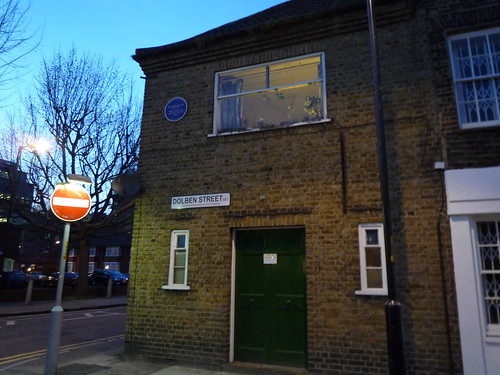
The previous leg of our walk took us through the mean streets of the City, around St Paul's Cathedral, and across the Thames to Southwark. As the sun was setting, we found our target: another plaque to Mary Wollstonecraft.


Claire Tomalin was involved, as she was with the Camden one. The biographer was given the honour of unveiling it in 2004; see the photos in this article from London-SE1 Community website. The plaque states: 
London Borough of Southwark
Mary Wollstonecraft
(1759-1797)
Writer, teacher and
champion of women's
rights
Voted by the people

It sits next to a battered first floor window, in a C20 house, number 45 Dolben Street, on the site of one that Mary moved to when she was determined to be "first of a new genus", to make her career as a writer. It was then known as George Street, and was newly built when she moved in. According to the 1950 Survey of London,
George Street was formed circa 1776 and the houses on either side were completed and tenanted by 1780 .... It was built across the open fields shown as "tenter grounds" on Rocque's maps.... The formation of George Street was part of the rapid development of the area which followed the erection of Blackfriars Bridge. 
[A tenterground is "an area used for drying newly manufactured cloth". There is a street in Spitalfields of that name, with a large building purchased in 2008 as a studio by Tracey Emin-ence grise of the once-Young still-British Art-is-what-you-can-get-away-with-ists.]
That was in 1769, making it the third bridge over the Thames in what was then London. The Survey of London goes on to detail the street, house by house. Just our luck that Mary lived in the one that got knocked down: "Nos. 41 to 57 on the north side are, with the exception of No. 45, the original houses dating from the latter part of the 18th century." The building next door, called Thompson House, would have been known to her. I believe she lived here 1788 - 1791, scribbling away. 

I think back to Nancy Means Wright's piece, number 6 in the cycle Vita and the only one set out as prose. Reproduced by her kind permission, it describes the moment Mary arrives at Johnson's door:
    THE BOOKSELLER HAS A MOMENT OF MANIC 
    Dismissed by the Kingsboroughs, Mary lands on the doorstep of publisher-bookseller Joseph Johnson with her first novel, "Mary: A Fiction." London, 1788     
    Certain physical considerations have kept me from women, but there she was on my doorstep, a feral cat starved for the flesh of intelligent discourse. What manner of woman was this? No prospects, no sign of that surrender to man or God that hangs on such a condition? Genius maybe, but The Education of Daughters a flawed work, copies gathering dust in my warehouse— and she dares to chide "Little Johnson" for favoring price over appearance. Now I don't believe in witchery, but when she rushed in with her shabby beaver hat and a sheaf of new script (fiction!) to break on my chest like a wave of raw light, I gave up my shore. (It seems these moments come to certain asthmatics). Tonight, I assured her, she would sleep in the wings of St. Paul's. But first, she insisted, we would dine, she needed to eat. Then talk. And talk! A small man makes a good listener.
Johnson gave her refuge at his home in the publishers' quarter of the City, but that could only be a temporary arrangement.  He was another man like Richard Price, also a friend: a generation older than Mary, learned, gentle, successful in his field, connected to lots of interesting people, willing to support her, both with direct financial aid but also with emotional support, believing in her, encouraging her. All this without any attempt to pat her on the knee under the dining table (indeed, one of the biographers says he may have been gay). He was, as Price had been, a mentor, a father figure.  

Johnson helped find her somewhere to stay, conveniently just over the river (crossing at Blackfriars Bridge -- no need for "oars!"). And there -- in what I like to imagine was a freezing garret -- Mary wrote for his Analytic Review, teaching herself French and German by undertaking translations and reviewing books (even her own, which was rather naughty).

Next stop, next Wednesday: Spitalfields, where Mary Wollstonecraft was born.
Photos by Chihiro.

Wednesday, April 13, 2011

Mary in St Paul's, almost

This is the third in a series of Wednesday walks. The first traced Mary Wollstonecraft's final days in Somers Town, and the second visited St Pancras Church, the scene of her marriage and burial. We -- the Japanese historian, the Swedish theatrician, and I -- were last seen indulging in a pot of tea at Drink Shop Do. Back in the day, Dissenters and Abolitionists were at the forefront of the boycott of slave-grown, i.e.. West Indian, sugar, and today's fair trade campaigns spring from the same instinct and indirectly the same roots. Mary called the slave trade one "that outrages every suggestion of reason and religion", so she remains with us even in the tea room.


Out the door, turn right, and in a few steps we are at Housmans, "radical booksellers since 1945". I took my little party inside and we looked around. With professional acuity, Chihiro scented Mary across the room, and zoomed in like a sniffer dog on a top-shelf copy of A Vindication of the Rights of Woman, the 2010 edition by Verso with an introduction by Sheila Rowbotham. Housman's website has a page for Mary, though strangely it doesn't list that book: 
As a tribute to one of the most gifted literary families of all time, Housmans retain a moderately comprehensive stock of books written by the Wollstonecraft family. 
I just love that: "the Wollstonecraft family". The shop sells postcards of the gravestone we visited in the previous leg of the walk, daffodils a-nodding. By this point the performance designer had to leave us for another appointment, but the historian, aware that this was her last 24 hours in London, wanted to continue. Great, said I, let's go looking for another plaque I've never seen before.

Surrounding buildings change, but the cathedral is much
as Mary would have known it. (Wikimedia Commons)
Across the street is the bus stop for number 17, which took us straight to St Paul's Cathedral. Wren's masterpiece survived World War II relatively unscathed, despite the best efforts of the Luftwaffe,  but a lot around it was destroyed, so we didn't spend the fading daylight searching for remnants of Joseph Johnson's publishing house, which would have been in the immediate vicinity.  (I've since found out abut a free rooftop gallery opposite the cathedral, and next time I might go up One New Change.)

We headed across the blade of light, the formerly wobbly pedestrian bridge, and imagined the Pool of London in the late C18, the beginnings of the real commercial success of the British Empire. It would have been packed thick with ships, laden with riches from Indias east and west: quinquiremes of Nineveh, sailing home to haven in cloudy London-town. (The so-called Rhinebeck panorama, held by the Museum of the Docklands, gives a good idea.) Ahead of us was the former power station, better known by the name of a sugar magnate who was born to a Unitarian clergyman. To one side of Tate Modern is Shakespeare's Globe Theatre, and to the other, a net of confusing streets we had to untangle. Just as the sun was setting, we found our plaque.


I've been told these posts tend to be on the lengthy side, and have been advised to curtail them. So -  the walk will continue next Wednesday, when I promise you that building, and the plaque, and a poem. 

Wednesday, April 6, 2011

Mary in St Pancras

This is the second in a series of Wednesday walks. The first took in Mary Wollstonecraft's life in Somers Town.

From the Polygon plaque it is a five-minute stroll to St Pancras Old Church, allegedly the second oldest site of Christianity in England. (Not to be confused with the almost-Ancient-Greek caryatids of St Pancras New Church on the Euston Road.) The building itself is a little gem; Victorian Web calls it "a small church with a big history". The churchyard too is rich with cultural and literary references;  Dickens name-checked it in A Tale of Two Cities as the site of night-time "fishing" (body snatching).

According to Chesca Potter's 1990 booklet Mysterious Kings Cross, the church was "only open to the general public on the Sunday nearest to St Pancras Day, May 12th", but that has now changed: the main doors are open almost every time I walk past, and glass ones behind cleverly signal open-ness. The small building is buzzing with life. The venue is listed in Time Out, and when we wandered in a band was rehearsing, presumably Porcelain Raft. The spiral staircase was unlocked, so we explored the library upstairs, with its overstuffed armchairs, and its pamphlets on the history and spiritual significance of aspects of both the church and the churchyard.

St Pancras Church was substantially rebuilt in the middle of the C19, and we tried to figure out what Mary would have recognised: the C6 altar stone, for a start, and an C18 font cover. Here she and Godwin married, something that soon drew disapproval: in declaring herself "a spinster of this parish" she was admitting that there had been no ceremony between her and Imlay, and thus that her first child was a bastard; and Godwin had written against the institution of marriage as it existed, so he was perceived as going against his principles. 

And then outside, to try to find Mary's memorial. It is doubtful how much she would have recognised: some items (especially gravestones) have moved, and many (especially tombs) post-date her death, viz the Burdett-Coutts memorial sundial, the image to the left. (The "richest heiress in England" was another woman devoted to her female companion, even unto death. A couple of years after Hannah Brown died -- "my poor darling, the companion and sunshine of my life for 52 years" -- Angela B-C married a man, eliciting scandalised raising of eyebrows. When I was showing a queer activist around town, she called this the Famous Dead Bisexuals Corner.)

The churchyard was much bigger in the C18, and was surrounded by fields (cf St Martins in the Fields, the church at Trafalgar Square). When the Midland Railway was being built in the 1860s, the line decided upon ran right through the cemetery, so the bodies, or whatever remained of them, had to be respectfully moved. The chap deputed to do this was none other than the young Thomas Hardy, who, after completing this distasteful task, decided to pursue a career in literature instead. He left to posterity not only the books by which he is so well known, but also the Hardy tree.  Other highlights of St Pancras Churchyard are the Soane Monument, for its design (which is supposed to have inspired the iconic red pissoirs telephone boxes), and, for their associations, the Rhodes family tomb and the grave of the last survivor of the Black Hole of Calcutta. All of these are post-Mary, though she may have seen Soane's early work on the Bank of England, so near her publisher at St Paul's Cathedral.


The stone bearing Mary's name is not what the unwary might expect. First of all, it is not hers alone. Godwin erected it soon after her death and, demonstrating an accurate judgement of how history would remember her (a judgement so singularly lacking when he rushed into publication of the too-much, too-soon Memoirs), he had it inscribed thus:

Mary Wollstonecraft 
Godwin 
Author of 
A Vindication 
of the rights of Woman 
Born 27th April 1759 
Died 10th September 1797

When Godwin died, nearly four decades later, he was buried in the same place, and his entry was carved on another face of the square, rationalist marker. His second wife survived him by five years, and she too gets one surface. (The final face is left blank; had he needed a third spouse, there was space.) With so many divorces nowadays, will we see a trend for multiple occupancy burial sites?  Polyamorous posterity?

(Mary Jane Clairmont, nee Vial, deserves a word. She comes down to us as yet another of history's wicked or at least unlovable stepmothers; young Mary cordially disliked her, poor Fanny committed suicide, and her own daughter ran away from home to seduce a celebrity. But she was "the only female publisher of substance in the London literary world of the early 1800s" and "in her business acumen, something of a bulwark against the financial improvidence of her husband", according to the University of Pennsylvania's Frankenstein project. It is too easy to dismiss or forget her. Had Mary lived, they would have been neighbours, and moved in similar literary circles. It is not hard to imagine them collaborating on a children's library.)

The second surprise, for those who haven't done their homework, is that Mary does not lie here. Her bones (and those of Godwin, but not, as far as I know, of his second wife) were moved to Bournemouth. Why Bournemouth, I hear you ask? What possible connection did Mary have with the South Coast? Well, precisely none. Field Place, near Warnham, West Sussex,  was the ancestral home of her tousle-hair'd son-in-law. The poet's conventional and unliterary son (MW's only grandchild) eventually inherited the estate, but chose to purchase and extend Boscombe Manor, near to Bournemouth and soon surrounded by the growth of the seaside resort. His ailing mother and genteel wife both got along well, and since Mary Shelley wanted to be buried with her parents, and Jane and Percy judged St Pancras entirely unsuitable as a resting place (the church was in a sad state by the mid C19, surrounded now by slums instead of fields), the solution hit upon was to move the distinguished ancestors. Hence Mary Wollstonecraft and William Godwin were whisked away from the insalubrious air of Dickensian Kings Cross and reburied amid the bracing, albeit incongruous, sea breezes of Bournemouth, where the whole happy family can be visited at the Shelley family tomb at St Peter's Church.  

(The connection between the Marys intrigues me. One died, and the other was born, with the same name: Mary Wollstonecraft Godwin. The daughter called herself Mary Wollstonecraft Shelley for much of her life, clinging on to her mother's name even after discarding her father's. What did that mean to her?) 

Beyond being removed from the parish of her happy final months, there's a further indignity Mary suffers. The church no longer is responsible for the churchyard, having passed the grounds to Camden Council, who run it largely for the benefit of dogwalkers. Next to the rather magnificent and seriously underappreciated gilded gates sits a placard explaining the gardens. It gives Mary only parenthetical mention, as Wife Of Important Man. I think another campaign would not go amiss...

Now it is time for tea and a sit down.There are two ways out of the gardens: return the same way, walk to the near (rear) end of St Pancras Station, and cross through it (not along it), coming out the other side; OR, out the smaller ungilded gates on the other side of the gardens, turn right under the huge railway bridge, passing Camley Street Natural Park on your left (which abounds in delightful places to sit down but is entirely devoid of tea, unless you had the foresight to bring your own thermos), and walk parallel to the railway lines.

In either case you will find yourself within a few minutes at the German Gymnasium. This 1865 brick building is now the marketing suite for Kings Cross Central, who are overseeing the enormous changes in the area. There is a small display on C19 radicalism in the neighbourhood, a terrifying maquette of future developments, and, best of all, the structure itself, bearing a distinct resemblance to the engravings here.

Nothing to do with Mary? True, it was built long after her death, in the blaze of German-philia that accompanied Queen Victoria's consort, along with Christmas trees from the Teutonic forests. But surely she who wrote "I wish to persuade women to endeavor to acquire strength, both of mind and body" would have rejoiced at the purpose and management of the building, for, according to the KCC website, "the German Gymnastics Society adopted a forward thinking approach to women’s exercise, with classes taking place here from as early as 1866." Upstairs there are sometimes exhibitions, and if not, you can imagine exhibitionists flinging themselves acrobatically from the stupendous rafters.


Now: tea. Quick march: through Kings Cross mainline, out the front, turn left, cross the lethal York Way very carefully, march along Pentonville Road ignoring bang bang bang McDonalds Starbucks Pret, turn left into the warren of refurbished warehouses phoenix'd as trendy offices, walk past the Spanish-ish tapas place and its decorative barrels that I cynically bet never held sherry, out the other side past the beautiful but ill-sited labyrinth on the wall (I like the melted computer keyboard), turn immediately left and up the steps to Drink Shop Do. You have arrived. If you need the loo, it's downstairs, shared with the neighbouring well-lit and friendly gay sex shop. NB amusingly worded warning notice on the door, for the benefit of the ladies with hairdos who are passing time till their train back to Yorkshire. 

When you are refreshed, the next Wednesday walk takes us to St Paul's and Southwark.
Tomorrow: Mary's sons and daughters

Photo credits: all by Asa Norling, except the Camden Council placard, by Chihiro, 
the two engravings of the German Gymnasium, by kind permission of Kings Cross Central,  
and the Burdett-Coutts memorial sundial, by Jacqueline Banerjee, of the Victorian Web.

Wednesday, March 30, 2011

Mary in Somers Town

A few days ago I went exploring, with Chihiro Umegaki, the Japanese historian mentioned earlier, and the Swedish performance designer Asa Norling. (Åsa had read the Scandinavian letters, and commented that Mary hadn't much liked the Swedes. I reassured her that she didn't think much of the Portuguese or Irish either, from her sojourns in those countries, and when she was in France hung out mostly with Americans.) Our little tour was mainly a Wollstonecraft pilgrimage, but I used it as an excuse to look at sculptures and other public art as we passed them, comparing good and bad examples that might feed in to Mary on the Green. This post is the first in a series describing what I shall call Wednesday walks.

The three of us met under the skirts of the goddess in St Pancras Station, that is, at the feet of the biggest and ugliest statue to have disgraced London in the last decade at least. It has its plus points: there are benches, it is right at the head of the station, it is a convenient place to gather -- especially to arrange to meet people who might not know London all that well. Anyone can find it: no one could miss it: I, however, wouldn't miss it at all. In terms of aesthetic appeal, I give it nil.

If you look closely, and use a little imagination, you'll see that the speech bubble above Brief Encounter says "Welcome to London, home of heteronormativity!" Fortunately, you don't actually have to look at the embracing couple, as they are too high to peer at without serious neck craning (unless you *really* want to look up her skirt, and be disappointed). At eye level, on the frieze around the base, are much more interesting figures, small, rich, detailed. (NB not shown on this photo, as they were added later.) Not really bas relief -- maybe medium relief? They are somewhat of a relief from looking up. Hard to believe the two works are by the same artist, Paul Day. There's a long explanation of the statue by him, archived on the BBC site; the comments from the punters are polarised, to say the least. OK, it's quite a feat of engineering, as The Evening Standard photos show, but that isn't what it is being judged on. It's supposed to be a work of art.

[Addendum: that indefatigable London explorer IanVisits has written up the frieze of commuters.]

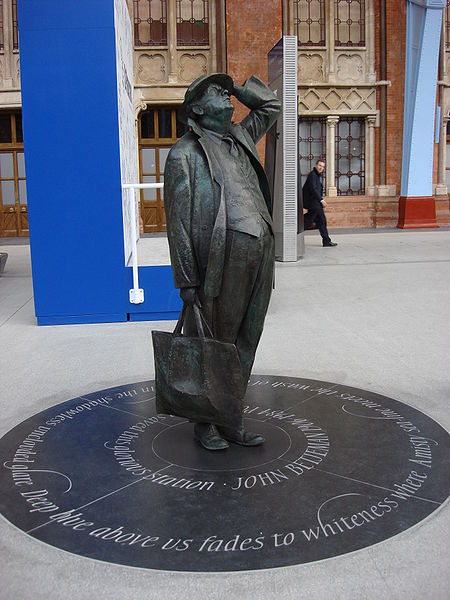
A few steps away is the charming statue of John Betjeman, which is so utterly appealing. This bronze, by Martin Jennings, is just over life size, and sits on the ground rather than a pedestal, so that tourists are often to be seen photographing themselves with him. The poet is clasping his hat in a breeze, his coat billowing, looking up at the station he campaigned to save; I am reminded of Sir Christopher Wren's epitaph in St Paul's Cathedral: "Reader, if you seek his monument, look around you." There's an article by Jennings in The Guardian, setting Betjeman and the project in context, and a description of the process of its creation, with photos along the way, at the artist's website, with various quotes.
Jennings's Betjeman - the best statue I've seen of a well-known figure - is so bright, so visually striking, that it's possible to believe that he actually embalmed the poet in bronze. Betjeman is so realistic that you think he's about to walk down the platform.
Duncan Hamilton, Yorkshire Post.
There is a trail of the poet's words leading up to his statue, carved into slate discs set into the floor and forming its base. It is definitely site-specific art, and also that most traditional of forms, a representational statue of an individual. I could wish for nothing better as a tribute to Mary.

We leave the station and walk along the noisy Euston Road, or the New Road as Mary would have known it. The M25 of its day opened in 1756 as a bypass around the amalgamation of the City of London and Westminster, and all their accretions up to that date. We pass the British Library, which was then housed within the British Museum; Mary lived within spitting distance of it on Store Street, but, I believe, would have been forbidden access on grounds of being a woman. Perhaps we will get to Bloomsbury on a future walk. On the other side of the Euston Road is St Pancras New Church, "new" only in the English sense of being almost 200 years old. Godwin would have seen its contentious and expensive rise.

Just past Chalton Street Market we turn into Churchway, its wiggliness a good indicator that the road pre-dates the grid layout around it. The name for this immediate area is Somers Town, as in the recent film made in honour of the Eurostar arrival. Somers Town stretches north towards Camden Town, but most Londoners know the area simply as St Pancras, originally after the church, or as St Pancras/Kings Cross, after the adjacent train stations. A couple of minutes' walk takes us to Polygon Road, named after the buildings in which Mary spent her last months, happy with Godwin and her work, and where she died.

We pause to gaze at a large mural on the side of a school. It is hard to appreciate the detail of the painting, as it is obscured by a high chain fence, but here's an image. Claire Tomalin, author of The Life and Death of Mary Wollstonecraft (2004),  lobbied in1992 for its retention, calling it "probably the finest in London":
...in 1980 the GLC [Greater London Council, abolished by Thatcher] commissioned the London artist Karen Gregory to paint a mural on the wall of a school to celebrate the history of the district and its famous residents...It offers a journey through time, drawing on the styles of many artists; Stubbs, Constable, Gainsborough, Ford Madox Brown, Sickert and Gilman. Old St Pancras church is in the background, surrounded by hay fields. The Fleet river runs by under an elm tree. Beneath it are seated the figures of William Godwin and Mary Wollstonecraft, who belong to the earliest period of Somers Town's history. Their daughter Mary is shown as a young woman, with her husband Shelley, sailing paper boats from the bridge over the Fleet, while behind them appears the head of Frankenstein's monster.
Her campaign was successful in raising funds for its restoration; it was moved in 2007, according to the London Mural Preservation Society, and its amended version includes not only the head teacher but Tomalin herself.

Opposite the mural is Oakshott Court, more or less where Mary's last home would have stood. An engraving of the Polygon depicts the circle of buildings, a speculative development in the middle of Clarenden Square, as very attractive. The church on the right hand side might be the one that Churchway leads to, but I see no sign of it on Greenwood's 1827 map. By that point the area had gone downmarket; Charles Dickens lodged there as a boy, and put the Polygon into Bleak House in 1852, as the home of a down-at-heel eccentric. The 1952 English Heritage survey says "Horwood's map of 1799 and Tompson's map of 1803 show the Polygon built in the fields with a circular road round it." That would accord with Godwin's description of walking home across fields, to what were then buildings only a couple of years old: desirable, purpose-built residences just outside the pollution of London, but conveniently close. This was still an age when everything needed to be within walking distance, unless you were rich enough to keep a horse.

After walking all the way around Oakshott Court, we find the brown plaque to Mary, erected by Camden London Borough Council, prodded by Claire Tomalin. "In a house on this site..." In the London Review of Books in 1989, Tomalin says:
‘Mary Who?’ is still the common form of her name, outside a small circle of specialists and enthusiasts. People stumble over the three simple syllables; its awkwardness has stood in the way of her fame. Pankhurst has an easy ring to it, and Mrs Pankhurst got a statue. When I set about organising a modest plaque on the site of the house in which Mary Wollstonecraft died in Somers Town, there was talk of naming flats or even a street after her: but again, those three syllables defeated too many people.
Next Wednesday's installment: to St Pancras Church (and tea).

All images Wikimedia Commons, except Polygon Road, courtesy Asa Norling.