Showing posts with label Newington Green. Show all posts

Monday, April 22, 2013

More on Mary's manifestation and Stewy's streetart

Just over a month ago,  Mary manifested!  Overnight Wollstonecraft appeared outside Newington Green Unitarian Church, courtesy the street artist Stewy.

Mary on the Green, the group campaigning for a statue, and Andy Pakula, the minister of the church at the heart of the village that changed the world* (and expanded Wollstonecraft's life), both bask in the reflected glory of the rather lovely life-sized image.

In the weeks since International Women's Day, the stencil on the wall has attracted a lot of publicity, as well as pilgrims and visitors. Here's a round-up (including interviews with yours truly):


There’s something about Mary, Hackney Post, Rachel Bayne

On a Stoke Newington corner, astride the New Unity Church railings, a banner proclaims ‘The Birthplace of Feminism’. In this small, Unitarian congregation beats a radical heart. Here, amongst the pews more than 250 years ago, sat Mary Wollstonecraft.

Last weekend, a mysterious portrait of the radical feminist appeared on the wall of the Church. The stencil, designed by graffiti artist Stewy was put there on International Women’s Day to celebrate the palpable influence Wollstonecraft made on the Newington Green community and far, far beyond.

Stewy’s painting also acts as a ghost-like trace, spearheading the path for a more lasting tribute in Stoke Newington. Roberta Wedge, local activist and member of the ‘Mary on the Green’ campaign, represents that hope with plans to build a statue of the feminist on Newington Green.
“I always say to people, if you were raised by a woman who could read and vote and work, then you owe something to Mary Wollstonecraft,” says Wedge.


Mysterious Banksy-style graffiti welcomed by Newington Green statue campaigners, Islington Gazette

The mural, which is the work of street artist Stewy – whose identity is unknown – emerged as events were staged in Newington Green to raise money for the statue and to celebrate International Women’s Day, which was last Friday.

Andy Pakula, minister of the New Unity congregation based at the chapel, said: “I hope we can leave it here because we think it’s fabulous. There’s different issues about street art, but she’s our guiding spirit. You’ve seen in the US where images of Jesus appear on toasted cheese sandwiches, well for us this is about the best that could happen to have Mary show up. She’s inspired us to work for justice in the world and we absolutely support the campaign for a statue. We would like to see a Mary Wollstonecraft centre for feminist studies in Newington Green one day.”

Writer Bee Rowlatt, 41, who is backing the campaign and recently published a chapter about Wollstonecraft in a new book titled 50 Shades Of Feminism, said: “It’s just unbelievable that there’s no permanent memorial to this incredible woman. The mural is really inspiring. She’s right there life-size on a building where she used to go. We feel like she’s appeared among us and we hope this is a small step towards getting the memorial.”


‘Apparition’ of 18th-century women’s rights campaigner Mary Wollstonecraft appears on church, Islington Tribune, Amy Smith

A MYSTERIOUS apparition on the side of the New Unity church in Newington Green caught the eye of passers-by when it appeared overnight. But it is not the “Mary” that some might expect. Instead, it’s a graffiti stencil of Mary Wollstonecraft, the influential 18th-century author and staunch advocate of women’s rights who was inspired by sermons at the church.

As a young school­mistress Wollstonecraft used to attend the New Unity church and its radical sermons were integral in shaping her political stance. Street artist Stewy was inspired by her message to create the piece. “I’ve been aware of Mary Wollstonecraft’s connection with the Unitarian Church for many years,” he said. “The placing of the image, where she may have walked, was important to me and I decided to make a small edition of 25 screen prints taken from the stencil to help raise money for ‘Mary on the Green’.” 


Mary Wollstonecraft "appears" in street art on her 18th C spiritual home! N16 magazine

New Unity Minister Andy Pakula said ‘This is a mysterious apparition of the mother of feminism - a daring figure who continues to inspire us in the fight for freedom and justice for all people. Without her spirit, it is unlikely that we would have stood forward so boldly for equal marriage, as we have in recent years. Mary's spirit has been with us always. Now her image is as well!’


Newington Green graffiti celebrates Wollstonecraft, Islington Now, Sarah Graham

Fans of famous feminist Mary Wollstonecraft are celebrating her surprise appearance in the form of graffiti on the side of a church in Newington Green. The stencilled image of the 18th century “mother of feminism”, by street artist Stewy, is a bonus for a local campaign to get a statue of Ms Wollstonecraft erected in the borough.

Islington-based movement Mary on the Green tweeted a photo of Stewy’s artwork, saying: “What a boost to the campaign! Mary manifests on NG church @newunity.” Newington Green Action Group set up the initiative in 2011 to make her life and work more accessible to local people.

Campaigner Bee Rowlatt said: “[Ms Wollstonecraft] is an internationally renowned champion of women’s rights and there’s no statue to her anywhere." Ms Wollstonecraft, author of A Vindication of the Rights of Woman, lived locally and attended the “radically-inclusive” New Unity church during her lifetime.


and even in the the newsletter of the National Museum Directors' Council

Street art evens up London’s representation of famous women: The image is clearly based on the John Opie picture of Wollstonecraft, which is on display in the National Portrait Gallery.  Mildmay’s Labour councillor Kate Groucutt says “I absolutely want it to stay. We’ve had confirmation from Hackney Council and they can’t remove it without checking with the owner, and that’s the church.  It’s not going to be painted over, we have secured that.” There are only a handful of statues to women among the hundreds in London. 


And the image is to be found as far afield as the United States UU World magazine: 
British Unitarians rally to save faith from extinction  by Donald E. Skinner

Unitarians in London gathered next to an image of 18th century Unitarian writer Mary Wollstonecraft. The image was created recently on the side of the Unitarian Chapel in Newington Green in north London, where efforts are underway to raise money for a statue of Wollstonecraft.

*************************
*The Village that Changed the World is the title of the beautifully illustrated little history produced by the Newington Green Action Group. It's available directly from the charity and no doubt from the online mega-retailer of your choice.
The photo above is, for a change, by me, of a pair of warm churchgoers on a cold day.

Friday, March 15, 2013

Hidden re-appears


With the kind permission of the artist himself, Red Saunders.

Red Saunders created Mary Wollstonecraft and the Dissenters of Newington Green 1781 as part of his Hidden from History series. Thanks to the Socialist Worker, I am pleased to report that it is visible once more, this time in the People's History Museum, until the end of September. I wrote about the creation of this elaborate photomontage here.

[This is my 200th post, over two and half years. Not bad going.]


Tuesday, March 12, 2013

Mary manifests!

Mary Wollstonecraft has appeared on the side of Newington Green Unitarian Church, on Mothers' Day and on the extended weekend of International Women's Day.

No sign of her on Saturday, when the walking tour got to hear her story at the beginning of "Feminist Hackney - Or Is It?". But when the congregation arrived on Sunday morning, she had (to their delight) manifested quite serenely and beautifully on the exterior west wall. This is the church that radicalised Mary Wollstonecraft, that helped this unpublished 25 year old schoolteacher, with no family or money or even a proper education herself, realise that she could make a mark on society. This is the community that introduced her to a wider intellectual sphere, and to the publisher who nurtured her for her ten brief years of productivity. This is, as the local history says, The Village that Changed the World.

Church Walk is now an alley, but in her day would have been a lane through a mile of farmland to Stoke Newington and the resolutely non-Dissenting St Mary's Church. All these fields were swallowed up by the relentless Victorian sprawl of London, but those with eyes to see can spot the history under our feet.

The image is clearly based on the last John Opie painting, when she was pregnant with her second daughter, known to history as Mary Shelley.  You can see the head and shoulders in the National Portrait Gallery, thanks to Bob Lamm liberating her from basement interment, or indeed in the nearest pub to the church, larger than life in the Dissenting Academy, but if you want to see the full-length version in the fresh air, I'd advise you to hurry. Who knows how long Hackney Council will allow her to stay? I've heard they take a dim view of street art, unlike neighbouring Islington. We shall see.

The wall stencil is signed STEWY. I hoped it might be a culinary reference; I was cycling into an unseasonably bitter wind and snow flurries this morning, so my thoughts naturally turned to well-seasoned eighteenth century winter stews. Apparently Stewy is a man, albeit a shadowy one. He has given a few interviews over the years, from which I glean that he trained as an illustrator, was influenced by Banksy and Blek Le Rat and their rodents, and decided to do 26 indigenous animals: F for fox, P for pigeon, etc. His politics are of the Billy Bragg variety* (with an extra dose of charmingly naive idealism) and his imagery is simple, full of character rather than narrative. His bare-bones tumblr is here.

From animals Stewy graduated to people, putting Quentin Crisp near Canal Street in Birmingham, Tracy Emin in Margate, and John Cooper Clarke in Salford. (For those not familiar with them: England's stateliest homo, no-longer-YBA enfant-terrible EMINence grise, and punk performance poet.)
I wanted to do something different so I had this idea like the [English Heritage] blue plaques.... I would only spray my people where they had an association, where they lived or were born or worked or died. And most of them that I have put up have remained which is great because they are obviously relevant to the people who live in the area, there is a sort of respect.
That was from the interview by Ken McGregor of the Australian Metro Gallery. (Mary Wollstonecraft has several plaques in London, including one on Newington Green.) Stewy went to a Manchester pub with Tom Balderstone and expounded some more:
I deliberately do underdogs or the people hidden or just behind the scenes. The people who haven’t really become famous....[With one of his images] loads of people come up asking who he is, not their fault, so it’s kind of educational; almost historical/geographical. In school I had an interest in both but I couldn’t do history, got a B in geography and I liked art, so it all came full circle and now I’m pulling that all together. I might do a map one day, and try to plot it all. But by then the pictures might have gone.
He also spoke to Joe Bill of Kent News about the future of street art, it becoming a positive force in society. "It’s not about me. The work highlights people or eccentrics who made a difference - changed how we approach art, music or writing - pushing the boundaries in Britain and shaking things up a little."

Stewy calls his combination of people in their context "psychogeography". So now we have a psychogeographic Mary Wollstonecraft, back in her old neighbourhood, looking straight at us. "Like a ghost across the street", a line from Blek. There she is. Thanks, Stewy.

***************************************************************
*Note to self: the Bard of Barking might be interested in Mary Wollstonecraft: 
that ancient port was where she formed her first memories. 

Wednesday, March 6, 2013

A round-up for International Women's Day

Time for a round-up of International Women's Day events that feature Mary Wollstonecraft.

There's "The Two Marys: A Conversation Piece", created by American writer Judith Chernaik, founder of Poems on the Underground. This one-off performance is sponsored by Camden Council, representing the place that embraced the end of the mother's life and the beginning of the daughter's. In a neighbouring borough there is a multifaceted celebration with a lot of music and an hour on Mary Wollstonecraft, by historian Clare Midgley, performance academic Anna Birch, and myself, reprising my IGNITE story-telling. That's organised by the Islington Unitarians in their post-Blitz hidden edifice on Upper Street. Their sister congregation in Newington Green, the church that nurtured Mary as a young schoolteacher, will be opened for the beginning of the Feminist (Or Is It?) walk by Hackney Tours. Simon Coles has chosen to offer the event as a fundraiser for Mary on the Green, the campaign for a statue, as has Hilary King, who is running an Alexander Technique taster session that afternoon. Stand tall, Mary Wollstonecraft fans!

Most of these are listed on Internationalwomensday.com, the corporate-sponsored "global hub for sharing International Women's Day news, events and resources". (Banner ad: "Discover BP's feminine side".) They provided the logo above, and straplines such as "The advancement of women is of prime importance to the economy, business and society. The support of corporate organisations supporting women is critical." I would argue that the support of copy editors is also critical, but I digress....

There are well over 1000 events on the IWD database, with more still being added; hundreds are happening in Britain. The search facility seems to be broken, so I can't see if any others list Mary Wollstonecraft as an inspiration, but one that intrigues me is a walking tour of "sculptures of remarkable women ... from Louisa Blake to Emmeline Pankhurst", led by the UNWomen UK London Committee:
We are the local representative, voice and champion for UN Women (formed in January 2011 from the amalgamation of UNIFEM and three other UN gender bodies) and support the work of UN Women in its mission for gender equality and the empowerment of women.
If only the tour could end up at a commemoration of England's first feminist!

Perhaps the most significant event will be the launch of Fifty Shades of Feminism, a compilation brought together by Lisa Appignanesi, Rachel Holmes and Susie Orbach. It features a chapter entitled "There's Something About Mary" by none other than Bee Rowlatt, no stranger to this blog. The launch is part of the three-day extravaganza on the Southbank, WOW, the Women of the World festival. Sometimes there are good reasons to love London.

Last year for International Women's Day I wrote on the importance of education and on maternal mortality, in the eighteenth century and now, here in the Wealthy West but also in the Wider World. The year before that, on the 100th anniversary of IWD, Mary Wollstonecraft got yet another non-blue plaque, situated most fittingly on a school. Islington Council was behind that nod of appreciation.

If you need more inspiration, have a look at these wonderful posters for IWD 2013.

Wednesday, February 6, 2013

Namechecked on Newsnight

Mary Wollstonecraft (but not, alas, Frances Blood) was mentioned yesterday on Newsnight, one of the BBC's leading current affairs programmes. Last night the House of Commons voted in favour of same-sex marriage. A lot of MPs were all, "Oh, teh churchez", and in fact the Church of England is specifically excluded in legislation, with a kinky sounding quadruple lock. BUT! Some religions want in: the Quakers, the liberal Jews, and the Unitarians. So a crew was sent to the little church that radicalised Mary. Here's Allegra Stratton's report:

Many Conservative rebels feared that religious organisations, due to have to opt in if they want to hold gay weddings, would actually feel coerced. One Unitarian church up in North London is already gung-ho.
Up here in Newington Green, historically outside the City of London, they have always made up their own rules. Mary Wollstonecraft worshipped here; so too did Tom Paine and people like Benjamin Franklin. And now, 300 years on, they'd like to be able to let gay couples marry.
David Cameron may think he's more in the mould of somebody like Wollstonecraft's rival, Edmund Burke, but in this he is a radical. David Cameron wants gay couples to be able to marry precisely because he's a Conservative, not despite being one.
As I've often said, marriage is the least queer option. I wonder if the two young schoolteachers in this special village would have chosen marriage, had it been available to them in 1785. They had more or less run away to set up a new life, living and working together, offering education to girls and a refuge to an abused wife, Mary's sister. To anyone who says marriage is an eternal institution that the state shouldn't interfere with, I have two words: marital rape. Remember how recently that was outlawed; prior to 1991, it was just part of the legal bargain, sexual access for financial support. Or for a point roughly equidistant between Mary's time and ours, the Married Woman's Property Acts (1870 and 1882), before which every penny a woman owned and every article of clothing on her back belonged to her husband. No wonder that other Famous Dead Bisexual near Mary's first grave decided to spend her life with a woman by her side and not a man. Much safer. Times change.

Who'll be the first same-sex couple to marry in Mary's church? Will they be conservatives or radicals, or both?
...

Friday, August 24, 2012

Mary at the Dissenting Academy

Mary Wollstonecraft has her portrait hanging in the new Dissenting Academy. It's not a school, college, or seminary, but a pub, and a very nice one too.
Throughout history, Newington Green has been a destination for free-thinking people who have challenged conventional ideas and changed society. The most famous dissenting academy in the land was located here, and it is from this exceptional establishment that our pub takes its name and its desire to challenge conformity. Today's Dissenting Academy celebrates purveyors of non-conformist art and music, and provides an inspirational environment in which to enjoy good beer, tasty food and brilliant company.
It opens today, and so far I've not had a chance to speak with manager Ben King. In time...

Wednesday, August 15, 2012

House for sale

Mary Wollstonecraft's life was changed in Newington Green, and a house that she knew there has just come up for sale. It's salutary to compare its glossy restoration to what is can be seen in her birthplace, Spitalfields. 

If you have £1.8 million to negotiate with, then have a look at the famous terrace on the west of the green. The house in question, number 55, appears to be next door to that of Rev Dr Richard Price, who entertained so many of the luminaries and radicals of the late eighteenth century. "The Village that Changed the World" says it "is considered to be the oldest surviving terrace in England ... and was restored between 1987 and 1996." (Street numbering around the green has changed at least once.) The estate agents say:
A rare opportunity to acquire this stunning Grade I listed house, offering over 3100 sq ft of sympathetically restored accommodation over five floors.... The property has been beautifully refurbished by the current owners and retains the majority of its wonderful period features, including an impressive original staircase, panelling and window shutters. Unusually for a property of this type, the house has a central staircase giving two generously proportioned rooms on each of the four floors. 
A couple of miles south is the City of London. Spitalfields has risen and fallen over the centuries; in 1759 it was still thronged with silkweavers (not least Wollstonecraft pere et fils); now it is on the up again. Wander its closely packed streets, as twilight closes in and the house lights go up, and through many of the uncurtained windows you can observe what I call Restoration dramas, people living their twenty-first century lives in old buildings on display to the world. Some are merely boring "luxury" flats with gleaming kitchens that could be anywhere, but many of these terraced houses have now been brought back to eighteenth century elegance. There are panelled parlours full of gentlemen's furniture, displayed as set pieces for the viewer's delectation, waiting for the actors to walk on. (And no, I'm not talking about Dennis Severs' House.) On Fournier Street, one of these substantial houses is for sale, for those with £2.5 million. Estate agent says: 

A simply superb four bedroomed house... boasting a unique and charming interior throughout, private garden and a location ideal for all local amenities....Reception room with fireplace and storage, dining room, kitchen with integrated appliances, excellent sized master bedroom with fitted wardrobes and stylish en suite shower room, second bedroom with modern en suite bathroom, two additional good sized bedrooms with storage space, lovely bathroom, utility room with space for appliances and a garage/store room.
Look at the photographs, both of the bones of the houses, and what has been done to them. One similarity I noticed was the interior doors. It takes an effort of will to feel one's way back into the time when Mary Wollstonecraft would have known them.


Tuesday, November 1, 2011

Formal Fawcetts fall for first feminist

The Fawcett Society wishes to find out more about Mary Wollstonecraft, and you are all invited: a week today, Tuesday 8 November, 7pm at Newington Green Unitarian Church, where Mary was radicalised. Dress warmly. The official announcement of this free, open, public meeting is here.

Technically, it is not Fawcett itself that will be soaking up the Wollstonecraft atmosphere that evening, but the East London branch, possibly with their North London sisters. (No doubt they will all take turns, sitting in Mary's pew.) Why do I call the Fawcetts "formal", aside from my woeful weakness for alliteration and allied alphabetical amusements? (And MW wasn't strictly speaking the first feminist.) Because they are the respectable face of British feminism, so much so that they don't even use the f-word. "Fawcett is the UK’s leading campaign for equality between women and men. Where there's an inequality gap between women and men we're working to close it." They lobby Parliament -- effectively. They wear suits and ballgowns, metaphorically and for all I know literally, and they Get Things Done. All power to them. 


As consummate campaigner and secular saint (enough already! - Ed.) Peter Tatchell pointed out, street activists recognise the value of committed negotiators who can get inside the establishment and talk to the power brokers in language they understand. What those who risk arrest don't like is when the besuited intermediaries ignore or belittle their contribution. Without OutRage! noisily and creatively demonstrating, Stonewall wouldn't have had its phone calls to MPs returned, or so went his argument. OutRage! acknowledged this interdependence but Stonewall didn't, or so he said, way back when. See Animal Liberation Front and RSPCA; see Black Power and the civil rights movement; see toffee-hammer-wielding suffragettes and patriotic patient persistent (I said stop! -Ed.) suffragists. I don't know the precise parallel to gender issues -- Riot Grrrls got co-opted into commercial music*, Guerrilla Girls never made it to the National Gallery -- but at any rate, Fawcett is the Stonewall of feminism, and they do what they do very well. "We make real differences in women’s lives by creating awareness, leading debate and driving change. Our lobbying power means we have real influence right at the top of UK politics and among those who make decisions."


The Fawcett ethos is one of liberal reform: "Our vision is of a society where women and our rights and freedoms are equally valued and respected and where we have equal power and influence in shaping our own lives and our wider world." I like to think its members would sit well with the Rational Dissenters of Newington Green, the ones who opened a young schoolteacher's eyes not to the injustices of the world -- she was well acquainted with them already - but with the political dimensions to these injustices. "We campaign on women’s representation in politics and public life; on equal pay, on pensions and poverty; valuing caring work; and the treatment of women in the justice system."

I'll do my show and tell (as I did a year ago at Ignite -- so sad to be missing this autumn's version! -- but if you haven't got tickets by now, you have no chance anyway, so might as well come along to Newington Green). We'll certainly cover the latest developments with Mary on the Green, and perhaps trade campaigning tips. The quiz on Mary (and democracy, and wonderful women worldwide) which I devised for my visit to the neighbouring Stoke Newington WI will not, after all, be reprised -- or not on this night. There is another event coming up, however...stay tuned.

The final reason for my fondness for the Fawcett Society is historical: "We trace our roots back to 1866, when Millicent Garrett Fawcett began her lifetime’s work leading the peaceful campaign for women’s votes."  This was the woman who wrote the introduction to the centenary edition of A Vindication of the Rights of Woman, cleansing Mary's memory and claiming her as a forerunner of the suffrage movement:
The remarkable degree in which she was ahead of her time is shown on almost every page of "The Vindication." She claims for women the right to share in the advantages of representation in Parliament, nearly seventy years before women's suffrage was heard of in the House of Commons. She knows that few, if any, at that time would be found to sympathise with her, but that does not prevent her from claiming for women what she felt was simple justice. She also perceives the enormous importance of the economic independence of women, and its bearing on social health and disease.
I claim MGF as a Lost Daughter.


--------------------------------------
*Oh. Oh no. Riot Grrrls has had its domain squatted by a lifestyle brand, with stockists. Don't look. Oh if you really have to look. Whereas the Guerrilla Girls were media savvy from 1985, and keep a firm hold of their brand name.

The 1891 intro is here. This version (held by Keele) seems to start mid-essay, 
and I can't find anything better at the moment.  Images from the Fawcett Society , 
One War Art for the Riot Grrrl Manifesto, John Gray's blog for the stamp, 
and Guerrilla Girls for the satirical movie poster.

Thursday, October 13, 2011

Wine, Wollstonecraft, and Women's Institute

"Wine, women, and Mary Wollstonecraft" was the title that the Stoke Newington Women's Institute chose to bill me under, retrospectively. A good time was had by all, except possibly the WI hedgehogs (cheese & pineapple variety). The quiz that I'd spent ages devising was brutal. Four rounds: Mary; democracy; inspiring women worldwide; significant British women. When we got to the Nobel Prize winners, one woman said - in tones I interpreted as halfway between accusatory and plaintive - "We make jam, you know." I think that was a joke.

One fun thing today was writing a twelve-tweet love-life mini-bio of Mary, stimulated by an exchange with visionary Cory Doctorow. Who knows what may come of it.

This post is too short. The previous one, the update on Mary on the Green, was probably too long. Oh well.

Monday, October 10, 2011

Mary on the Green

It's time for an update on Mary on the Green, the campaign to get Mary Wollstonecraft a statue on Newington Green. We got an article in the Islington Tribune on Friday, the hook being that this hyperlocal campaign is soliciting funds from a big UK bank. Here's how it works: you go to Community Force Project 2478, register (hint: all they ask for is an email address; it doesn't have to be your main one), and vote. It's free, it takes less than a minute, and I see no sign that it geolocates. If Mary on the Green gets enough votes, NatWest will donate £6000, which would certainly boost the project. If you love Mary like I love Mary...isn't that a song? Go on, do the decent thing, wherever you live: express your support for the campaign by voting, and tell your friends about it too - Facebook, Twitter, blogs, you know the drill.

Other publicity is bubbling along nicely. Student radio wanted an interview the same day as the local paper; the promised .wav might yet show up. I'll be addressing the new-look and zeitgeisty Stoke Newington Women's Institute this evening, rattling the tin. Three questions to get out of the way first.

Why Mary Wollstonecraft? I hope readers of this blog can provide answers aplenty: England's first feminist (well, close enough) - and so much else besides - lacks any substantial memorial anywhere in the world.

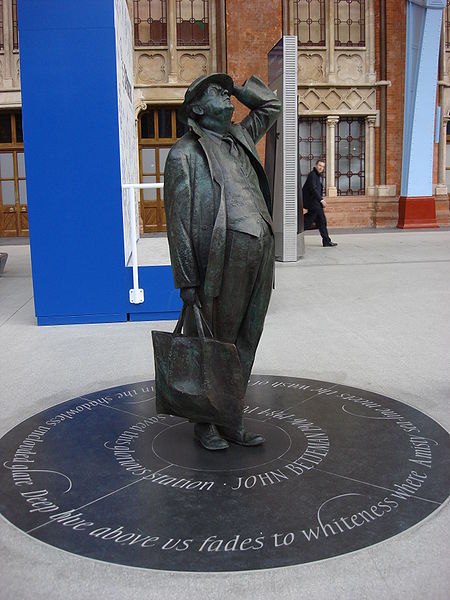
John Betjeman, I love you .
Wikimedia Commons, ILYT.
Why a statue? If you care to argue for some other form of public art, go ahead, but I have my heart set on a representational and recognisable statue, not an abstract reference to her such as a pile of books. Don't get me wrong; I like some pieces of conceptual art very much, but not for this project. Mary on the Green, as a group, has no official view on this; we want to give the artists a free hand and see what they come up with. But I know where my campaigning energies, such as they are, lie.

And why Newington Green? True, there are many other locations associated with Mary, including quite a few in central London (her birthplace in Spitalfields, her garret on the South Bank, her publisher at St Paul's, her chipped teacup lodgings in Bloomsbury, her happy last months in Somers Town and St Pancras). Newington Green was where she lived as a young woman, with her beloved. She arrived an unknown and unpublished schoolteacher; she left a couple of years later, having had her world enlarged by hanging out with well-read, high-minded, hard-working neighbours. Most of them were Rational Dissenters, associated with the little chapel of which Richard Price was the minister. That great and gentle man was kind and generous to her, as was Mrs Burgh, widow of an educationalist, and truly a fairy godmother to Mary. The chapel still says Newington Green Unitarian Church, and is still radical - in fact, it has just rehung on the outside railings the banner that says Birthplace of Feminism (in Mary's honour, and in place of the previous one, 300 Years of Dissent). So Newington Green has a strong claim to Mary.

But the reason that this part of London, as opposed to any other, is going to become the world centre of pilgrimage to Our Lady (this is my blog; let me dream) is because some twenty-first century neighbours care enough to make it happen. I have written before of the formidable team of the Newington Green Action Group, who brought the green itself back to life within the last decade, and who now wish for a cherry atop their cake. NGAG has registered charity status, elected officers, a bank account, a track record, contacts across the borough, kosher paperwork, the whole lot. Mary on the Green had a soft launch of sorts on International Women's Day, with the unveiling of the council's un-blue plaque to Mary, high up on Newington Green Primary School, followed by a children's choir in the church, from that school. We got our letter in the Guardian, signed by all those peers and MPs. (Stop! I'm having flashbacks of those hundreds and hundreds of hideous handmade emails. I've been trying to block it out. More absinthe, please)  The Mary on the Green website went live: cannily and simply maryonthegreen.org. I appeared on Woman's Hour and Jenni Murray called me "besotted". That was half a year ago.

In the intervening months, Mary on the Green has been solidifying its structure and plotting its big splash of publicity to entice the money. The former is fairly dry and tedious, but of course necessary: laying the groundwork so that the best, i.e. most suitable, artist and art work will be chosen. What are the criteria for the sculpture? What needs to go into the brief? Who gets to choose the long list, the short list, and the successful candidate? Has anyone thought about pigeonshit and vandalism? (The art world isn't all canapes, I can tell you.) The attention-grabbing splash is rather more juicy. I can't say too much just yet, but think HP sauce, not ketchup!

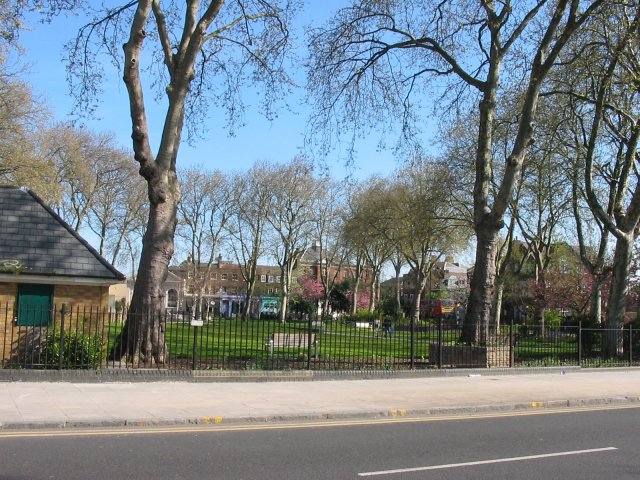
Photo of Newington Green by Vicky Ayech. Photo of bottles by Jonathan Brodsky. 
Both CC-BY-2.0 (www.creativecommons.org/licenses/by/2.0) via Wikimedia Commons 

Saturday, October 8, 2011

Hidden photomontage in Bradford

If you missed "Mary Wollstonecraft and the Newington Green Dissenters, 1784" when it was at the Museum of London, fear not! Hidden, the magnificent series of photo-montages by Red Saunders, is up once again. This time it is at the Impressions Gallery in Bradford, the other side of Yorkshire from Beverley, where Mary spent happy childhood days (and fell in love with Ardent Jane and her library).


Here is our previous post about Hidden, and the artist's thoughts on the history not taught at school.


PS And there's an article by Paul Furness in the Socialist WorkerHidden: Illustrating the secret history of workers’ resistance, describing Mary wearing her rosette for the French Revolution.  He also lists three new photomontages: Captain Swing, the agricultural riots in the 1830s; Hilda of Whitby,  a 7th century nun "who insisted that girls had as much right to education as boys", and:

Then we meet the Grindletonians. These were mainly women from the Yorkshire Pennine village of Grindleton who challenged the accepted world view in the run up to the English Civil War. They argued that a new way of living was possible in this old world if only the people living in it would seize it back from those who run it. 

The picture shows a gathering of radical soldiers and villagers seated together in a clearing at dusk. They listen intently to a woman who tells them that a new world is not just possible but is within their reach if only they would stand up as one and take it.It was little gatherings like this that mushroomed into the Civil War—in fact a revolution where the king’s head came off.

Image kindly provided by Red Saunders.

Saturday, September 17, 2011

London Open House

This weekend is the wonderful architectural festival known as London Open House. One of the many treasures open free of charge to the public is Newington Green Unitarian Church, where, as last year, I was delighted to show visitors around, and tell them about Mary Wollstonecraft's life-changing time here. This is the church that radicalised England's first feminist! Dozens of people made the pilgrimage today, to sit in her pew and soak up the atmosphere of the chapel that changed the world. (A riff on the little history produced by Newington Green Action Group, The Village that Changed the World.)

Mary had a couple of crucial years in early adulthood with the Rational Dissenters of Newington Green. (Red Saunders has conjured up a photo-montage of Mary and the Dissenters, and James Hobbs has drawn charming sketches of the church and the house of Mary's mentor Richard Price.)  Was Mary a Unitarian? In affiliation, she and her contemporaries would have said not; but in her writing, it is easy to see her as one. She expresses views about the Divine and Nature that could fit into many a modern Unitarian sermon -- not to mention her revolutionary social perspective.

Tomorrow, the chapel is again open to all comers, 1:30 to 5pm. In addition, services are held on most Sundays at 11am (though not on Sept 18 - check here first), and if you get there early, you too can sit in Mary's pew.

[Addendum: one of the visitors was Cherry Potts, Writer, who came not only to admire the pews' rare ball hinges, but to pay her respects to pew 19, confessing to "a soft spot" for Our Mary.]

[PS2: I am told the total number of weekend visitors was 212.]

Monday, July 4, 2011

Rev Dr Richard Price and the American Revolution

By DevinCook [Public domain],
 via Wikimedia Commons
Happy United States Day! Mary Wollstonecraft never made it to the unshackled colonies, but for some time she yearned for the frontier, her heart full of Gilbert Imlay, her faithless lover, and her head full of Richard Price, "whose talents and modest virtues place him high in the scale of moral excellence". We looked before at A Vindication of the Rights of MEN, her swift response to Edmund Burke's attack on Price, and the respect in which she held the minister of the Dissenting community where she had settled. Yesterday, at the beginning of this week with a focus on the USA, we looked at Lyndall Gordon's explanation of why Mary was so drawn to that country. In brief: because the birth of this nation in the New World represented a fresh beginning, not merely personal, but political in all possible senses. In fact, I might say "one small step for (a) man, one giant leap for mankind". For womankind, it remained to be seen, but the optimists saw reason for hope. 

"Remember the ladies," Abigail Adams had written to her husband John in 1776, when he was assisting in the drafting of the constitution. (Then he had been a congressman; they moved to London when he was appointed ambassador; by the time Mary was in Paris, Adams was vice-president, and from 1797, president.) The Adamses, and many others associated with the United States, went to hear Price preach. People flocked to the sermons of "this respectable old man, in his pulpit, with hands clasped, and eyes devoutly fixed, praying with all the simple energy of unaffected piety; or, when more erect, inculcating the dignity of virtue, and enforcing the doctrines his life adorns" (as MW says as she begins her rebuttal to Burke). In his home and church she might have bumped into:
Founding Fathers of the United States such as Benjamin Franklin, Thomas Jefferson, and Thomas Paine; other American politicians such as John Adams, who later became the second president of the United States, and his wife Abigail; British politicians such as Lord Lyttleton, the Earl of Shelburne, Earl Stanhope (known as "Citizen Stanhope"), and even the Prime Minister William Pitt ; philosophers David Hume and Adam Smith; agitators such as prison reformer John Howard, gadfly John Horne Tooke, and husband and wife John and Ann Jebb, who between them campaigned on expansion of the franchise, opposition to the war with America, support for the French Revolution, abolitionism, and an end to legal discrimination against Roman Catholics; writers such as poet and banker Samuel Rogers; and clergyman-mathematician Thomas Bayes, of Bayes' theorem.
(This is from the biography of Richard Price on Wikipedia, minus the profusion of distracting links; I have no embarrassment in sharing my passion for education and freedom.) We know that he influenced her thoughts on religion, and we can debate whether or not she was a Unitarian, but what is equally intriguing is her political development while at Newington Green. She was surrounded by stimulating thinkers who took women and education seriously; they lent her books; they included her in their social circles and conversations. Rev Price was particularly kind to her, but so was Mrs Burgh, and so were others. The whole atmosphere of the village was one of high-minded Dissent. During the decade before she arrived there:
Price turned his attention to the question of the American colonies. He had from the first been strongly opposed to the war, and in 1776 he published a pamphlet entitled Observations on the Nature of Civil Liberty, the Principles of Government, and the Justice and Policy of the War with America. Sixty thousand copies of this work were sold within a few days; a cheap edition was soon issued which sold twice as many copies; the pamphlet was extolled by one set of politicians and abused by another....it is said that his pamphlet had no inconsiderable share in determining the Americans to declare their independence.
 
A second pamphlet on the war with America, the debts of Great Britain, and kindred topics followed in the spring of 1777. His name thus became identified with the cause of American independence. He was the intimate friend of Franklin; he corresponded with Turgot; and in the winter of 1778 he was invited by Congress to go to America and assist in the financial administration of the states. This offer he refused from unwillingness to quit his own country and his family connections. In 1781 he, solely with George Washington, received the degree of Doctor of Laws from Yale College.
(Source, ditto; stripped, ditto.) So Mary Wollstonecraft was primed with these arguments when she met Gilbert Imlay. Lyndall Gordon wants to give him a more rounded portrait, to give us a better sense of why Mary fell so hard. He was
the writer of a respected book on the frontier and ...an upholder of values Wollstonecraft shared: an abhorrence of slavery and militarism; a regard for native Americans; and sympathy for women trapped in a marriage contract that denied them basic human rights.
By the time Mary Wollstonecraft came to womanhood, the American Revolution was in full swing. In her 20s, political attention swung also to the fires in Ireland (which she had helped to stoke, in the tiniest way, via her pupil Margaret King); in her 30s, the 1790s, the eyes of those longing for liberty were on Haiti and France.  The righteousness of the cause of the American colonists was taken for granted in the circles in which Mary moved.  Had Imlay proved more steadfast, in all likelihood the couple would have moved to the United States, where she would have carved out a name and a future for herself on unploughed soil. But he was who he was, and so she jumped off the bridge and searched for treasure in Scandinavia and became the grandmother of Frankenstein, none of which would have happened otherwise. What if, what if. We are where we are.

So, poised somewhat halfway between our celebration of Canada Day and next week's French commemorations, once again: Happy Fourth of July!

Image: Betsy Ross 1777, By Jean Leon Gerome Ferris (1863–1930) [Public domain], via Wikimedia Commons

Friday, April 1, 2011

Hidden photomontage at Museum of London


With the kind permission of the artist himself, Red Saunders.

I wrote previously of the large photomontages of Red Saunders, at the Museum of London until 6 April. Mary Wollstonecraft and the Dissenters of Newington Green is the fourth in the series Hidden, and was added only a couple of weeks ago to the three that had been hanging in the foyer since November: Wat Tyler and the Peasants' Revolt, very bloody, like a full-stage production of Macbeth; Tom Paine, alone on horseback in the woods and looking quite the gentleman; and William Cuffay and the London Chartists 1848, a huge set piece like a Renaissance history painting, of an organising committee that led to the extension of the (male) suffrage. 

Saunders describes his work on his site, Red Dog:

Red calls HIDDEN a photographic 'chamber epic' (a description suggested by the playwright Trevor Griffiths) which recreates events in the long struggle for parliamentary representation and democracy in Britain. Not the history of Kings and Queens, but of the 'Hidden' neglected scenes of working class history. This was no smooth gradual transition; many actions in this long struggle were of life and death intensity, as working people fought for their rights while struggling to keep alive the history made by mass movements of dissenters, non conformists, radicals and revolutionaries.

Museum of London foyer. Thanks, Chihiro!

Mary Wollstonecraft and the Dissenters of Newington Green, or, for shorthand, Mary on the Green.....There's a snapshot of the day of the January shoot, a few of the models chatting while they wait outside the Geffrye Museum, on the winter-green lawn embraced by the arms of the almshouses. Roland Denning put together a Vimeo video -- actually a four-minute slideshow with a voiceover consisting of general explanation and interviews with several of the key players, most notably Red himself.

The photomontage is available on the Geffrye Museum site as well as the Museum of London one (but MoL has broken the link, let's hope temporarily, with their website redesign). Looking at the image, I see what Deyan Sudjic, director of the Design Museum, means when he refers to the "painterly quality" of Red's work. 

Hidden has been reviewed, and Saunders interviewed, by the Camden New Journal (Picture perfect snapshots of English history) and the Socialist Worker (History you don't learn at school). Tony Benn is a patron of the project, which works primarily with volunteers. There's a Facebook group to sign up to, if you wish to keep informed, and possibly volunteer for a future shoot.

Many thanks to Red for coming through with the image file today, thanks to Chihiro for her on site inspection, and a hat tip to Sophie Woolley (@Mrs_Evil) for alerting me on Twitter to the arrival of the image in situ.

Sunday, March 20, 2011

More visual delights

Mary Wollstonecraft did venture beyond (what is now) North London, and this coming week over the next several Wednesdays I'll be exploring some of those connections. However, to round off this past fortnight's focus on Newington Green, here are two sketches by the kind permission of James Hobbs (www.james-hobbs.co.uk). I've never met the man, but his style of gentle colour and clarity appeals to me, call them grown-up architectural cartoons, and the next time I am near the Oxo Tower on the South Bank, I intend to pop in to Skylark Gallery and see what he has hanging there.

I like how the image focuses on the church building, but those in the know can positively smell the Belle Epoque patisserie next door, under the awning. James has work hanging there too, but do beware if you enter the building -- you won't be able to leave without having eaten something too good to be good for you.

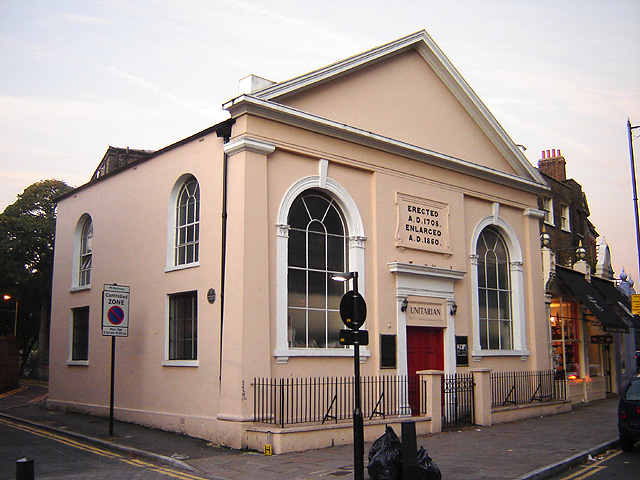
The pastry shop wasn't there in the 1780s, of course; I wonder what was? The church was the centre of its community then, but it looked rather different. On its front now it bears the inscription "Erected 1708. Enlarged 1860", a phraseology that's the source of many adolescent chuckles. Aside from the Victorian schoolhouse, which is attached to the back and thus invisible in the sketch, the front was altered, so Mary would have seen the same building in a simpler guise. And in her day it didn't have a banner proclaiming "Birthplace of feminism".


I suppose that label could equally well apply to the house of the minister, Dr Richard Price, one of the few Dissenters who could get away with preaching support for e.g. the American Revolution, and yet still have the ear of the king's men -- in his case, for his work on economics and statistics. His hospitality, and the warmth with which he supported Mary, are well known. He lived for decades on the west of the Green, in what was even in his day a 100 year old building, now the oldest brick terrace in London. Wouldn't it be wonderful if Dr Price's house could become the location for the Mary Wollstonecraft Museum, or Women's Leadership Centre, or Human Rights Academy? You heard it here first...


[Update: James writes about Mary and Newington Green on his blog here.] [Another update: I've never even met James, but I congratulate him on getting his works onto five uber-London notecards to be distributed worldwide. Thanks, IKEA.]

Thursday, March 17, 2011

A feast for eye and mind

No, not just Mary Wollstonecraft herself, delectable though she no doubt was. The visual and mental feast I refer to is the latest in a series of magnificent photomontages by Red Saunders. This cleverly composed image of the Rational Dissenters of  Newington Green features a group of women, with Mary in the centre, and two men, presumably Dr Price --and Friendly Church, perhaps? The church is behind them; the brick terrace where the minister lived has been digitally extended beyond its wildest mid-seventeenth century ambitions; the green is free, or bereft, both of children's playing equipment and lowing cattle.

It is one of several large photo/compositions, collectively called "Hidden",  and will be on display in the foyer of the Museum of London until 6 April. I sincerely hope that the collection will remain on the website indefinitely.

Here is the image of Mary, and here the Museum's general explanation of what it calls "tableaux vivant":
"Hidden" engages with a different historical narrative involving dissenters, revolutionaries and radicals. Red Saunders combines his photographic practice with cultural, artistic, musical, and political activism.  He said, "I recreate important moments in the long struggle of working people for democracy and social justice. History has been dominated by kings, queens, war and ‘great men’."

Sunday, March 13, 2011

Plaque is well and truly unveiled

The Islington Tribune came through with a good article here entitled "Mary Wollstonecraft gets a green plaque at Newington Green Primary... will statue be next?" The plaque was commissioned by Islington Council, whose page on it is here.

A plaque is all very well and good, but there must be a reason why I Freudianly slip-type it as "plague" instead. A plaque is a sort of holding point. Wollstonecraft deserves a proper statue, hence the committee to make it happen, Mary on the Green. Beyond that, what about an institution in her name -- a girls' school in Afghanistan, a women's leadership institute, a museum, possibly in Richard Price's house on Newington Green. (There is an inspiring example of a cluster of modern initiatives around an early feminist: in Rochester, New York, where Susan B. Anthony lived and worked. More on them another time.) And beyond a statue and institution: a full-monty biopic -- Mary, the Movie.

There are several plaques to Mary in London. None are Blue Plaques; English Heritage is very strict about their criteria, and there are no buildings still standing in which Mary lived or worked. In 2004, biographer Claire Tomalin unveiled a plaque in Southwark near Blackfriars Bridge (warning: it appears blue to the casual viewer, but this may be an illusion). Why there? Because from 1787 Mary lived on George Street (now Dolben Street), and the plaque is on number 45, "a 20th-century building but Thompson House next door would have been known" to her. While there, she wrote Original Stories, with William Blake as its illustrator. Shelley lived nearby in Nelson Square some years later, where he has his own plaque. 


There is a plaque on the site of the Polygon in Camden, her final home, and thus the birthplace of Mary Shelley. There are those odd gates at Spitalfields. There is the Mary Wollstonecraft Lecture Theatre at Bournemouth University and the Mary Wollstonecraft Memorial Lecture at the University of Hull. Any more examples would be gratefully received, but I'm not expecting a flood.