Showing posts with label event. Show all posts

Sunday, June 30, 2013

The Two Marys, in more radical company

The two Marys, mother Wollstonecraft and daughter Shelley, are to meet in conversation this week, at the radical booksellers of Kings Cross. Joseph Johnson will doubtless be there in spirit, at Housmans Bookshop at 7pm on Wednesday, peering around and reflecting on the changing face of publishing over the centuries.

The Two Marys: A Conversation Piece, accompanied by cello, were heard at the Camden Archive Centre in March; my review is here. They will be reprising the piece, which was first performed in the National Portrait Gallery on 14 September 1997, marking the bicentenary of the death and birth. The change of venue is apt, wrenching the pair from history to current politics. "For the fifth year running Housmans will be giving over our summer events programme to a season of talks and book events celebrating radical aspects of the capital’s social history." Have you ever visited Housmans, in bricks and mortar or online? (I believe they dropped the apostrophe when Kings Cross did.)

Independent bookshops struggle; Charing Cross Road now sells pizza and Chinese medicine; the Amazon river has deluged us all; but there's always a place for specialist booksellers, which invariably attract knowledgeable and passionate people as both staff and customers. From its website:
Housmans is London’s premier radical bookshop – it’s one of the last remaining such shops, as well as having been one of the first (originally opening in 1945). ... Whilst acknowledging its roots in the peace movement – and, specifically, in the radical pacifist end of the movement – it aims to be a broad-based, non-sectarian shop, encouraging the dissemination of a wide range of progressive and alternative ideas. As the shop’s founders recognised, opposing injustice and oppression and the degradation of our planet are prerequisites of a more peaceful society.
You may remember that we popped into Housmans, with the Japanese historian and the Swedish theatre designer. We had just found the Wollstonecraft plaque in Somers Town and were about to board the bus to St Paul's, where Johnson had his publishing house, on our quest for the plaque in Southwark. Kings Cross is handy for transport connections, and was so, even in eighteenth century.

From the official description of A Conversation Piece:
Two months after Shelley’s death, Mary Shelley fights off her anguish for the sake of her remaining child. She clings to her books: Shelley’s poems; the works of her father, the philosopher William Godwin; the feminist writings of her mother, Mary Wollstonecraft, who died shortly after giving birth to her.
In her despair, the young Mary pours her heart out in a letter to an English friend who was her mother’s first pupil. If only she could conjure up her mother from the past, if only she could speak to her for an hour...


Saturday, June 1, 2013

Reflections on Love

Today at Clare College, Sylvana Tomaselli speaks on "Reflections on Love in the political writings of Wollstonecraft". This concludes a two-day event entitled Cambridge Platonism: Reception and Influence. More information on the conference here and the speaker here.

Thank you, Cambridge and Arts and Humanities Research Council: it's free to attend. I note that once again Mary is getting an airing under a philosophical umbrella, as opposed to a historical or gender studies one. I think this bodes well for the future.

Tuesday, April 16, 2013

Claire Tomalin at the London Literature Festival

Claire Tomalin wrote her first biography in 1974. It was - no surprise - on Mary Wollstonecraft. Before that, she'd been a literary editor, but her success with The Life and Death of propelled her into a new career. She'll be giving a series of five lectures at the London Literature Festival this year on several of her subjects (Jane Austen, Samuel Pepys, etc.), concluding on 3 June with our heroine. 
Claire Tomalin concludes her five-part lecture series in the week of the Women's Prize for Fiction with a study of one of the great voices of the Enlightenment - Mary Wollstonecroft. 
Wollstonecroft died in childbirth in 1797 at the age 38, but in her short life she fired the opening shots in the long battle for sexual equality.  
Her 'Vindication of the Rights of Woman' made her famous throughout Europe. Her support of the ideas behind the French Revolution took her to Paris to see it in action.  
In her professional life as a journalist and writer, and in her turbulent private life, she laid out a pattern of difficulties, triumphs and sorrows that every modern working woman can recognise.
Such a difficult name to spell.  The title contains the same error, which means anyone searching through the database risks being stymied by software telling them that there are no events about Mary Wollstonecraft. 

Tickets can be purchased here. I hope you have better luck with the South Bank computers than I did, when I was trying to plan my time at the Women of the World weekend. Good thing the launch of Fifty Shades of Feminism was in an unticketed space. 

Wednesday, April 10, 2013

A Brave Woman There Was...

Next week sees another intimate gathering, drawing on the life and works of Mary Wollstonecraft. Truly, London is overflowing with remembrances. Again, three performers; again, words and music; again, a Camden library. But all else is different.

This is billed as "an encounter with Mary Wollstonecraft":
The show has three phases. First you will hear extracts from the Original Stories for Children and meet one of the great, though lesser known, characters of English literature, Mrs Mason. 
Hooray for this long-lived Lost Daughter, who started life as Margaret King, Mary's doubly rebellious charge during that dire year of governessing.
The scene then moves to Paris, during Mary’s stay in France, and introduces you to another outstanding, though perhaps less widely known, feminist writer, Olympe de Gouges.  
Ah yes, Mary in France. Tumultuous years. Did these two ever meet? There is every reason to hope so - certainly they moved in overlapping circles - but, as far as I know, no hard evidence. If this encounter did take place, it must have been in the first half of 1793; Wollstonecraft left Paris in June for a few months, and de Gouges was arrested in August, I believe. 
Finally we see Mary at her birthday tea, formulating ideas for her “Vindication of the Rights of Woman”, despite some hindrance from a male visitor. 
And who might that be, I wonder? Talleyrand or Godwin? Either way, I expect they get served wine in a chipped teacup.
Nearly all the script consists of the words actually written by the two women, but presented in dramatic form. 
That is much the same approach as last month's The Two Marys: A Conversation Piece, also at a Camden library. The borough has a claim on her (via The Polygon, within Somers Town, and St Pancras). 
Most of the music dates from the period.
Just like the birthday concert!

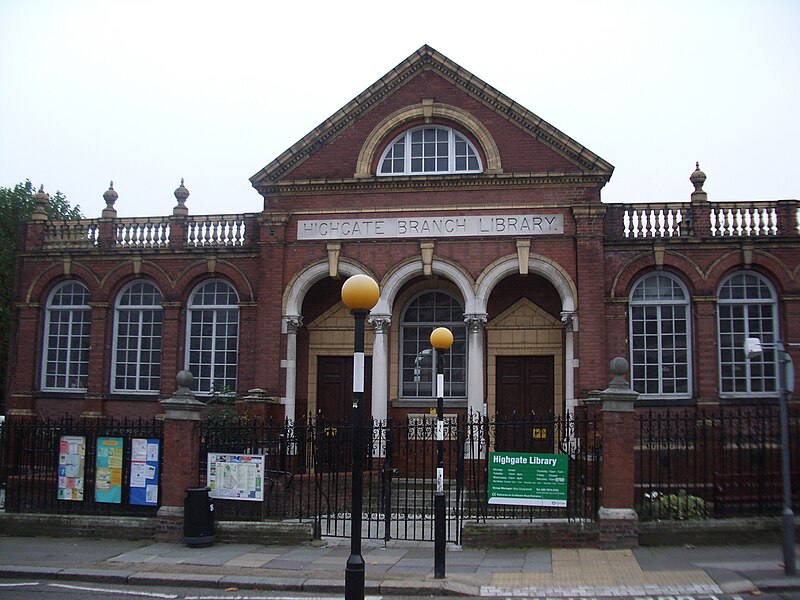
I'm not sure whether Mary Wollstonecraft spent much time in Highate, then a village as distant from London as Newington Green, and more difficult to get to, in that the muddy hills were worse. Still, in the years since then the good burghers of Highgate have taken advantage of Mr Macadam's tar, and the roads are quite passable these days.

If you are free next Thursday, why not visit Highgate Library? 18 April, 7:15 for 7:30pm.


************************************************
Photo by Justinc. Used under the 
Creative Commons Attribution-Share Alike 2.0 Generic licence.


Wednesday, March 20, 2013

London immortals

There is no statue to Mary Wollstonecraft anywhere in the world. There is, however, a sprinkling of public memorials to prominent women in central London. The local chapter of United Nations Women organised a walking tour of half a dozen of them last Saturday. Despite the persistent rain, a goodly crowd assembled, including a pair of self-possessed twelve year olds. Each statue had its designated champion, telling us about their chosen person, from national heroine to forgotten obscurity. Here is the group, listening to the story of Edith Cavell, at the impressive memorial outside the National Portrait Gallery. I even found the opportunity to expound for the benefit of Mary on the Green.

The walk started in Bloomsbury at Tavistock Square, wandered via Lincoln's Inn Fields to the Strand, along to Trafalgar Square, then Pall Mall and Whitehall and finally Parliament, a satisfying circuit through literary, legal, and legislative London.

The full list was:
Louisa Aldrich-Blake (1865-1925), the first female surgeon in Britain.
Virginia Woolf (1882-1941), a writer at the forefront of British Modernism.
Margaret MacDonald (1870 – 1911), a feminist and social reformer. 
Edith Cavell (1865-1915), a pioneering nurse more famous for her death. 
Florence Nightingale (1820-1910), not only a pioneer of nursing but also of statistics.
Women in World War II, the only sculpture not of a specific person. 
Emmeline Pankhurst (1858-1928), the leader of the suffragette movement. 

There are others: Time Out lists Violet Szabo and Sarah Siddons. The labour of love that is London Remembers provides endless browsing fascination; here's their page on the military monument. And the Victorian Web is very good between 1837 and 1901, as e.g. with Florence Nightingale

I've spent ages and ages making a Google Map, Statues of prominent women, with links and everything. Do have a look


Sunday, March 17, 2013

A musical birthday


Mary Wollstonecraft's 254th birthday will be celebrated by Chorus of Dissent and the Elastic Band, "featuring music performed in London during her lifetime".

The venue is Stoke Newington, in her day a village known for its Quakers, just as Newington Green, where she had her school a mile away across the fields, was associated with the Rational Dissenters, now Unitarians. The difference is that Stokey was the centre of the Church of England parish: it had St Mary's. In the eighteenth century this was still the little medieval building, but the sprawl of the metropolis a century later necessitated the construction of a Victorian barn (unusually, directly opposite its predecessor). Now St Mary's Old Church is on the way to becoming an arts venue, and St Mary's New Church appears to be thriving.

The tickets have not yet been released, but pencil in 5:30 pm on Saturday 27 April 2013 for a "delightfully short concert from Stoke Newington’s very own choir and professional orchestra". We are promised "scenes from Handel’s Messiah ... juxtaposed with Haydn’s Creation, the whole presented in our inimitable and inclusive Dissenting style". And who are these singers?
Dissenters was set up by Ruth Whitehead to offer local, inclusive and excellent creative arts experiences, without one iota of dumbing down. Drawing on her background as a professional musician she set up Chorus of Dissent and the professional orchestra, the Elastic Band. All Dissenters’ events are sponsored by her company Ruth Whitehead Associates, your local investment advisers and IFAs.
Lots more about Chorus of Dissent on their website. Here's how they began:
The 21st Century Dissenters gathered under an urban apple tree in the garden of a Thomas Cubitt house in Albion Road, Stoke Newington London N16, to discuss following in the footsteps of the local nonconformist heritage. Shamelessly leaning on our distinguished history of freethinkers, philanthropists and artists, from famous feminist writer Mary Wollstonecraft to Champagne Charlie (musical hall artist George Leybourne), Dissenters London N16 came into being.

***************************
Photo of the two St Mary spires 
by Tarquin Binary via Wikimedia Commons, 
used under Creative Commons share-alike licence.

Wednesday, March 13, 2013

The Two Marys: A Conversation Piece

Last night saw an encounter between Mary Wollstonecraft and Mary Shelley, a rare one-off performance of The Two Marys: A Conversation Piece.  Sasha Hails played the mother, speaking with the wisdom of the afterlife, and Victoria Ross the daughter, still in the first grief of her widowhood in her mid-20s.

The setting was the very undramatic Camden Local Studies & Archives Centre. (The Centre is also hosting a temporary exhibition on historical religious buildings within the borough, some still extant, others demolished; this is exactly the sort of display that needs to be thoroughly preserved in the etheric afterlife. Roll on, digital humanities.) The Polygon, where Wollstonecraft spent the last period of her peripatetic life, and where her equally travel-hungry daughter began hers, lies within Somers Town, and of course St Pancras plays a key role for both writers, so Camden has a legitimate claim on them.

The two Marys were accompanied by David Cherniak's cello obligatto. The author herself was there: Judith Cherniak is an American long settled in London, who stamped her mark on the culture of the capital by setting up Poems on the Underground. (There's a celebration this Sunday at Keats House.)

I found the music mournful and the performance poignant. It begins with the young widow writing to Mrs Mason, her mother's former pupil who in turn offered maternal care to the Shelley entourage when they reached Pisa. (We've looked at before at this Lost Daughter, who started life as Margaret King.) She bemoans her fate and describes her distress, all alone without a friend in the world, or so it seems to her. The depths of her mourning embarrass those around her, both the English and the Italians. If only she could speak with the mother she never knew! And so the elder Mary arises from the chair in the corner, and approaches her daughter. They converse. They explain their lives to each other. They bond. And the audience sees the strong similarities between these strong women who never met.

Apparently the two-handed show first saw the light in September 1997, the bicentary of the Marys' birth and death, at the National Portrait Gallery. Wouldn't it be marvellous to put this on again? Maybe somewhere a little more atmospheric than the municipal library. Newington Green Unitarian Church, for example, site of the miraculous manifestation.

From yesterday's programme:
September 1822, Genoa
Two months after Shelley's death, Mary Shelley fights off her anguish for the sake of her remaining child. She clings to her books: Shelley's poems; the works of her father, the philosopher William Godwin; the feminist writings of her mother, Mary Wollstonecraft, who died shortly after giving birth to her. In her despair, the young Mary pours her heart out in a letter to an English friend who was her mother's first pupil. If only she could conjure up her mother from the past, if only she could speak to her for an hour...

Monday, March 11, 2013

Fifty Shades of Feminism

Mary Wollstonecraft inspired one of the entries in the newly released Fifty Shades of Feminism. "There's Something About Mary" is Bee Rowlatt's paean, and a taster of her book to come. On Saturday night, there she was at the Clore Ballroom in the Southbank Centre, being introduced by Sandi Toksvig. The readings were done in pairs: Bee read from the entry by Martha Spurrier, and the human rights lawyer returned the favour.
Mary Wollstonecraft was a woman so far ahead of her time that we are still living in her dust trail. She was a worldwide troublemaker, and a sea-faring single mother. 
The audience lapped it up. "What would Mary do?" is the new motto. 
The Virago website is (at time of writing) oddly unhelpful, but Amazon (for better or worse) has the regular description and GoogleBooks has what looks like a full list of contributors. Trusty Foyles was there on the Southbank spot, selling the elegant grey hardback. Behind the stage curtains, the contributors were all signing each others' copies.

The Women of the World festival, a three-day extravaganza over the past weekend, was definitely the biggest and glitziest of those events we rounded up for International Women's Day. But the others were good too, and there is still the sculpture walk to look forward to on 16 March.

********************
Photos: the top one is from gracious activist Kamila Shamsie.  Apologies for poor resolution, but the atmosphere is clear. "Bee with tea" is courtesy the author herself.

Thursday, March 7, 2013

A London confab of philosophers

The end of May will see a one-day symposium on The Social and Political Thought of Mary Wollstonecraft, hosted by that very special constituent of the University of London, Birkbeck College, "a world-class research and teaching institution, a vibrant centre of academic excellence and London's only specialist provider of evening higher education". Best of all, the event is freely open to everyone. Thursday 30 May, 9am to 5pm: mark your diaries now. Its description: 
Mary Wollstonecraft is by any accounts a remarkable and versatile thinker. Long appreciated as an inspirational and visionary feminist, she was also a noted historian, travel writer, educator, novelist and activist. Only recently, however, is she being rediscovered as an important and innovative philosopher in her own right, and one who deserves to be studied and understood not only as a product of her time, or through the canon of male writers who influenced her, but firmly on her own terms.
The papers in this symposium explore Wollstonecraft’s ideas both in relation to other female writers of the period and as providing valuable insights into issues of contemporary political relevance such as the nature of rights and the accommodation of cultural diversity.
The event brings together several of the speakers at the 220th anniversary of the publication of A Vindication of the Rights of Woman, including Sandrine Berges, our first guest blogger. Also present a year ago at Mary Wollstonecraft: Philosophy and Enlightenment was Lena Halldenius, its organiser, who very kindly invited me to the official dinner, and Alan Coffee, the London philosopher whose interest in MW is matched only by his interest in Frederick Douglass (and thereby hangs a tale). Martina Reuter was at Lund as well, and Barbara Taylor and I shared the Woman's Hour hotseat two years ago. The speakers:

Sandrine Berges (Bilkent University): Wollstonecraft and Sophie de Grouchy
Alan Coffee (King’s College London): Diversity and the Virtuous Republic
Lena Halldenius (Lund University): Wollstonecraft and Representation
Susan James (Birkbeck College London): Wollstonecraft and Rights
Martina Reuter (Jyvaskyla University): Wollstonecraft’s Critique of Rousseau
Barbara Taylor (Queen Mary): Wollstonecraft and Modern Philosophy

Wednesday, March 6, 2013

A round-up for International Women's Day

Time for a round-up of International Women's Day events that feature Mary Wollstonecraft.

There's "The Two Marys: A Conversation Piece", created by American writer Judith Chernaik, founder of Poems on the Underground. This one-off performance is sponsored by Camden Council, representing the place that embraced the end of the mother's life and the beginning of the daughter's. In a neighbouring borough there is a multifaceted celebration with a lot of music and an hour on Mary Wollstonecraft, by historian Clare Midgley, performance academic Anna Birch, and myself, reprising my IGNITE story-telling. That's organised by the Islington Unitarians in their post-Blitz hidden edifice on Upper Street. Their sister congregation in Newington Green, the church that nurtured Mary as a young schoolteacher, will be opened for the beginning of the Feminist (Or Is It?) walk by Hackney Tours. Simon Coles has chosen to offer the event as a fundraiser for Mary on the Green, the campaign for a statue, as has Hilary King, who is running an Alexander Technique taster session that afternoon. Stand tall, Mary Wollstonecraft fans!

Most of these are listed on Internationalwomensday.com, the corporate-sponsored "global hub for sharing International Women's Day news, events and resources". (Banner ad: "Discover BP's feminine side".) They provided the logo above, and straplines such as "The advancement of women is of prime importance to the economy, business and society. The support of corporate organisations supporting women is critical." I would argue that the support of copy editors is also critical, but I digress....

There are well over 1000 events on the IWD database, with more still being added; hundreds are happening in Britain. The search facility seems to be broken, so I can't see if any others list Mary Wollstonecraft as an inspiration, but one that intrigues me is a walking tour of "sculptures of remarkable women ... from Louisa Blake to Emmeline Pankhurst", led by the UNWomen UK London Committee:
We are the local representative, voice and champion for UN Women (formed in January 2011 from the amalgamation of UNIFEM and three other UN gender bodies) and support the work of UN Women in its mission for gender equality and the empowerment of women.
If only the tour could end up at a commemoration of England's first feminist!

Perhaps the most significant event will be the launch of Fifty Shades of Feminism, a compilation brought together by Lisa Appignanesi, Rachel Holmes and Susie Orbach. It features a chapter entitled "There's Something About Mary" by none other than Bee Rowlatt, no stranger to this blog. The launch is part of the three-day extravaganza on the Southbank, WOW, the Women of the World festival. Sometimes there are good reasons to love London.

Last year for International Women's Day I wrote on the importance of education and on maternal mortality, in the eighteenth century and now, here in the Wealthy West but also in the Wider World. The year before that, on the 100th anniversary of IWD, Mary Wollstonecraft got yet another non-blue plaque, situated most fittingly on a school. Islington Council was behind that nod of appreciation.

If you need more inspiration, have a look at these wonderful posters for IWD 2013.

Monday, August 13, 2012

A talk in the middle of England

A month from now is a talk from Lyndall Gordon on Mary Wollstonecraft: First of a New Genus.

When? September 11, 7pm.

Where? The Stony Stratford Library. Where?? It's one of the little towns swallowed by Milton Keynes. And its appeal?
Welcome to the community website for Stony Stratford. We offer FREE parking and 5* Loos so please come and visit us soon.
NB the site is run by the council. I found a picture of the pleasant-looking high street, but for some reason it won't load; you can have a look at it if you like.

More info on the talk here. It's free, but ticketed, and run by Friends of the Library, who provide cake and wine. And, no doubt, five-star toilets.

Wednesday, March 28, 2012

Learn with Lyndall Gordon

An Oxford study day near Mary Wollstonecraft's birthday. Ironic that she does not really appear in the title -- Revolutionary Lives: the Godwins and the Shelleys. Biographer Lyndall Gordon, whose talk on Mary and the Unitarians I attended in May 2011, will be presenting 75 minutes of "A New Genus". The day, Saturday 28 April 2012, recapitulates the quadrille played out in the exhibition at the Bodleian, Shelley's Ghost (aka Our Mary, Her Husband, Their Daughter, and the Tousle-hair'd Poet), which I visited with Chihiro Umegaki, and which has recently been rehung at the New York Public Library

Sunday, March 11, 2012

In her footsteps

There's another walk featuring Mary Wollstonecraft, this time around the area where she spent her last few years, when she took little Frances and set up home with William Godwin in the parish of St Pancras, in an area of Camden now known as Somers Town. This walk is called All Change at Kings Cross* and is led by Rob Smith of Footprints of London. It takes place on Sunday 25 March from 11am to 1pm and costs £10, or £7.50 concessions; Rob has promised to make a donation to Mary on the Green. It covers:
the history of the area, looking at the existing buildings and what is planned for the future. You'll hear how Kings Cross kept London supplied with food and the areas links with the Beatles, the Olympics, Frankenstein and the French Revolution as well as many other stories.
I've catalogued my previous walks, starting in St Pancras and progressing to Somers Town, via St Paul's and Southwark, with many more waiting in the wings: Bloomsbury, Barking, Spitalfields, and of course Newington Green.

The little church at the head of the village green was the final point for last Sunday's walk with Simon Cole of Hackney Tours. (I love the page on its ethos - how many tour companies have one of those?). This walk is called "Feminism, fame & infamy: How Hackney women have shaped our world" and makes very specific reference to Mary Wollstonecraft. He led this tour on the Sunday before International Women's Day, donating half the fee to the sculpture campaign.

--------------------------

Thursday, March 8, 2012

IWD: education above all

Mary Wollstonecraft was above all an educator, and her Vindication of the Rights of Woman is a plea for good education. We have free education for all - the battle has been won. Right? In honour of  International Women's Day, yesterday we looked at maternal mortality, i.e. her death, and today we turn our attention to girls' education, her life, because the struggle continues, not only globally and but also right here in her heartland.

Education in the eighteenth century is perhaps better understood now by the word "upbringing"*. Mary Wollstonecraft worked as a teacher and a governess, set herself up as the proprietor of a boarding school, and cut her writer's quill on pedagogy. Her first book, Thoughts on the Education of Daughters, was aimed squarely at fellow educators, parents and teachers both; her second, Original Stories from Real Life, was intended to be used with children. Later she compiled A Female Reader, just in the nick of time for the Austen girls' home schooling.


A Vindication of the Rights of Woman is predominantly an educational treatise -- after all, she was responding in part to Talleyrand's proposals for the education system of the new France. Gladstone read and annotated her magnum opus, and re-read it in the years of the British debate over the establishment of national education. She is credited as one of the first educationalists to call for all classes and both sexes to learn together in their first years. Here's an excerpt of what she thought on the subject.

Aside from her writings, she inspired others on a personal basis too: her employer dismissed her from her post as governess after a year because her pupils loved the visiting Englishwoman more than they did their own mother. (This aristocrat was the very model of Lady Bertram, lapdogs and all - more proof that Jane Austen was a Lost Daughter - and the eldest girl, Margaret King, went on to be quite the rebel herself, even naming her final incarnation in honour of her inspirational governess.)

So why do we need to be concerned with girls' education now, when they often outperform the boys? Two reasons: one here in the Wealthy West, and one in the Wider World. In all the English-speaking countries I know, girls and young women still tend to avoid the subjects that can lead to lucrative and engaging careers. Remember "Math is hard. Let's go shopping!" brought to you by the Barbie Liberation Organization? (The culture jamming reached the New York Times, while the resulting snowclone is tracked down by Language Log.) Look at this 2010 report from the Institute of Education: Bright girls less likely to want to study maths and physics at A-level than bright boys.

The second is that no woman is an island. Many children around the world do not complete a basic education; most of those are girls. Take Pakistan as an example - a country with strong ties to Britain, not least in that a substantial number of British schoolchildren have roots there. Statistics from its Ministry of Education (the date isn't clear, but probably around 2002) state that the male literacy rate was 61% - pretty bad. And the female? 37%. "Left out/ out of school children": 5.5 million. NB not disaggregated by gender, but you take a guess. That country is one of many where girls don't get the beginning of a chance at a fair education, and this has multiple ramifications.

As I say to both men and women, if you were raised by a woman who could read and work and vote, you owe something to Mary Wollstonecraft. It is salutary to remember that many girls and boys around the world do not have the privilege of an educated mother.

If you want more information, just released is the very resource: The UNESCO World Atlas of Gender Equality in Education (i.e. gender inequality). There's the United Nations Girls Education Initiative too. And again - this eclectic collection of IWD 2012 posters.  

---------------------------
Logo from Education International"the world's largest federation of unions", 
representing "organisations of teachers and other education employees across the globe".
*A line from the recent Montreal film Monsieur Lazhar stuck. The uptight parents of an uptight pupil are speaking to the eponymous teacher: "We would rather you concentrated on teaching our daughter; we will bring her up." 
Enseigner vs. eduquer.  French preserves the wider meaning that English has largely lost

Wednesday, March 7, 2012

IWD: maternal mortality

International Women's Day is celebrated on March 8 every year. What would Mary Wollstonecraft make of it? Last year was its 100th anniversary, and so it got more of a media splash in the UK than it has done for some time. 2011 also saw the unveiling of the most recent plaque commemorating a place where "England's first feminist" lived or worked. This year, again, there is a corporate-sponsored website aiming for comprehensive coverage of events. (They do things differently in France.) Let's focus on two themes: maternal mortality and girls' education. Today, the first.

Mary Wollstonecraft died in childbirth. Two graphs "about this cause of avoidable mortality in women", pulled together by Ben Goldacre, the doctor who likes statistics, famous for his Bad Science columns, blog and books. One is the UK, 1880 to 1980. The other is international, 2005. Do you want to guess the worst time and place? It was about three times as bad in Afghanistan a few years ago as it was at its iatrogenic peak in the UK in the 1890s. With adjustments for population: for every woman who dies in childbirth in El Salvador, more than ten die in Afghanistan. For every woman who dies in Canada, more than twenty die in El Salvador. Logarithmic scales of difference, in our world, here, today. Almost a thousand women die every day of pregnancy-related reasons, according to Women Deliver. I'l repeat that, louder: A THOUSAND DEATHS A DAY.

Ruth Franklin, stimulated by the arrival of Shelley's Ghost in New York, asks in The New Republic if Frankenstein was really about pregnancy and childbirth. It's not a novel argument. A cursory acquaintance with a few biographical facts makes it evident that, as she puts it, "not only was Mary Shelley pregnant during much of the period that she was writing Frankenstein, but she had already suffered the birth and death of an infant." A later miscarriage brought her close to death. What Franklin doesn't explore is the impact of motherlessness (or, conversely, that of the Wicked Stepmother) on young Mary. Had the obstetrician washed his hands, the world might have had decades more of paradigm-shifting political writing, but we would not have had Frankenstein. That is a book that could only have been written by someone who knew that her birth had killed her mother.*

The perils of maternity was not the lesson taught by Mary Wollstonecraft's life but that imposed on her legacy. The death of artistic creativity after childbirth, famously summarised by Cyril Connolly as "the pram in the hall", was supposed to be so much worse for women. Instead of one type of creativity feeding the other, they were seen to cancel each other out. There was no point in educating girls, because they disappeared into multiple motherhood, or died in the effort. Or they went mad - the wandering womb - The Yellow Wallpaper. The lucky and exceptional ones, exceptionally educated, could aspire to become men, like Elizabeth I.

The lesson explicitly taught by Mary Wollstonecraft was the value of education. Tomorrow, on International Women's Day itself, we'll explore what that means in 2012. In the meantime, for inspiration, check out this eclectic collection of IWD 2012 posters.  

---------------------------
Logo from Education International"the world's largest federation of unions", 
representing "organisations of teachers and other education employees across the globe".
*This brings to mind "Each man kills the thing he loves." Happily married Oscar Wilde had his views on pregnancy too. 

Tuesday, February 28, 2012

Mary & Mary on stage, on tour

Here's a new play entitled Mary Shelley, with - it would appear - an emphasis on that young woman's ghostly relationship with her dead parent:

Having lost her mother, feminist Mary Wollstonecraft, at an early age, young Mary finds comfort in reading the family memoir written by her father, the radical philosopher William Godwin. However, his free-thinking account of her mother’s suicide attempt, extra-marital affair and birth of her illegitimate elder daughter are regarded by society as shocking....Delving into Mary Shelley’s turbulent personal history this striking production sheds light on the life of a bold young woman....
(From The Morley Observer.)  However, the West Yorkshire Playhouse,  where Mary Shelley launches its "world premiere tour", doesn't mention Our Lady:
This powerful new play explores Shelley's remarkable life: her controversial philosopher father, her scandalous elopement aged 16 and how she wrote a novel, so radical in its ideology, that in 1817 she changed the literary landscape forever.
We shall see. The company is Shared Experience, the playwright Helen Edmundson, the director Polly Teale. Mary Shelley is a co-production between the company and the Nottingham and West Yorkshire Playhouses, in association with the Oxford one. It launches in Leeds from 16 March to 7 April, tours half a dozen cities, landing finally at the Tricycle in London 12 June to 7 July.

[Addendum: some thoughtful comments in an interview between Catherine Noonan and Polly Teale on "Female-led theatre in an imperfect world".] [And a review from la petite feministe anglaise, Sarah Graham.]


------------------------------------
Kristen Atherton as Mary Shelley.

Monday, February 20, 2012

Presidents' Day, Family Day

In the United States it is Presidents' Day*. In parts of Canada, it is Family Day**. What would Mary think? She preferred presidents to monarchs, and family to both. She made her own family in Newington Green, with gentle Frances and rescued sister.

Does anyone want to start a campaign for a Mary Wollstonecraft Day? It doesn't have to start off as a worldwide paid day off. It could be like Apple Day, which is not sponsored by the Apple Marketing Board, or Apple Corp. (Aside: I saw a "Sent from my iPhone" at the end of a message, except it was space-curtailed. The truncated version said "Sent from my iPho". For a second my brain misfired. "What? Steve Jobs's ghost is serving Vietnamese soup? Someone has to tell them when to stop!")

------------------------
*Wikipedia has two whole paragraphs about the apostrophe issue. 
I decree a LOVE YOUR PEDANTS DAY.

**Same day, different name in Manitoba: Louis Riel Day. 
Best Tshirt spotted in Toronto: portrait of the rabble-rouser, captioned Keepin' it Riel. 

Photo of Riel is in the public domain, see here.

Thursday, February 16, 2012

American conference program

The University of Florida has released the programme (or, I should say, program), for Mary Wollstonecraft: Legacies, to be held next week, at Ustler Hall, Gainesville (pictured).
The Center for Women’s Studies and Gender Research will host a conference on February 23-24, 2012 to commemorate the 220th anniversary of the publication of Mary Wollstonecraft’s Vindication of the Rights of Woman, a text that has had profound influence on political modernity and on continuing discussions about feminist thought. This conference follows our inaugural conference on Simone de Beauvoir (February 10-11, 2011), and is the second in a series that will commemorate the re-reading of key feminist texts and the legacies of major feminist thinkers.
Thursday 23 February
4:30-6:00: Panel Discussion on Wollstonecraft’s Legacies
Anita Anatharam, Rachel Rebouché, Stephanie Smith, Louise Newman, and Judith Page, moderator (all University of Florida)

Friday 24 February
10:30-Noon
Sheryl Kroen, Associate Professor of History, UF, “Writing Women's Lives: the Case of Mary Wollstonecraft”
Kari Lokke, Professor of Comparative Literature, UC-Davis, “Grasping at Immortality:
Forms of Freedom in Mary Wollstonecraft's Scandinavian Letters.”
Anne K. Mellor, Distinguished Professor of English and Women’s Studies, UCLA,
“Wollstonecraft, Austen and the Problems at Mansfield Park”
Moderator: Pamela Gilbert (University of Florida)

2:00-3:30
Wendy Gunther-Canada, Professor and Chair of Political Science, UA-Birmingham,
“Disinherited Daughters: Wollstonecraft and the Politics of Female Birthright”.
Daniel O’Neill, Associate Professor of Political Science, UF, “Mary Wollstonecraft and Democracy”
Danaya Wright, Professor of Law, UF, “Mary Wollstonecraft’s Unintended Legacy: The Normative Contours of the Parens Patriae Jurisdiction and the Changing Face of Legal Interference in the Family”
Moderator: Ed White (University of Florida)

4:30-6:00
A talk by Anne Mellor, Distinguished Professor of English and Women’s Studies, UCLA, “Wollstonecraft’s Vindication of the Rights of Woman and the Problems of Liberal Feminism,” followed by discussion

More details here and the full program(me) here (pdf). The long breaks between the sessions, when lots of interesting conversations are bound to happen, are well judged. When I first wrote of this conference, Janet Todd was giving the keynote talk; now, apparently not, alas.

Perhaps you'd prefer the philosophers' day-long symposium in Sweden. Bear in mind that Lund is just up the road (in the European sense) from Malmo. Malmo, across the bridge from Copenhagen, has a programme to experience Swedish hospitality -- supper (and maybe party games) with the locals.  No promises that the mayor will invite you to camp in his garden shed; details here, or maybe not....


Addendum: I had forgotten, or not known, that Janet Todd gained her PhD at the University of Florida. The Guardian's Higher Education profile (by John Sutherland, with whom I have a question outstanding) says:
She wanted to do Mary Wollstonecraft "but nobody had heard of her". So she did her doctoral work on the rustic poet John Clare. They hadn't heard of him, either, but the name was reassuringly masculine. Todd's supervisor died mid-thesis, so her research was uninterfered with - something she has always preferred.

---------------------
Photo: Ustler Hall is, according to Wikipedia , "the only freestanding campus building in the United States devoted solely to Women’s Studies [...and...] the first building on the UF campus renamed to honor a woman." (First, or only, I wonder?) 
I do appreciate the coincidence linking it to the German Gymnasium near MW's first grave: 
"I wish to persuade women to endeavor to acquire strength, both of mind and body".  
The image was taken by Douglas Whittaker and is used under a GNU Free Documentation License.

Sunday, February 12, 2012

Mastermind answers

Mary Wollstonecraft was on the BBC quizshow Mastermind - lots of excitement on Twitter during the Friday broadcast. Yesterday we looked at the questions faced by the teacher named Godwin (or Goodwin, but I can dream). Episode 14 is available on iPlayer, in theory. Today, the answers.


  1. Who famously described her as a "hyena in petticoats", following the publication of A Vindication of the Rights of Woman in 1792?  -- Horace Walpole
  2. To which friend in Beverley, the daughter of a philosopher and a lecturer, did the 14 year old Wollstonecraft write her earliest surviving letter? -- Jane Arden
  3. In which London church did she marry the anarchist and novelist William Godwin on 29 March 1797? -- (Old) St Pancras
  4. In  A Vindication of the Rights of Men, whose definition of English liberty did she attack as "security of property"? -- Edmund Burke
  5. Which young woman, slender and elegant of form, whom Wollstonecraft met in 1775, is thought to be the principal model for Anne in the novel Mary? -- Frances (Fanny) Blood
  6. In the conclusion of Maria, or the Wrongs of Woman, Maria says the conflict is over, and then says that she will live for whom?  -- "My child"
  7. Which writer and artist provided illustrations for the second edition of  Wollstonecraft's Original Stories from Real Life? -- William Blake
  8. In the 15th of her Letters Written During a Short Residence in Sweden, Norway, and Denmark, Wollstonecraft says her thoughts darted from earth to heaven when she saw what sublime waterfall? -- Fredericstradt
  9. With which political group, sometimes known as Brissotins, was she closely involved during the French Revolution? -- Girondins
  10. Which institution is described in Maria, or the Wrongs of Woman, as "the most insufferable bondage for minds governed by superior principles"?  -- Matrimony (marriage)
  11. In her early Thoughts on the Education of Daughters, which animal story by Dorothy Kilner does Wollstonecraft recommend to amuse and instruct? -- The Life and Perambulation of a Mouse
  12. Which other celebrated writer was present at the dinner party of Joseph Johnson where Wollstonecraft first met her future husband William Godwin?  -- She said Holcroft, but the presenter over-ruled her with Thomas Paine.
  13. To which politician and former churchman was A Vindication of the Rights of Woman dedicated? -- Talleyrand
  14. According to the Letters, the design of the deity throughout the whole of nature appears to be the preservation of what? -- The species
  15. Who registered Wollstonecraft as his wife at the American Embassy in Paris to give her protection when war broke out between Britain and revolutionary France? -- Gilbert Imlay
  16. Wollstonecraft jumped off which bridge over the Thames in an attempt to commit suicide in 1795, following the breakdown of her relationship with Gilbert Imlay? -- Putney Bridge
Back to A Vindication of the Rights of Woman tomorrow, working towards its 220th anniversary.

----------------------
The black chair, from the BBC Mastermind page. It is famous, apparently.

Saturday, February 11, 2012

More on Mastermind

So Mary was on Mastermind yesterday. I have been sent a .wma file of the sound. I played it with VLC, but can't see how to embed it here. Hmm.  Episode 14 is available on iPlayer for a month, if your computer is deemed to live in the correct jurisdiction.

First in the spotlight is Catherine Goodwin [Godwin?], a teacher from Newcastle. Her subject is one of the first feminist campaigners and writers, Mary Wollstonecraft....

She did well in the face of those quick-fired questions from John Humphrys, but alas not well enough.

The questions were:

  1. Who famously described her as a "hyena in petticoats", following the publication of A Vindication of the Rights of Woman in 1792?
  2. To which friend in Beverley, daughter of a philosopher and a lecturer, did the 14 year old Wollstonecraft write her earliest surviving letter?
  3. In which London church did she marry the anarchist and novelist William Godwin on 29 March 1797?
  4. In  A Vindication of the Rights of Men, whose definition of English liberty did she attack as "security of property"?
  5. Which young woman, slender and elegant of form, whom Wollstonecraft met in 1775, is thought to be the principal model for Anne in the novel Mary?
  6. In the conclusion of Maria, or the Wrongs of Woman, Maria says the conflict is over, and then says she will live for whom?
  7. Which writer and artist provided illustrations for the second edition of  Wollstonecraft's Original Stories from Real Life?
  8. In the 15th of her Letters Written During a Short Residence in Sweden, Norway, and Denmark, Wollstonecraft says her thoughts darted from earth to heaven when she saw what sublime waterfall?
  9. With which political group, sometimes known as Brissotins, was she closely involved during the French Revolution?
  10. Which institution is described in Maria, or the Wrongs of Woman, as "the most insufferable bondage for minds governed by superior principles"?
  11. In her early Thoughts on the Education of Daughters, which animal story by Dorothy Kilner did she recommend to amuse and instruct?
  12. Which other celebrated writer was present at the dinner party of Joseph Johnson where Wollstonecraft met her future husband William Godwin?
  13. To which politician and former churchman was A Vindication of the Rights of Woman dedicated?
  14. According to the Letters, the design of the deity throughout the whole of nature appears to be the preservation of what?
  15. Who registered Wollstonecraft as his wife at the American Embassy in Paris to give her protection when war broke out between Britain and revolutionary France?
  16. Wollstonecraft jumped off which bridge over the Thames in an attempt to commit suicide in 1795, following the breakdown of her relationship with Gilbert Imlay?

Answers tomorrow.

----------------------
The black chair, from the BBC Mastermind page. It is famous, apparently.