Two of the main works by Mary Wollstonecraft are available as a digital concordance, thanks to Nagoya University's Victorian Literary Studies Archive, and particularly Mitsu Matsuoka, of their Graduate School of Languages and Cultures. A Vindication of the Rights of Woman and Maria, or the Wrongs of Women (and, worryingly, Frankenstein, but we'll let that pass) are available for scholarly scrutiny and casual curiosity alike, line by line, word by word.
How many times is "husband" used in the essay? How does that compare to "wife"? Is it possible to tease out the use of "woman" as a singular and an abstract noun? How is "women" used, in contrast?
The ease of manipulating digital texts contrasts with the difficulty of doing it with pencil and paper. It amazes me that pre-digital concordances existed at all. The labour involved! The Bible was the main text for centuries, of course, but other works did get the treatment. Hyper-concordances have established themselves as one of the first and most visible arms of the digital humanities. Who knows what the next development will be?
wife: 34
husband: 65
Showing posts with label quotation. Show all posts
Showing posts with label quotation. Show all posts
Monday, August 20, 2012


Friday, August 17, 2012
The British Library and the long S
The British Library website has chosen to feature A Vindication of the Rights of Woman with a photo of the opened book. You can see how Joseph Johnson still used those long Ss that look like Fs to today's eyes. (When I was a child, I thought our ancestors all had lisps.) The photographic quality allows you to see the actual texture of the paper, the slight mottled spots, the imperfect corners.
The national library of record has form, of course: that book and its author were stars of the show entitled Taking Liberties, a site thoroughly worth exploring. It was curated by a chap called Matt Shaw, who, in response to a query on Twitter, took the time to look into female readers in the first few decades of the Reading Room. Such is the wealth of BL resources that the exhibition site points us in turn to a 1792 map by Richard Horwood, showing all the houses not only of London and Westmister, but of Southwark too, just across the bridge from the booksellers' hub at St Paul's.... but before we get lost...
Timelines: Sources from History starts in the 1200s. By the 1790s, the publications that shaped our world are coming thick and fast. 1791 is represented by Tom Paine's Rights of Man, and 1793 by the execution of Louis XVI. Sandwiched in between are two pages from the dedication to Rights of Woman, with an explanation of its context. Since she is allegedly writing to Talleyrand, Mary Wollstonecraft reflects on the French way of doing things:
The national library of record has form, of course: that book and its author were stars of the show entitled Taking Liberties, a site thoroughly worth exploring. It was curated by a chap called Matt Shaw, who, in response to a query on Twitter, took the time to look into female readers in the first few decades of the Reading Room. Such is the wealth of BL resources that the exhibition site points us in turn to a 1792 map by Richard Horwood, showing all the houses not only of London and Westmister, but of Southwark too, just across the bridge from the booksellers' hub at St Paul's.... but before we get lost...
Timelines: Sources from History starts in the 1200s. By the 1790s, the publications that shaped our world are coming thick and fast. 1791 is represented by Tom Paine's Rights of Man, and 1793 by the execution of Louis XVI. Sandwiched in between are two pages from the dedication to Rights of Woman, with an explanation of its context. Since she is allegedly writing to Talleyrand, Mary Wollstonecraft reflects on the French way of doing things:
...the system of duplicity that the whole tenour of their political and civil government taught, have given a sinister sort of sagacity to the French character, properly termed finesse; from which naturally flow a polish of manners that injures the substance, by hunting sincerity out of society.
And, modesty, the fairest garb of virtue! has been more grossly insulted in France than even in England, till their women have treated as prudish that attention to decency, which brutes instinctively observe.
Manners and morals are so nearly allied that they have often been confounded; but, though the former should only be the natural reflection of the latter, yet, when various causes have produced factitious and corrupt manners, which are very early caught, morality becomes an empty name. The personal reserve, and sacred respect for cleanliness and delicacy in domestic life, which French women almost despise, are the graceful pillars of modesty; but, far from despising them, if the pure flame of patriotism have reached their bosoms, they should labour to improve the morals of their fellow-citizens, by
teaching men, not only to respect modesty in women, but to acquire it themselves, as the only way to merit their esteem.
Contending for the rights of woman, my main argument is built on this simple principle, that if she be not prepared by education to become the companion of man, she will stop the progress of knowledge and virtue; for truth must be common to all, or it will be inefficacious with respect to its influence on general practice. And how can woman be expected to co-operate unless she know why she
ought to be virtuous? unless freedom strengthen her reason till she comprehend her duty, and see in what manner it is connected with her real good?
Wednesday, February 15, 2012
Vindication, from Philosophy Bro

 |
| Philosophy is hard - I read and summarize, so you don't have to, man. |
His take on A Vindication starts
Do you want to know why women fit your stereotypes of stupid, silly creatures? Because they're taught that it's the only way to be. That's what happens when all the bros running education just want pretty idiots to take as mistresses instead of smart ladies to take as wives. Every girl is being taught by these assholes, so if you're frustrated that your wife is like a mistress who spends her time shopping instead of putting out, stop pointing fingers, bro. No wonder she wants nothing more than to shop and drink tea - I don't care how resilient you are, twenty years of being told pretty is the highest value and eventually anyone would start to believe it.
And ends with:
The comments are interesting. "An Art Professor" writes:Look, if you want women to stop being weak, stupid complainers who waste money, start educating them. Even I think women are dumb as shit, and I am one. They read bullshit romances and believe in horoscopes and thinks with their hearts instead of their brains. And for thousands of years you've been like, "What's up with dumb bitches?" all while you crank them the fuck out like it's your job. It's time to try something new: teach them reason, and see if they aren't more reasonable. Let them think, and see if they don't. Encourage them to raise their kids and be kind to their servants, and see if they aren't so moody all the time.In conclusion, it's no fucking wonder bros are awesome; women could be great too, if you would just let them.
I just checked out your tshirts. What is up with the bitches ones? That's never going to be ok. It perpetuates "with humor" the lasting, brutally damaging stereotypes that we still suffer from. Humor about "hoes" and bitches" is one of the most insidious and fucked up things that still lingers.One response, half a year later:
Dear "Art Professor", it's okay, calm down. You're just "of a different generation", so to speak.Another, perhaps the most heartening:
- an anti-kyriarchal (post?)feminist
As a bro - and one who read Wollstonecraft - I would like to thank you so much for this piece. I've always believed that real men are Feminists, because strong bro's have nothing to fear from equality, and smart women, confident women are hot!
Monday, February 13, 2012
Vindication, squashed

Mary Wollstonecraft's A Vindication of the Rights of Woman, which turns 220 years old this month, can be tough going if you are not used to eighteenth century prose. Fortunately, it has been interpreted and condensed (and not just my paragraph-long attempt). Last week we looked at a recap of resources and some new ones too. Today, we offer you a version which "reduces the original 85,000 words by nearly 90%, but, as Wollstonecraft is an unusually repetitive writer, no great amount of her sense has been lost." It promises to deliver in 50 minutes.
It's the most radical shrinking I've yet presented (though stay tuned for next time). Squashed Philosophers exists to condense " ...the big books, the ones which defined the way The West thinks now, in their original words, neatly abridged down into little afternoons reads." It is all the work of one man, on such a shoestring he doesn't even have a domain name. Three cheers for Glyn Hughes of Lancashire, and here's to the power of the amateur! I love his generous and clear copyright waiver, "so that anyone anywhere (who hasn't been told not to) may reproduce these pages for any non-commercial purpose". I like the way he invites readers to get in touch: "Complaints are especially welcome." Worryingly, weirdly, he claims his website "has repeatedly been subject to serious, targeted, cyber attack. Are mad fundamentalists or wicked States attempting to destroy this grand disseminator of truth and enquiry? Or just geeks with too much spare time?"
So here is the task he has set himself:
For more than a decade Squashed Philosophers has been here to provide a way of making some sort of sense of the writings of The Western Philosophers. It lets you get to grips with a great idea in an hour or so, whether that's to prepare yourself for something bigger, or just for the joy of discovery. These versions are not complete and they're not perfect, but they do let you do something the originals can't - get for yourself a sort of grand overview of the whole universe of ideas, without having to just take other people's word for it. You'll love them.He starts with a biography, to put her magnum opus in context:
At the heart of Mary Wollstonecraft's Vindication of the Rights of Women, are the twin virtues of freedom of thought and devotion to family. Few people have so well combined the two as Mary herself, the presiding matriarch of one of the most remarkable families of free-thinkers the West has ever seen. A self-taught London teacher, Mary and her sister Eliza became convinced that the girls they attempted to enlighten were already enslaved by a social training that subordinated them to men.... Mary Wollstonecraft may be the "mother of feminism", yet, for all that she was called a "hyena in petticoats", by today's standards she seems somewhat prudish and more than modest in her aims. She does not lay any claim to equal opportunity for women, but rather allows for the sort of variation in the roles of the sexes which her sucessors might now call 'difference feminism'.It promises to deliver in 50 minutes. "This condensed edition reduces the original 85,000 words by nearly 90%, but, as Wollstonecraft is an unusually repetitive writer, no great amount of her sense has been lost." However, if you don't have time for almost 10, 000 words, try this distillation:
No Time? Read THE VERY, VERY SQUASHED VERSION...
Mary Wollstonecraft, 1792
A Vindication of the Rights of Women
"I do not wish them to have power over men;
but over themselves."I have a profound conviction that women are rendered weak and wretched, especially by a false system of education, gathered from books written by men who have been more anxious to make of women alluring mistresses than rational wives. The DIVINE RIGHT of husbands, like the divine right of kings, may, it is to be hoped, in this enlightened age, be contested without danger. Men, in their youth, are prepared for professions, but women can only look to marriage to sharpen their faculties. Yet, novels, music, poetry and gallantry all tend to make women creatures of sensation."Educate women like men," says Rousseau, "and the less power will they have over us." This is my point. I do not wish them to have power over men; but over themselves. Rousseau holds that women ought to be weak and passive. Dr. Fordyce and Dr. Gregory's advice to women are full of old prejudices. Modesty is a great virtue, O my sisters, but modesty is incompatible with ignorance and vanity!Though I consider that women in the common walks of life are called to be wives and mothers, I lament that women of a superior cast have no way to pursue usefulness and independence. I really think that women ought to have representatives, instead of being arbitrarily governed without any share in the deliberations of government. Taxes on the very necessaries of life support an endless tribe of idle princes. Women might study medicine, politics and business. Women would not then marry for a support.Parental affection is often but a pretext to tyrannize. Children cannot be taught too early to submit to reason; but it is unreasoned parental authority that first injures the mind. I think that schools are now hot-beds of vice and folly. Day schools should be established by government, in which boys and girls might be educated together. Humanity to animals should be particularly inculcated.Belief in horoscopes is one of the worst affectations of women. Stupid, sentimental novels are another, as is an immoderate savage-like fondness for dress, for pleasure and sway. The majority of mothers leave their children entirely to the care of servants: or treat them as if they were demi-gods, yet such women seldom show common humanity to servants. Let woman share the rights, and she will emulate the virtues of man.
Friday, December 23, 2011
Portraits & quotes on Tumblr
In trying to get to grips with Tumblr, I came across a compilation of images of Mary Wollstonecraft and her daughter. If you like portraiture, have a look. That is one person's curation. Another place offers a list of posts, mostly quotes, tagged with "Mary Wollstonecraft". Someone else has written about the Mary on the Green Parliamentary projection. And oh look, now I have a Tumblr too. But do I really want one? What is it all for? That is the question.
Sunday, July 10, 2011
Mary and France
Today we begin a series on Mary Wollstonecraft and her associations with France. (Last week, Independence Day and the USA; this week, Britain's nearest neighbour, leading up to Bastille Day.) Mary spent significant years in France, as the Revolution ripened into Terror, and met Gilbert Imlay and bore him baby Frances, in between documenting the unfolding dramas. But before she ever set foot there, she had made her name in London as a commentator and political theorist with a long essay about the French Revolution, A Vindication of the Rights of Men. This pamphlet was published mere weeks after Edmund Burke's attack on the revolutionary reverend, Richard Price of Newington Green Unitarian Church.
In order that liberty should have a firm foundation, an acquaintance with the world would naturally lead cool men to conclude that it must be laid, knowing the weakness of the human heart, and the ‘deceitfulness of riches,’ either by poor men, or philosophers, if a sufficient number of men, disinterested from principle, or truly wise, could be found. Was it natural to expect that sensual prejudices should give way to reason, or present feelings to enlarged views?–No; I am afraid that human nature is still in such a weak state, that the abolition of titles, the corner-stone of despotism, could only have been the work of men who had no titles to sacrifice. The National Assembly, it is true, contains some honourable exceptions; but the majority had not such powerful feelings to struggle with, when reason led them to respect the naked dignity of virtue.
Weak minds are always timid. And what can equal the weakness of mind produced by servile flattery, and the vapid pleasures that neither hope nor fear seasoned? Had the constitution of France been new modelled, or more cautiously repaired, by the lovers of elegance and beauty, it is natural to suppose that the imagination would have erected a fragile temporary building; or the power of one tyrant, divided amongst a hundred, might have rendered the struggle for liberty only a choice of masters. And the glorious chance that is now given to human nature of attaining more virtue and happiness than has hitherto blessed our globe, might have been sacrificed to a meteor of the imagination, a bubble of passion.Mary Wollstonecraft was not alone in her high hopes for the birth of a new chapter in the story of humanity.
Wednesday, June 29, 2011
Mary and motherhood: a start (with Melissa)
Melissa Benn is, inter alia, the author of Madonna and Child: towards a new politics of motherhood. She comments on Mary Wollstonecraft's take on maternity, a theme this blog will circle round and return to.
Wollstonecraft was not a mother when she wrote [A Vindication of the Rights of Woman], although it touches often on the theme of motherhood. Rearing a family, she argued, was a perfectly proper occupation for a woman, unlike taking an unhealthy interest in one's appearance, but it must be undertaken in a spirit of self-reliance. "To be a good mother, a woman must have sense and that independence of mind which few women possess who are taught to depend entirely on their husbands."
One of the saddest aspects of Mary Wollstonecraft's life is how profoundly she was changed by her personal experience of love and motherhood. ... [The Scandinavian Letters] speak of a very different Wollstonecraft to her earlier work. Their tone is sober and tender, particularly about her daughter Fanny:
I feel more than the dependent and oppressed state of her sex. I dread that she should be forced to sacrifice her heart to her principles, or principles to her heart. With trembling hand I shall cultivate sensibility, and cherish delicacy of sentiment. I dread to unfold her mind, lest it should render her unfit for the world she is to inhabit - Hapless woman! What fate is thine!
It is impossible not to feel touched by Wollstonecraft's personal tragedy two centuries on. She was a volatile woman who risked all for love. But she also lived in an age where economic independence for women was a rarity and unmarried motherhood a scandal. And, of course, childbirth itself was a far greater physical risk than it is today. Wollstonecraft died of blood poisoning barely two weeks after the birth of her second daughter. It is impossible not to feel deep gratitude to writers like her who have tried to argue for new ways of living for women, men and children, braving ridicule and hatred from the more conventional parts of society.
The Independent, "Historical Notes: From personal tragedy to new ways of living and old", 21 January 1999.
Sunday, June 26, 2011
A word from Voltairine de Cleyre
Again and again she returned to this theme. “Every individual should have a room or rooms for himself exclusively,” she wrote to her mother, “never subject to the intrusive familiarities of our present ‘family life.’ A ‘closet’ where each could ‘pray in secret,’ without some persons who love him assuming the right to walk in and do as they please. And do you know how I was pleased beyond measure the other day to find that William Godwin, the great English philosopher, and Mary Wollstonecraft, mother of Mrs. Shelley, taught and as far as possible practiced the same thing just 100 years ago.”
“To me,” she told her mother, “any dependence, any thing which destroys the complete selfhood of the individual, is in the line of slavery and destroys the pure spontaneity of love.”
This is from An American Anarchist The Life of Voltairine de Cleyre by Paul Avrich. And very kindly forwarded to this blog by VdC herself! Do I need to point out again that Virginia Woolf takes up the same theme in such similar words a generation later?
[Voltairine de Cleyre was the lost daughter featured a couple of weeks previously.]
Wednesday, June 22, 2011
Scandinavia at Solstice

But first, context: Mary travelled in Sweden, Norway, and Denmark, from June to September 1795, as an agent of Gilbert Imlay, who had mislaid a silver treasure ship. In the letter charging her with this quest, he describes her as his "wife and best friend". Hollow laughter, as Mary undertook her Scandinavian journey between Imlay-inspired suicide attempts. She took heart-break seriously: his infidelity was the betrayal of ideals. On returning to London from France with their baby daughter, she found the man she regarded as her husband shacked up with a woman of the stage; she took laudnum; he rescued her; she offered to prove her devotion; he packed her off to foreign parts. On returning from Scandinavia, she found him still unfaithful, and jumped off Putney Bridge. So I guess all that sublime northern nature wasn't quite enough to reconcile her to her love-torn fate.
What we need is something of the sublime. Mary encounters, alone and alert, a night at high latitude:
Midnight was coming on, yet it might with such propriety have been termed the noon of night that, had Young ever travelled towards the north, I should not have wondered at his becoming enamoured of the moon. But it is not the Queen of Night alone who reigns here in all her splendour, though the sun, loitering just below the horizon, decks her within a golden tinge from his car, illuminating the cliffs that hide him; the heavens also, of a clear softened blue, throw her forward, and the evening star appears a smaller moon to the naked eye. The huge shadows of the rocks, fringed with firs, concentrating the views without darkening them, excited that tender melancholy which, sublimating the imagination, exalts rather than depresses the mind.
My companions fell asleep—fortunately they did not snore; and I contemplated, fearless of idle questions, a night such as I had never before seen or felt, to charm the senses, and calm the heart. The very air was balmy as it freshened into morn, producing the most voluptuous sensations. A vague pleasurable sentiment absorbed me, as I opened my bosom to the embraces of nature; and my soul rose to its Author, with the chirping of the solitary birds, which began to feel, rather than see, advancing day. I had leisure to mark its progress. The grey morn, streaked with silvery rays, ushered in the orient beams (how beautifully varying into purple!), yet I was sorry to lose the soft watery clouds which preceded them, exciting a kind of expectation that made me almost afraid to breathe, lest I should break the charm. I saw the sun—and sighed.
("Young" must be Edward Young (1681-1765), the poet identified by Barbara Taylor as a source "for her 'romantic' themes". Young was best known for his long poem ''Night Thoughts'', more correctly entitled The Complaint: or, Night-Thoughts on Life, Death, & Immortality, a title guaranteed to set any intellectual depressive musing. It was re-issued in 1795, with illustrations commissioned from William Blake, who a couple of years earlier had tackled MW's Original Stories from Real Life.)
So, as the "glorious luminary" reaches its zenith in the northern hemisphere, and high summer rolls on before us, we leave Mary to the composing of another of her Letters Written in Sweden, Norway, and Denmark.
Photo of sunrise (albeit not in Norway) by Fabolu (selbst aufgenommen von Fabolu)
[GFDL 1.2 (www.gnu.org/licenses/old-licenses/fdl-1.2.html)], via Wikimedia Commons
Sunday, June 19, 2011
Romanticism for the rational

So, what is it to be a Romantic, anyway, leaving love to the side? One aspect of it is sensitivity to nature and particularly the sublime: the Letters exemplify that, all those waterfalls triggering meditations on death, and all those mountains lifting the spirit. Part of it is also a reaction against the Age of Enlightenment, and of course Mary was in the thick of that.
Here's a quote, very slightly adapted. Its origins, tomorrow:
Often categorized as a rationalist philosopher, Wollstonecraft demonstrates her commitment to and appreciation of feeling in Letters Written in Sweden, Norway, and Denmark. She argues that subjective experiences, such as the transcendent emotions prompted by the sublime and the beautiful, possess a value equal to the objective truths discovered through reason. In her earlier works, reason was paramount, because it allowed access to universal truths. In the Letters, however, reason serves as a tool for reflection, mediating between the sensual experiences of the world and an abstract notion of truth (not necessarily universal truth). Maturation is not only the acquisition of reason, but also an understanding of when and how to trust one's emotions.Her future husband read the Letters when the compilation was first published, and later famously wrote:
(Thomas Holcroft, the stableboy turned dramatist, jailed for treason, also appreciated the two sides to Mary's nature: "In you I discover the being for whom my soul has for years been languishing, woman of reason, playful & passionate child of love". Cor, phwoar, etc. I've taken that quote to plug Mary: the Movie -- see the punchline of the elevator pitch.)If ever there was a book calculated to make a man in love with its author, this appears to me to be the book. She speaks of her sorrows, in a way that fills us with melancholy, and dissolves us in tenderness, at the same time that she displays a genius which commands all our admiration. Affliction had tempered her heart to a softness almost more than human; and the gentleness of her spirit seems precisely to accord with all the romance of unbounded attachment.
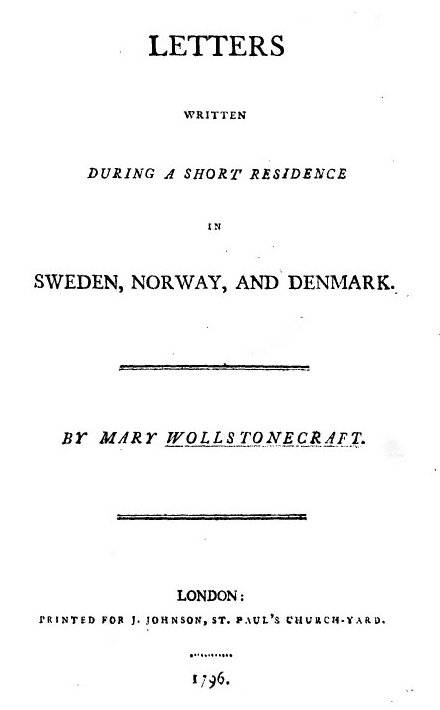
I will limit myself to one passage as an example of the Letters as a whole. The summer solstice approaches. This seems apt:
Nothing, in fact, can equal the beauty of the northern summer’s evening and night, if night it may be called that only wants the glare of day, the full light which frequently seems so impertinent, for I could write at midnight very well without a candle. I contemplated all Nature at rest; the rocks, even grown darker in their appearance, looked as if they partook of the general repose, and reclined more heavily on their foundation. “What,” I exclaimed, “is this active principle which keeps me still awake? Why fly my thoughts abroad, when everything around me appears at home?” My child was sleeping with equal calmness—innocent and sweet as the closing flowers. Some recollections, attached to the idea of home, mingled with reflections respecting the state of society I had been contemplating that evening, made a tear drop on the rosy cheek I had just kissed, and emotions that trembled on the brink of ecstasy and agony gave a poignancy to my sensations which made me feel more alive than usual.Barbara Taylor remarks, in footnote 208 to Mary Wollstonecraft and the feminist imagination, that
Not much is to be gained, in my view, from classifying Wollstonecraft as a romantic or pre-romantic writer. Her debt to earlier eighteenth-century sources for her "romantic" themes is readily traced (Edward Young and Hugh Blair are obvious sources), and treating her ideas as anticipations of later romantic motifs is less illuminating to my mind than understanding them in their own terms.I appreciate her point -- none of us can know what posterity will make of our work, and we can't be held responsible for repercussions we never anticipated. Nonetheless, it interests me to trace the threads, to track the breadcrumbs.
Painting by Caspar David Friedrich, "Wanderer above the Sea of Fog'' (1818), held in the Hamburg Art Gallery.
Book by Mary Wollstonecraft (1759-1797) (Eighteenth Century Collections Online) .
Both public domain, via Wikimedia Commons.
Monday, June 13, 2011
Mary, molls, and modesty
Yesterday we looked at the London Slutwalk. Today we continue our exploration of Mary Wollstonecraft's attitude towards modesty, from the chapter of that title in A Vindication of the Rights of Woman.
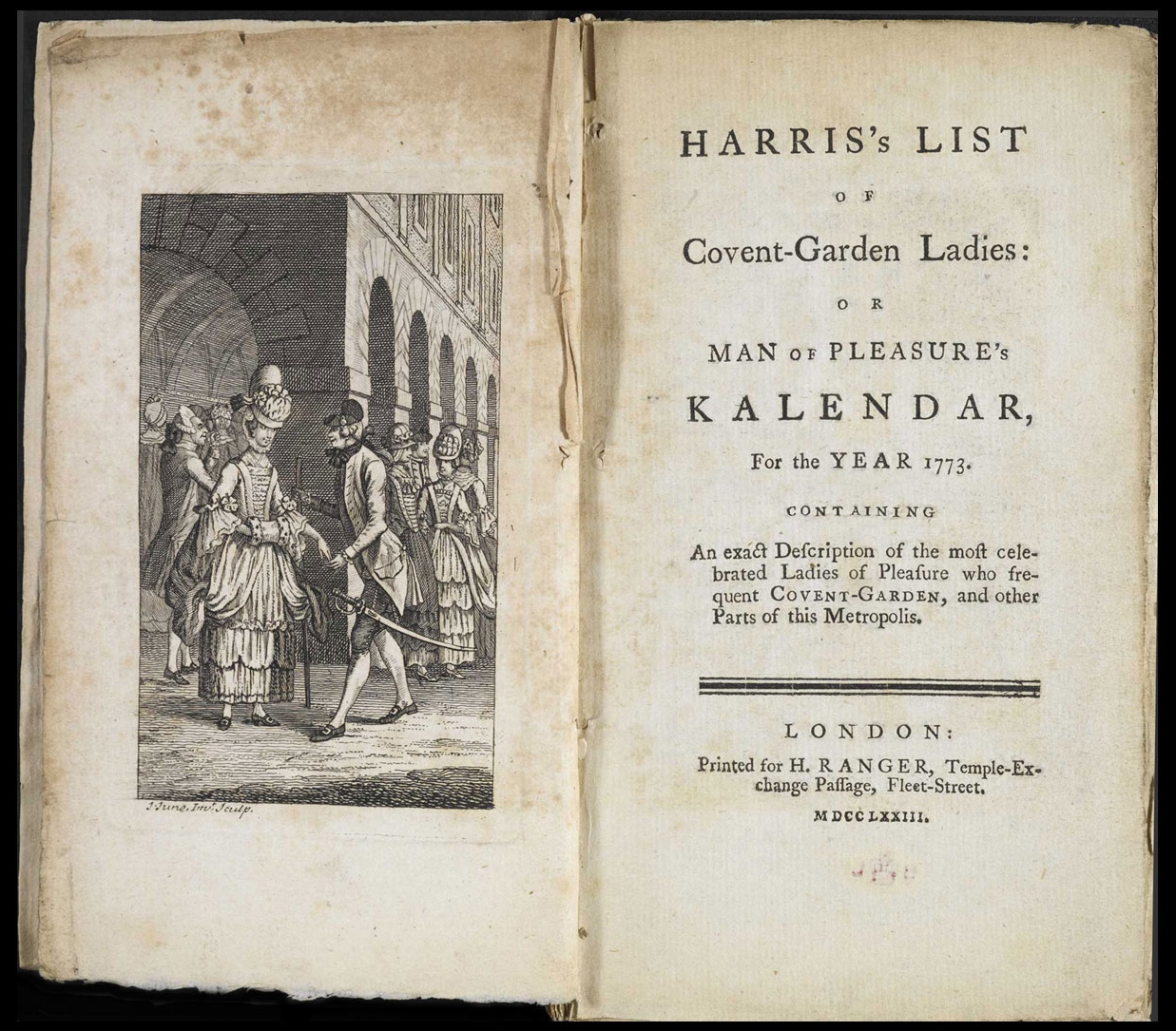 |
| By Samuel Derrick [Public domain], via Wikimedia Commons |
She deals explicitly with prostitution, showing she is not a prude or someone with her head in the sand. The world's oldest profession had a huge impact on urban life at that time, not least because other occupations were closed to women. Dan Cruikshank claims in The Secret History of Georgian London: How the Wages of Sin Shaped the Capital that "as many as one in five young women were prostitutes in eighteenth-century London".
I am not sure of the scope of the term "prostitute" in her day. Mary, nobody's fool, would have been aware of the aristocrats' mistresses (predecessors of the pretty horse-breakers of Rotten Row), and Harris's List of Covent Garden Ladies : in other words, both those women seeking a long-term arrangement, and those who charged by the hour. Dr Johnson's Scottish companion describes his lusty London encounters in his diaries -- "I got myself quite intoxicated, went to a Bawdy-house and past a whole night in the arms of a Whore. She indeed was a fine strong spirited Girl, a Whore worthy of Boswell if Boswell must have a whore". James was carousing in the streets and the decades when Mary was a young woman.
She, and others like her, would have had to exercise an effort to minimise her risk of being approached or addressed as a street tart. Whether this effort was conscious or not, women had to perform goodness, or "virtue" in the limited female sense: hair, clothes, body language, chastity of the eyes, pace, voice, deportment, all signalled "don't mess with me", as opposed to "might be worth a try". "If you want to stay safe, don't dress like a slut," said the policeman very recently. When so many women were reduced to opening their legs for a few pennies, and the sexual scale went up from there, all "good" women who did not want to participate in those transactions had to take action to distance themselves from the "bad" ones. This was especially true for girls, that is, unmarried women. "If you don't want to be approached, don't give a man any reason to approach you." For a young woman walking the streets of London without a male escort, as Mary did of necessity, every signal she sent out was subject to scrutiny.
I am not sure of the scope of the term "prostitute" in her day. Mary, nobody's fool, would have been aware of the aristocrats' mistresses (predecessors of the pretty horse-breakers of Rotten Row), and Harris's List of Covent Garden Ladies : in other words, both those women seeking a long-term arrangement, and those who charged by the hour. Dr Johnson's Scottish companion describes his lusty London encounters in his diaries -- "I got myself quite intoxicated, went to a Bawdy-house and past a whole night in the arms of a Whore. She indeed was a fine strong spirited Girl, a Whore worthy of Boswell if Boswell must have a whore". James was carousing in the streets and the decades when Mary was a young woman.
She, and others like her, would have had to exercise an effort to minimise her risk of being approached or addressed as a street tart. Whether this effort was conscious or not, women had to perform goodness, or "virtue" in the limited female sense: hair, clothes, body language, chastity of the eyes, pace, voice, deportment, all signalled "don't mess with me", as opposed to "might be worth a try". "If you want to stay safe, don't dress like a slut," said the policeman very recently. When so many women were reduced to opening their legs for a few pennies, and the sexual scale went up from there, all "good" women who did not want to participate in those transactions had to take action to distance themselves from the "bad" ones. This was especially true for girls, that is, unmarried women. "If you don't want to be approached, don't give a man any reason to approach you." For a young woman walking the streets of London without a male escort, as Mary did of necessity, every signal she sent out was subject to scrutiny.
The following passage seems to refer to street prostitution. One wing of this was characterised by country maids being deceived on coming to the city (which still happens today, only the maids come from countries further afield and are often hampered by a lack of the local language). Mary Wollstonecraft characterises them as simple people who never had any real and elevating modesty to lose:
The shameless behaviour of the prostitutes, who infest the streets of London, raising alternate emotions of pity and disgust, may serve to illustrate [the difference between bashfulness and modesty]. They trample on virgin bashfulness with a sort of bravado, and glorying in their shame, become more audaciously lewd than men... But these poor ignorant wretches never had any modesty to lose, when they consigned themselves to infamy; for modesty is a virtue not a quality. No, they were only bashful, shame-faced innocents; and losing their innocence, their shame-facedness was rudely brushed off; a virtue would have left some vestiges in the mind, had it been sacrificed to passion, to make us respect the grand ruin.
Instead of worrying about bashfulness, women should strive to improve their understanding, and their wider compassion, and this will lead, via "purity of mind", to modesty. Dwelling on flirting and love will not have such happy results:
Those women who have most improved their reason must have the most modesty—though a dignified sedateness of deportment may have succeeded the playful, bewitching bashfulness of youth. To render chastity the virtue from which unsophisticated modesty will naturally flow, the attention should be called away from employments which only exercise the sensibility; and the heart made to beat time to humanity, rather than to throb with love. The woman who has dedicated a considerable portion of her time to pursuits purely intellectual, and whose affections have been exercised by humane plans of usefulness, must have more purity of mind, as a natural consequence, than the ignorant beings whose time and thoughts have been occupied by gay pleasures or schemes to conquer hearts.
She is clear that modesty does not lie in the actions one performs or the etiquette one adheres to:
The regulation of the behaviour is not modesty, though those who study rules of decorum are, in general, termed modest women. Make the heart clean, let it expand and feel for all that is human, instead of being narrowed by selfish passions; and let the mind frequently contemplate subjects that exercise the understanding, without heating the imagination, and artless modesty will give the finishing touches to the picture.
Chastity isn't a word used much now, except if you are Sonny and Cher picking a name for your daughter. In the Biblical sense it means virginity before marriage and monogamy within it. In effect, adhering to community norms. Mary distinguishes it from modesty.
As a sex, women are more chaste than men, and as modesty is the effect of chastity, they may deserve to have this virtue ascribed to them in rather an appropriated sense; yet, I must be allowed to add an hesitating if:—for I doubt whether chastity will produce modesty, though it may propriety of conduct, when it is merely a respect for the opinion of the world, and when coquetry and the lovelorn tales of novelists employ the thoughts. Nay, from experience and reason, I should be led to expect to meet with more modesty amongst men than women, simply because men exercise their understandings more than women.
Remember she wrote both Vindications before she went to Paris and met Gilbert Imlay. She is thought to have been a virgin up till that point, a subject I hope to discuss in a future post.
Also, it has not passed me by that this discussion of modesty bears some resemblance to the Muslim concept of hijab, too often understood only as dress restrictions for women, most specifically the headscarf, but in fact a statement of the necessity of modesty, applying equally to men and women. Again, something I may come back to, once Jane Austen and Lyndall Gordon and the Scandinavian traveller and all sorts of sculptural possibilities are out of the way.
Also, it has not passed me by that this discussion of modesty bears some resemblance to the Muslim concept of hijab, too often understood only as dress restrictions for women, most specifically the headscarf, but in fact a statement of the necessity of modesty, applying equally to men and women. Again, something I may come back to, once Jane Austen and Lyndall Gordon and the Scandinavian traveller and all sorts of sculptural possibilities are out of the way.
Sunday, June 12, 2011
Mary and the Slutwalk
 |
| Slutwalk Chicago, because none of the London photos have reached Wikicommons as of the time of writing. |
Background: Slutwalks are a resurgence of street feminism, featuring home-made banners and a lot of energy and anger. They sprang from the ill-judged comments of a Toronto policeman to a group of law students. "I've been told I'm not supposed to say this - however, women should avoid dressing like sluts in order not to be victimised." Cue massive international outrage, and organised visible resistance to the notion that victims of sexual assault are asking for it. One of the few repeated placard slogans runs: "Yes means yes, no means no, however I dress, wherever I go." The London website carries the strapline "The radical notion that nobody deserves to be raped."
 |
| Sketch by Isaac Cruikshank, ca. 1790, via WikiCommons. |
So: what would Mary do? It isn't as if sexual assault is a new concept. There was plenty of it in Georgian London; marital rape, for example, was entirely legal, and remained so until 1991. (Lyndall Gordon hypothesises that "invisible abuse", possibly including "marital sex that verges on rape", was one factor that caused Mary's younger sister Bess Bishop to flee her husband.) There is a difference of presentation between now and then: female clothing of all classes was more concealing than today, with the partial exception of some aristocratic bosoms. Skirts were ankle-length; sleeves went to the elbow, if not wrist. Western women didn't really begin to uncover themselves until after World War I. So Mary would not have expressed her radicalism,or her distaste for male abuse of power, by showing some skin.
She expected high standards from men, and from women too. Modesty was one part of this, and she wrote at some length about it. Indeed, she devoted a whole chapter of her magnum opus to the concept, so it is worth exploring what she meant by the term. She begins with poetic effusiveness:
MODESTY! Sacred offspring of sensibility and reason!—true delicacy of mind!—may I unblamed presume to investigate thy nature, and trace to its covert the mild charm, that mellowing each harsh feature of a character, renders what would otherwise only inspire cold admiration—lovely!—Thou that smoothest the wrinkles of wisdom, and softenest the tone of the sublimest virtues till they all melt into humanity;—thou that spreadest the ethereal cloud that surrounding love heightens every beauty, it half shades, breathing those coy sweets that steal into the heart, and charm the senses—modulate for me the language of persuasive reason, till I rouse my sex from the flowery bed, on which they supinely sleep life away!
So what is all that supposed to mean, aside from modesty being A Good Thing? She goes on to make clear that she does not equate modesty with bashfulness, or "the instinctive timidity of ignorance". It is not a milkmaid's downcast eyes and cowed silence that makes modesty (moo!). Modesty is a virtue she defines first in male terms and with male examples.
Modesty [is] that soberness of mind which teaches a man not to think more highly of himself than he ought to think, and should be distinguished from humility, because humility is a kind of self-abasement....A modest man is steady, an humble man timid, and a vain one presumptuous:—this is the judgment, which the observation of many characters, has led me to form. Jesus Christ was modest, Moses was humble, and Peter vain.
The politics of sexual display were familiar to Mary Wollstonecraft. Young women sought the attention of men, for a good marriage was what they pinned their life hopes on. The difference is that then the rules were stricter: "good girls" never said yes before marriage, so men had no wiggle room for claiming a misunderstanding. This was true, at least, of the middle classes, where Mary pitched her tent. Even “making love” -- in the now entirely obsolete sense of talking explicitly about love, professing one’s devotion -- was considered in bad taste. If a man thus took advantage of being alone with a woman, his statement of intent might well, unless reciprocated, lead to real distress on her part. It could be taken as an insult.
Much of her writings were aimed at elevating women, and to do so, she often cast them down, depicting their current existence as shallow, trivial, unworthy. However, there are occasions when she takes the men to task as well. Here she addresses men's poor behaviour, particularly their assertion of sexual ownership of public space, something that taps into the Slutwalk ethos:
What can be more disgusting than that impudent dross of gallantry, thought so manly, which makes many men stare insultingly at every female they meet? Is this respect for the sex? This loose behaviour shews such habitual depravity, such weakness of mind, that it is vain to expect much public or private virtue, till both men and women grow more modest—till men, curbing a sensual fondness for the sex, or an affectation of manly assurance, more properly speaking, impudence, treat each other with respect—unless appetite or passion give the tone, peculiar to it, to their behaviour. I mean even personal respect—the modest respect of humanity, and fellow-feeling—not the the libidinous mockery of gallantry, nor the insolent condescension of protectorship.More on modesty
[Medieval philosopher Christine de Pizan had some views on rape and dress and Slutwalks, according to actual real life philosopher Sandrine.]
Sunday, May 15, 2011
Mary and God
 |
| St Pancras Old Church |
 |
| Newington Green Unitarian Church |
Here's a chapter title you don't often hear cited: "Chap. XIII. Some Instances of the Folly Which the Ignorance of Women Generates; with Concluding Reflections on the Moral Improvement That a Revolution in Female Manners Might Naturally Be Expected to Produce." In other words, "Silly Things Ill-Educated Women Do, and How Much Better the World Would Be If Only They Behaved Themselves". It starts by entreating women to reflect on God, and telling them off at length for seeking out fortune-tellers and "fashionable deceptions, practised by the whole tribe of magnetisers" (sounds like the altmed crowd - note to self, another post another time). There is a list of rhetorical questions, to which she expects the answer "yes":
Do you believe that there is but one God, and that he is powerful, wise, and good?Do you believe that all things were created by him, and that all beings are dependent on him?Do you rely on his wisdom, so conspicuous in his works, and in your own frame, and are you convinced that he has ordered all things which do not come under the cognizance of your senses, in the same perfect harmony, to fulfil his designs?
She also writes a long digression "considering the attributes of God":
Positive punishment appears so contrary to the nature of God, discoverable in all his works, and in our own reason, that I could sooner believe that the Deity paid no attention to the conduct of men, than that he punished without the benevolent design of reforming.
To suppose only that an all-wise and powerful Being, as good as he is great, should create a being foreseeing, that after fifty or sixty years of feverish existence, it would be plunged into never ending woe—is blasphemy. I know that many devout people boast of submitting to the Will of God blindly, as to an arbitrary sceptre or rod, on the same principle as the Indians worship the devil. In other words, like people in the common concerns of life, they homage to power, and cringe under the foot that can crush them. Rational religion, on the contrary, is a submission to the will of a being so perfectly wise, that all he wills must be directed by the proper motive—must be reasonable.This is one of the passages that makes it so unfair that the Victorians vilified her for being an atheist: she was a through-going deist all her life, as far as I can tell. It was dear William Godwin and his ill-considered memoir that inadvertently caused her to be seen as rejecting God on her deathbed. It's a bit like being "accused" of being gay. ( I put the verb in scare-quotes because it presumes that one or both parties perceive gayness to be a bad thing.) What if the answer is, yes I am - so what? Or what if the answer is, no I'm not actually, although there's nothing wrong with it? If that is the truth, further denials can become awkward, and anyway are impossible if one happens to be dead, and the distraught widower, as an avowed atheist, has no interest in protesting on one's behalf.
I can't wait to hear what Lyndall Gordon has to say about Mary Wollstonecraft and the Unitarians.
Images via Wikicommons.
Sunday, May 8, 2011
Mary and national education
Mary Wollstonecraft was first and foremost an educator. Her second career was as a writer, but many of her books were attempts to educate, in one way or another. Some of the girls whose minds and spirits she touched went on to have extraordinary lives. Some of her works went on to find readers in unexpected places; more on that another time. Here is what she had to say about the establishment of a national education system:
Let an enlightened nation then try what effect reason would have to bring them back to nature, and their duty; and allowing them to share the advantages of education and government with man, see whether they will become better, as they grow wiser and become free. They cannot be injured by the experiment; for it is not in the power of man to render them more insignificant than they are at present.
To render this practicable, day schools, for particular ages, should be established by government, in which boys and girls might be educated together. The school for the younger children, from five to nine years of age, ought to be absolutely free and open to all classes...
... in an elementary day school, ...boys and girls, the rich and poor, should meet together. And to prevent any of the distinctions of vanity, they should be dressed alike, and all obliged to submit to the same discipline, or leave the school. The school-room ought to be surrounded by a large piece of ground, in which the children might be usefully exercised, for at this age they should not be confined to any sedentary employment for more than an hour at a time. But these relaxations might all be rendered a part of elementary education, for many things improve and amuse the senses, when introduced as a kind of show, to the principles of which, dryly laid down, children would turn a deaf ear. For instance, botany, mechanics, and astronomy. Reading, writing, arithmetic, natural history, and some simple experiments in natural philosophy, might fill up the day; but these pursuits should never encroach on gymnastic plays in the open air. The elements of religion, history, the history of man, and politics, might also be taught, by conversations, in the socratic form.
After the age of nine, girls and boys, intended for domestic employments, or mechanical trades, ought to be removed to other schools, and receive instruction, in some measure appropriated to the destination of each individual, the two sexes being still together in the morning; but in the afternoon, the girls should attend a school, where plain-work, mantua-making, millinery, &c. would be their employment.
The young people of superiour abilities, or fortune, might now be taught, in another school, the dead and living languages, the elements of science, and continue the study of history and politics, on a more extensive scale, which would not exclude polite literature.
Girls and boys still together? I hear some readers ask: yes.
Sunday, April 24, 2011
Mary and the Dissenters
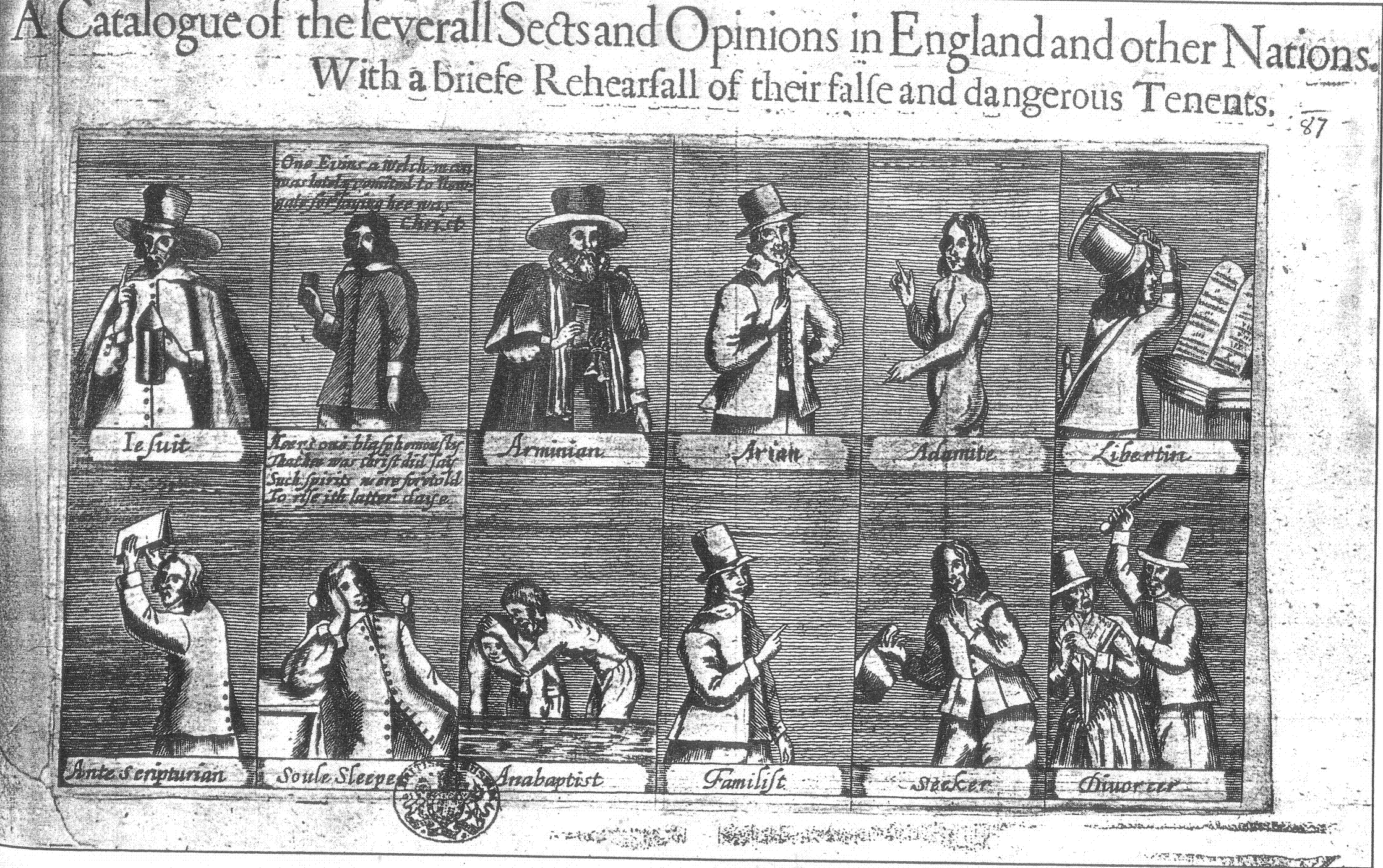 |
| A Catalogue of the Severall Sects and Opinions in England and other Nations (1647). Public domain, Wikimedia Commons. |
Another parallel is less so. Mary Wollstonecraft compared the situation of women in her day to that of a religious minority, those we now look back on under the name of Rational Dissenters. They had split from the Church of England, or, as they saw it, the established church had split from them. Protestant non-conformists then, Socinians or Arians later, Unitarians now. Mary spent a few years in their midst at Newington Green, befriended by the Dissenting minister, Dr Richard Price, and that fairy godmother, the widow Burgh. From her time there, she drew these impressions, which later found their way into A Vindication of the Rights of Woman:
Were not dissenters, for instance, a class of people, with strict truth characterized as cunning? And may I not lay some stress on this fact to prove, that when any power but reason curbs the free spirit of man, dissimulation is practised, and the various shifts of art are naturally called forth? Great attention to decorum, which was carried to a degree of scrupulosity, and all that puerile bustle about trifles and consequential solemnity, which Butler's caricature of a dissenter, brings before the imagination, shaped their persons as well as their minds in the mould of prim littleness.
I speak collectively, for I know how many ornaments to human nature have been enrolled amongst sectaries [how many great people have been found among those who belong to religious sects]; yet, I assert, that the same narrow prejudice for their sect, which women have for their families, prevailed in the dissenting part of the community, however worthy in other respects; and also that the same timid prudence, or headstrong efforts, often disgraced the exertions of both. Oppression thus formed many of the features of their character perfectly to coincide with that of the oppressed half of mankind; for is it not notorious that dissenters were, like women, fond of deliberating together, and asking advice of each other, till by a complication of little contrivances, some little end was brought about? A similar attention to preserve their reputation was conspicuous in the dissenting and female world, and was produced by a similar cause.Both Dissenters and women were denied political power or full education. The parallels are intriguing, and despite her many good reasons for gratitude, Mary Wollstonecraft is not blind to their faults. I'll be waiting to hear what Lyndall Gordon has to say about the matter in Oxford on 22 May.
Sunday, April 17, 2011
Mary, money, morality

This week's excerpt comes from chapter 9 of A Vindication of the Rights of Woman: "Of the Pernicious Effects Which Arise from the Unnatural Distinctions Established in Society."
From the respect paid to property flow, as from a poisoned fountain, most of the evils and vices which render this world such a dreary scene to the contemplative mind. For it is in the most polished society that noisome reptiles and venomous serpents lurk under the rank herbage; and there is voluptuousness pampered by the still sultry air, which relaxes every good disposition before it ripens into virtue.That sounds very like "For the love of money is the root of all evil" -- not money itself, but loving it above all else; not property itself, but respecting it to the exclusion of other values. I take the last bit to mean that children may be fundamentally of good character, but this doesn't have a chance to develop if they grow up in luxury, which weakens them morally.
One class presses on another; for all are aiming to procure respect on account of their property: and property, once gained, will procure the respect due only to talents and virtue. Men neglect the duties incumbent on man, yet are treated like demi-gods; religion is also separated from morality by a ceremonial veil, yet men wonder that the world is almost, literally speaking, a den of sharpers or oppressors.She seems to be saying that, no matter what class we come from, we all seek respect from others by showing off our money, our houses, our cars, our clothes, our holidays. Once we have these, it doesn't matter whether we have any worthwhile skills to offer or goodness inside us. -- Celebrity culture? -- And I think the "men" here are people, not just male people: we will treat some frail humans like idols, even if they treat those around them very badly indeed. -- Pop Idol? Celebrity Has Talent?
There is a homely proverb, which speaks a shrewd truth, that whoever the devil finds idle he will employ. And what but habitual idleness can hereditary wealth and titles produce? For man is so constituted that he can only attain a proper use of his faculties by exercising them, and will not exercise them unless necessity, of some kind, first set the wheels in motion. Virtue likewise can only be acquired by the discharge of relative duties; but the importance of these sacred duties will scarcely be felt by the being who is cajoled out of his humanity by the flattery of sycophants. There must be more equality established in society, or morality will never gain ground...."The devil makes work for idle hands." Not an adage often heard these days. The problem of hereditary money is a very current one, and can only become more so with the increasing concentration of the world's wealth among the plutocracy. Rich kids: how to handle them? And those whose talent and hard work elevate them very young into the pop aristocracy: sportsmen, singers, actors. And those who are famous for being famous: from the vulgarati of the unreality shows, to the posh girls from country estates, perhaps both photographed stumbling out of the same nightclubs, perhaps both sharing the same drug dealer.
Those who are cajoled out of their humanity by the flattery of sycophants... the echo chamber of fame, the Hall of Mirrors of TV and tabloids. Lillie Langtry and the cult of celebrity, from the 1870s. The It girls, dating from Clara Bow in the 1920s. "Famous for fifteen minutes", as Andy Warhol said in 1968. None of these phenomena are new, but it seems to be ramped up these days. From society beauties to celebutantes - what would Mary Wollstonecraft have made of it all?
Photo: By marya from San Luis Obispo, USA (day in the life: lunch money)
[CC-BY-2.0 (www.creativecommons.org/licenses/by/2.0)], via Wikimedia Commons
Sunday, April 3, 2011
A first attempt at translation
 |
| A representation of the method of lexical simplification presented by Jan De Belder, Koen Deschacht, via Wikimedia Commons |
I've chosen the passage I read for the link into the Woman's Hour interview. This one-minute audio clip covered the noises of biographer Barbara Taylor and me finding our seats opposite the formidable Jenni Murray, who kept her eyes on her papers until she was ready to pierce us with her first question.
From the introduction:
My own sex, I hope, will excuse me, if I treat them like rational creatures, instead of flattering their fascinating graces, and viewing them as if they were in a state of perpetual childhood, unable to stand alone. I earnestly wish to point out in what true dignity and human happiness consists—I wish to persuade women to endeavour to acquire strength, both of mind and body, and to convince them that the soft phrases, susceptibility of heart, delicacy of sentiment, and refinement of taste, are almost synonimous with epithets of weakness, and that those beings who are only the objects of pity and that kind of love, which has been termed its sister, will soon become objects of contempt.
Dismissing then those pretty feminine phrases, which the men condescendingly use to soften our slavish dependence, and despising that weak elegancy of mind, exquisite sensibility, and sweet docility of manners, supposed to be the sexual characteristics of the weaker vessel, I wish to show that elegance is inferior to virtue, that the first object of laudable ambition is to obtain a character as a human being, regardless of the distinction of sex; and that secondary views should be brought to this simple touchstone.
I ran the text above through a readability calculator. It said the passage had three sentences, with an average of 67 words per sentence, and gave as an "indication of the number of years of formal education that a person requires in order to easily understand the text on the first reading" ... 32. So that would be finishing high school, and continuing to study for 20 years. After two decades I think I could translate the passage into Japanese (which, dear reader, I speak not a kanji). It gives an "approximate representation of the U.S. grade level needed to comprehend the text" -- in fact, it gives several, ranging from 12 to 35. These are imperfect tools, but still, by any standards, the text is difficult to penetrate for the reader unaccustomed to eighteenth-century literary norms. Here's my first attempt at rewriting the passage for the C21:
Women won't mind if I treat them like people who can think. I don't intend to say how charming they are, or to look at them like grown-up children, always dependent on others. I want to describe what makes real happiness, and, yes, human dignity. Women should try to grow strong in body and mind. Things which are thought to be feminine -- certain ways of talking, feeling strong emotions easily, giving way to others -- are almost the same as weaknesses. People who others feel sorry for, and the kind of love which they feel for these people, will soon be looked down on.
I won't use pretty, feminine phrases. Men talk like that because they don't respect us. We depend on men, as a slave depends on his master, and they want to charm us into forgetting that fact. Having a weak mind, having no will of one's own, being too fussy about everything -- all these characteristics are supposed to mark us as the weaker sex. I want to demonstrate that elegance is less important than doing the right thing. The most important objective in anyone's life, the first thing to strive for, is to develop a good reputation as a human being. This is true for both men and women, and everything else should be measured against this objective.
That has 13 sentences, with 17 words per sentence, for much the same grand total. It would only need ten years of formal education, or about grade 8. (I don't really understand the difference.) Now let's simplify it -- the rhetoric, but not, I hope, the ideas -- still more. Mary turns to face us directly:
Look, I'm sorry, but you're a thinking person, right? I'm not going to flatter you by saying how amazing you are, like you're a little girl or a doll. You can stand on your own two feet. I'm here to tell you what real happiness is about. Strengthen your mind! Strengthen your body! Soft chat, falling in love, doing what other people want, all these are weak. If people pity you, their love will turn to contempt.
I'm not going to talk in fancy phrases, like men do when they want to soften us up. As if we're slaves, dependent on them! Letting your brain go mushy, and acting all nicey-nicey, is supposed to make you a girl. You know what? Acting nice is less important than doing right. The first thing in life is to get respect. It doesn't matter if you're male or female. Every thing else follows on from that.
16 sentences, 10 words a sentence, so somewhat shorter. And now we're down to a grade 5 reading level.
That was kind of fun! I wonder if anyone has tried this with their students? The comments are for you...
[Later: see my description of Jonathan Bennett's site on Early Modern Texts, which offers a wide range of texts, in somewhat more contemporary language.]
[And still later: the 220th anniversary of the Vindication, in February 2012, prompted me to recap the resources around the book. There is lots out there, to help learners learn and teachers teach, and to help all concerned and interested readers get the most out of the experience. Not to mention the conferences...]
[Later: see my description of Jonathan Bennett's site on Early Modern Texts, which offers a wide range of texts, in somewhat more contemporary language.]
[And still later: the 220th anniversary of the Vindication, in February 2012, prompted me to recap the resources around the book. There is lots out there, to help learners learn and teachers teach, and to help all concerned and interested readers get the most out of the experience. Not to mention the conferences...]
Subscribe to:
Posts (Atom)