Showing posts with label legacy. Show all posts

Monday, March 11, 2013

Fifty Shades of Feminism

Mary Wollstonecraft inspired one of the entries in the newly released Fifty Shades of Feminism. "There's Something About Mary" is Bee Rowlatt's paean, and a taster of her book to come. On Saturday night, there she was at the Clore Ballroom in the Southbank Centre, being introduced by Sandi Toksvig. The readings were done in pairs: Bee read from the entry by Martha Spurrier, and the human rights lawyer returned the favour.
Mary Wollstonecraft was a woman so far ahead of her time that we are still living in her dust trail. She was a worldwide troublemaker, and a sea-faring single mother. 
The audience lapped it up. "What would Mary do?" is the new motto. 
The Virago website is (at time of writing) oddly unhelpful, but Amazon (for better or worse) has the regular description and GoogleBooks has what looks like a full list of contributors. Trusty Foyles was there on the Southbank spot, selling the elegant grey hardback. Behind the stage curtains, the contributors were all signing each others' copies.

The Women of the World festival, a three-day extravaganza over the past weekend, was definitely the biggest and glitziest of those events we rounded up for International Women's Day. But the others were good too, and there is still the sculpture walk to look forward to on 16 March.

********************
Photos: the top one is from gracious activist Kamila Shamsie.  Apologies for poor resolution, but the atmosphere is clear. "Bee with tea" is courtesy the author herself.

Monday, August 6, 2012

A Dead Good (New) Beginning

Hello everyone, I'm back. A most amusing summary of Mary Wollstonecraft's life and legacy has crossed my desk.  I decided to ask for permission to bring it to you verbatim, which Ashley Lister, co-ordinator of the Blackpool writers collectively known as A Dead Good Blog, promptly and kindly granted. See? The internet can be a pleasant place. I don't usually reproduce blog posts, but since it's time to start anew, perhaps it's time to start a new ... habit? Practice? Tradition? If I enjoy a piece of writing, why not see if I can grant the same pleasure to my dear readers, as well. So here goes "The beginning is always today", by poet and writer Vicky Ellis:

*********************

"I hate clever women...they are only troublesome."  This is not a quote from my favourite writer.  These are the words of Henry Fuseli: artist, visionary and twunt.  He was also 'unhelpful crush #1' for Mary Wollstonecraft, author, feminist and lover of twunts. 

Here's what Mary wrote:

'Security of property! Behold in a few words, the definition of English liberty. And to this selfish principle every nobler one is sacrificed....'

'Virtue can only flourish amongst equals' 

From A Vindication of the Rights of Man (1790) which preceded Thomas Paine's Rights of Man by a year.

“[I]f we revert to history, we shall find that the women who have distinguished themselves have neither been the most beautiful nor the most gentle of their sex.”  

“My own sex, I hope, will excuse me, if I treat them like rational creatures, instead of flattering their fascinating graces, and viewing them as if they were in a state of perpetual childhood, unable to stand alone.” 

“Taught from their infancy that beauty is woman's sceptre, the mind shapes itself to the body, and roaming round its gilt cage, only seeks to adorn its prison.”  

From A Vindication of the Rights of Woman

Clearly she was a rational, keen-minded individual with a, sadly, contemporary-sounding axe to grind.  But these words, marvellous as they are, do not encapsulate what was wonderful about Mary Wollstonecraft.  Mary was, in the nicest possible way, a bit of a fuck up.  She had a habit of falling for the least suitable man to hand. 

Now these men were respected in their professions.  They were intellectuals, noted for their work.  They were no doubt fascinating in some way or I doubt they would have caught her attention.  They were not, however, particularly nice men.  Take twunt #1 above.  Fuseli was an interesting chap.  Repressed sexuality aside, he helped define the Romantic movement and he did a reet good incubus, so he did.  He shared a deep Platonic relationship with Mary which, for her part, turned into love.  Fuseli was married.  A slight hitch.  Mary decided that she could work around that and asked his wife if she'd mind terribly if she moved in with them, seeing as she had such great affection for Henry and all.  Sophia, Henry's wife, failed to see the practicality of this solution and forbade Mary from ever seeing Henry again.  Henry had no further contact with Mary.

You could argue that Mary was being unrealistic, or even that she was a little bit mad.  I think not.  I think she was working within the remit of the manifesto which she had written.  The first quote above makes it clear that she believed that the laws of property interfered with 'noble principles'.  The definition of property can be extended to include notions of ownership in relationships.  As a fiercely independent woman, her suggestion makes sense in a way that was centuries ahead of its time. 

After this humiliating event, Mary travelled to France, to enjoy her fame as a supporter of the Revolution.  There she met the dreamboat, Gilbert Imlay, aka twunt #2.  He was a speculator, and had an interesting approach to diplomacy, running British blockades of French ports while acting as ambassador in Paris.  He mirrored this approach in his dealings with Mary.  A lusty love affair led to pregnancy.  She had his child.  He became restless.  He left her with the baby in Paris and moved back to London.  She followed him to London.  He largely ignored her.  She tried to kill herself.  She recovered and agreed to go on a business trip across Europe, with her baby, on his behalf.  She returned to find him shacked up with another woman.  She tried to drown herself in the Thames.  

Again, you could argue that Mary was being a little bit naive by trekking across to Sweden on his behalf.  At the same time, however, she wrote to him frequently.  Her letters to him were collected and read by her later husband, William Godwin, who said of them: "If ever there was a book calculated to make a man in love with its author, this appears to me to be the book."  The letters allowed Mary to make a clever and emotional plea for Imlay's affection, ranging between vulnerability and independence.  Here was a woman who capable of using her writing like a spell to enchant her would-be lover. 

But Imlay was a bad egg.  Mary's letters didn't entice him back towards his responsibilities, however alluring their content, and Mary was forced to come down on the side of independence once more.  Those words which she had sent out into the world found their enraptured audience, however, in William Godwin, writer and philosopher.  The pair hit it off and soon she was pregnant again.  This time the couple married.  Seems like a good idea right?  Well as it turns out this marriage only drew attention to the fact that she hadn't been married to Imlay when she bore his child.  English Society was not too chuffed and a few of her friends found that the stench of scandal was more than they could bear. 

Nevermind, Mary and William set themselves up in the Polygon, a pair of ajoining houses which allowed them to be independent and communicate by letter.  Superb.  Their eversomodern plan was working out splendidly until Mary died of septicaemia 11 days after giving birth.  Bugger.  

William published a biography of Mary a year after her death, detailing her suicide attempts, the hopeless love affairs and illegitimate children.  England was scandalized once more.  Her name was mud until the Feminists cleaned her off and called her Mother.  

So there she is.  Mary Wollstonecraft.  Intellectual rebel.  Emotional hazard.  Fierce, fragile and expressive.  Role model.  Icon.  

Friday, March 16, 2012

The Mary Wollstonecraft Centre

The brass plaque on the door said

The Mary Wollstonecraft 
and Richard Price Centre 
for Women's Leadership 
and Financial Literacy

I woke from a dream a few weeks ago with this image in my head. Yesterday I shared this vision with sensible people who did not laugh at me. Something is about to happen.

Thursday, February 16, 2012

American conference program

The University of Florida has released the programme (or, I should say, program), for Mary Wollstonecraft: Legacies, to be held next week, at Ustler Hall, Gainesville (pictured).
The Center for Women’s Studies and Gender Research will host a conference on February 23-24, 2012 to commemorate the 220th anniversary of the publication of Mary Wollstonecraft’s Vindication of the Rights of Woman, a text that has had profound influence on political modernity and on continuing discussions about feminist thought. This conference follows our inaugural conference on Simone de Beauvoir (February 10-11, 2011), and is the second in a series that will commemorate the re-reading of key feminist texts and the legacies of major feminist thinkers.
Thursday 23 February
4:30-6:00: Panel Discussion on Wollstonecraft’s Legacies
Anita Anatharam, Rachel Rebouché, Stephanie Smith, Louise Newman, and Judith Page, moderator (all University of Florida)

Friday 24 February
10:30-Noon
Sheryl Kroen, Associate Professor of History, UF, “Writing Women's Lives: the Case of Mary Wollstonecraft”
Kari Lokke, Professor of Comparative Literature, UC-Davis, “Grasping at Immortality:
Forms of Freedom in Mary Wollstonecraft's Scandinavian Letters.”
Anne K. Mellor, Distinguished Professor of English and Women’s Studies, UCLA,
“Wollstonecraft, Austen and the Problems at Mansfield Park”
Moderator: Pamela Gilbert (University of Florida)

2:00-3:30
Wendy Gunther-Canada, Professor and Chair of Political Science, UA-Birmingham,
“Disinherited Daughters: Wollstonecraft and the Politics of Female Birthright”.
Daniel O’Neill, Associate Professor of Political Science, UF, “Mary Wollstonecraft and Democracy”
Danaya Wright, Professor of Law, UF, “Mary Wollstonecraft’s Unintended Legacy: The Normative Contours of the Parens Patriae Jurisdiction and the Changing Face of Legal Interference in the Family”
Moderator: Ed White (University of Florida)

4:30-6:00
A talk by Anne Mellor, Distinguished Professor of English and Women’s Studies, UCLA, “Wollstonecraft’s Vindication of the Rights of Woman and the Problems of Liberal Feminism,” followed by discussion

More details here and the full program(me) here (pdf). The long breaks between the sessions, when lots of interesting conversations are bound to happen, are well judged. When I first wrote of this conference, Janet Todd was giving the keynote talk; now, apparently not, alas.

Perhaps you'd prefer the philosophers' day-long symposium in Sweden. Bear in mind that Lund is just up the road (in the European sense) from Malmo. Malmo, across the bridge from Copenhagen, has a programme to experience Swedish hospitality -- supper (and maybe party games) with the locals.  No promises that the mayor will invite you to camp in his garden shed; details here, or maybe not....


Addendum: I had forgotten, or not known, that Janet Todd gained her PhD at the University of Florida. The Guardian's Higher Education profile (by John Sutherland, with whom I have a question outstanding) says:
She wanted to do Mary Wollstonecraft "but nobody had heard of her". So she did her doctoral work on the rustic poet John Clare. They hadn't heard of him, either, but the name was reassuringly masculine. Todd's supervisor died mid-thesis, so her research was uninterfered with - something she has always preferred.

---------------------
Photo: Ustler Hall is, according to Wikipedia , "the only freestanding campus building in the United States devoted solely to Women’s Studies [...and...] the first building on the UF campus renamed to honor a woman." (First, or only, I wonder?) 
I do appreciate the coincidence linking it to the German Gymnasium near MW's first grave: 
"I wish to persuade women to endeavor to acquire strength, both of mind and body".  
The image was taken by Douglas Whittaker and is used under a GNU Free Documentation License.

Wednesday, February 8, 2012

Vindication: new resources

If I estimate that perhaps one in a hundred Britons could tell you who Mary Wollstonecraft is, not one in a hundred of those cognoscenti would know that the Vindication that she is remembered for was her second. Fourteen months before, she had published A Vindication of the Rights of Men, a response to Edmund Burke's essay attacking her mentor Richard Price, the minister to the Dissenters of Newington Green. It was that book that made her an intellectual celebrity, placing her name firmly on the map of lettered London, and hence A Vindication of the Rights of Woman, published exactly 220 years ago, was received with interest and widely read; even if many disagreed with its conclusions, they paid the book and its author the respect of engaging with the arguments.

Now for some resources not covered in our recent recap: Taking Liberties, "the 900-year struggle for Britain's freedoms and rights in key documents", was the winter 2008/09 temporary exhibition at the British Library. It situates the Vindication in what it calls the human rights group, stretching back to 1690 Locke's Treatises, via the Minutes of the Committee for Effecting the Abolition of Slavery (1787),  and forward to the 1948 UN Declaration of Human Rights (an obvious choice) and, its last entry, the 1957 Wolfenden Report (a braver choice). The exhibition website (as good in its way as the one of Shelley's Ghost) describes the Vindication thus: "The firmly-argued book, written in the tumultuous period following the French Revolution, was one of the first great works of female emancipation - but the goals she advocated took many decades to attain."

A Vindication draws on the parallels between women's position and that of slaves. It is worth mentioning the environment in which the author developed these ideas. The 1787 committee had a dozen members, all men: nine Quakers and three Anglicans, including William Wilberforce. A non-denominational (or multi-denominational) pressure group was thought to be more effective than one composed exclusively of those outside the establishment: Quakers could not stand for Parliament, and suffered other civil disabilities. It is only fair to remember, however, that abolitionism began with the Society of Friends - a lesser known committee, entirely of Quakers, preceded this famous one by three years. Not surprisingly, some of its members, such as Joseph Woods senior and Samuel Hoare junior, lived at Stoke Newington, a village popular with that sect and due north of the City of London, an easy journey for merchants who wanted the benefit of fresh country air for their growing families. It also happens to be the neighbouring village to Newington Green. This was the environment in which Mary was radicalised; from her childhood she knew that the world could be a harsh and unjust place, but there she learned to see its injustices through political eyes.

One final resource: the avid readers at A Year of Feminist Classics devoted January 2011 to reading A Vindication, and their comments are preserved. Their year proved so productive that they are continuing into 2013, according to the reading list.

Coming up are some interpretations -- or, you could say, translations -- of A Vindication of the Rights of Woman.

Thursday, January 26, 2012

Lost daughter: Jane Austen, part six (Russo and Broemel)


And now to a more formal analysis of the influence of Mary Wollstonecraft on Jane Austen, continuing on from our first look at the connection. By serendipity, this month sees Women in Revolutionary Debate: Female Novelists from Burney to Austen by Stephanie Russo of Macquarie University. (That is in Sydney, Australia, where there's a suburb named after Mary's nephew.) It has just been published by Hes & de Graaf, who describe it thus:
In the later 18th and earlier 19th centuries novels were believed to have the power to change behaviour, and affect the political landscape of society on a large scale. The English response to the French Revolution can be traced through a reading of the novels of the period. The French Revolution in itself was indelibly associated with the domestic arena, and, thus, by extension, with women. Again and again in novels of the period, and particularly in women’s novels, the stability, or otherwise, of the family reflects the stability of government and of the nation. It was through the medium of the novel that women could enter the debate on revolution, using their novels as means through which to explore many of the dominant social and political issues of the day.
The novel was a medium uniquely suited to an exploration of revolutionary ideologies in the late 18th and early 19th centuries. The emerging form of the novel offered a unique opportunity for women to present new, challenging perspectives on the revolutionary crisis of the 1790s. The works of Frances Burney, Charlotte Smith, Mary Wollstonecraft, Mary Robinson, Maria Edgeworth, Mrs Bullock and Jane Austen, all occupy an important place in this debate, and indeed, in the history of the novel. They demonstrate that women were at the forefront of development of the form of the novel itself.
 The International League of Antiquarian Booksellers says the monograph is
a very good read, and a highly important work for everyone who is interested in the history of ideas, culture and society, and, in particular, in the history of women who did not only embroider cushions while waiting in the parlour for Mister Darcy, but who took their opportunities to change their situation and to influence their society by means of literature.
So, a side by side comparison of the novels of Mary and Jane! Alas, the book-buying budget is not up to 60 euros. In fact, it is probably about 60 euros short of the sum needed. Still, there are libraries, are there not?

From the professional to the amateur (and how we love the enthusiasts): via the useful suggestion of a fellow blogger, I've begun to read the huge resources at www.theloiterer.org, a Jane Austen website set up in 1998, "Revised: September 1, 2001" and apparently not touched since then. It runs to long, detailed pages full of quotes from the Austen canon, biographies, history, other novelists' work - but not other bloggers. No comments or feedback and definitely no social buttons. This is (relatively) early web stuff, thinking things through for oneself and using a static website as a way to keep all those thoughts in one coherent, self-governed place. Self-publishing in the old sense. The "editor", who in fact seems to have written reams and reams, goes by the name of Sophia Sentiment, but also admits to Linda Broemel. She claims James Austen's words as self-description: 'eccentric by principle' and 'irregular by system', but this is an excess of modesty. She has given us Mary Wollstonecraft, Mary Shelley, and Other Contemporaries of Jane Austen and Women Writers and Other Influences In Jane Austen's Time
In this second page, we turn to the literature of Jane Austen's time. The emphasis is on those things that Jane Austen might have read - on possible Jane-Austen influences. We will discover that Jane Austen's time seems to have been a golden age for women writers. We also attempt to understand how the male voices of our Lady's time thought about women. - What were their attitudes?
Then The Gathering Storm: Godwin, Malthus and revolutions and a few dozen other long essays (Mary Shelley and Marxism ,Wollstonecraft on Dr Fordyce's sermons, Women and inheritance, Henry Fielding on love, Anti-Catholic riots in London 1780). There are tables of contents to whet the appetite.

My own Austen musings led me to discover her secret nod, in which she names a contentious protagonist after two of the most formative individuals in Mary Wollstonecraft's life. Since becoming aware of the theories of Arnie Perlstein and the others we've looked at earlier, I have re-read parts of Northanger Abbey. For those of you who haven't memorised the Janeite canon, that's the one that mocks or spoofs the gothic genre, and it contains the famous defence of novel-reading, by a man of marriageable age. (He also has certain telling things to say about the nature of men and women, character and reason.)  I note with interest that Isabella Thorpe, the young schemer who ensnares first Catherine Morland's brother and then Eleanor Tilney's, is said to live at Putney, a village long swallowed by the growth of Victorian London, as was Newington Green. Putney Bridge was the site of Mary's second suicide attempt. Why else would JA name-check it? But not only these facts set out the influence that the polemicist had on the novelist: even the prose style echoes it. When the heart-sore Henry James* writes to his sister to reveal the deception of her erstwhile friend, he says, "if ever man had reason to believe himself loved, I was that man." Cf. "If ever there was a book calculated to make a man in love with its author, this appears to me to be the book." OK, that's not Mary herself, but her husband, or I should say, widower. Quibble. It seems clear to me that Jane Austen was responding to Mary Wollstonecraft's life and work.

But really, that may be enough Austen for now: six servings in a row. Just one more thing: the wonderful Chawton House has a wealth of resources about female writers, and Valerie Patten has written a fine potted biography of Mary Wollstonecraft there, which you may prefer to mine.

Tomorrow, a new series, weekly, infinite, no rush: statues. Finally!

[*Slip of the pen. I wrote "heart-sore Henry", when of course it should have been "jilted James". I do know the difference, really, but was led by astray by alliteration. Thanks, commenters, for keeping me on my toes.]

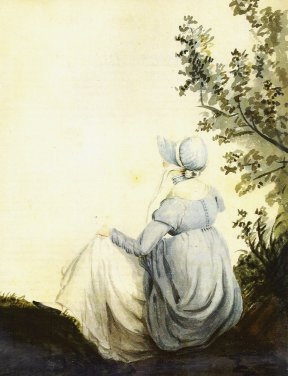
Jane Austen, by her sister Cassandra. (1773-1845) [Public domain], via Wikimedia Commons

Tuesday, January 24, 2012

Lost daughter: Jane Austen, part five (Gilbert)


And thus to the blog post by Lauren Gilbert, historical novelist, that started this whole series on the connections between Jane Austen and Mary Wollstonecraft. Did the former read the latter? She begins with some good old fashioned archival research, of the sort that turned up the father of Claire Clairmont:
I contacted Jane Austen’s House and Museum, Bath Central Library, Jane Austen Centre, and Chawton House Library. No catalog of Rev. George Austen’s library is known to exist. (Jane Austen’s House and Museum does have a copy of the inventory of the contents of the Steventon Rectory but no catalog of his books.) The Bath Central Library indicated that VINDICATION was on the catalog for Marshalls Circulating Library on Milsom Street dated 1808; it is the only one they have in Jane’s time frame. Since VINDICATION was published in 1792 and was a well-known work, this argues that the book was probably available via a circulating library when Jane Austen lived in Bath, or visited in London or other cities.
So far, this is more or less what we already knew from part two, Margaret Kirkham's research decades ago. But  it goes on to mention a Lost Son to add to my little list of people influenced by Mary.
Jane is known to have had a copy of HERMSPRONG, or man as he is not by Robert Bage (philosophically, Mr Bage embraced the idea of the superiority of the “natural man”, considered women the equal of man and supported women’s rights, and was known to have had a high regard for Mary Wollstonecraft; these ideals are demonstrated by the story in HERMSPRONG). Jane’s copy is in the Huntington Library (her signature in all 4 volumes). This would argue a mind open to the ideas expressed in VINDICATION. There is also a theory that Jane would not necessarily referred to Mary Wollstonecraft’s work or influence, due to Mary’s unconventional morals and lifestyle (see Claire Tomalin and Miriam Ascarelli).
Lauren Gilbert concludes that JA "was exposed to and affected by" and indeed "profoundly influenced by" the second Vindication. "That Mary Wollstonecraft’s work was known to Jane Austen is not a point of serious debate that I can find." This agrees with what Lyndall Gordon says (part three in our series). JA's novels serve as warnings of what happens when women are raised to be, as Mary put it, "alluring mistresses" rather "than affectionate wives and rational mothers". The blogpost ends by claiming "almost direct references" in the novels to the polemic. Everyone's favourite spinster novelist:
... with her light touch and subtle humor, highlighted the issues Ms. Wollstonecraft raised. While she could not very well have acknowledged this influence at the time she published, Ms. Wollstonecraft’s reputation being what it was, I think Jane Austen clearly carried Ms. Wollstonecraft’s ideas regarding the education of women, and a higher concept of marriage, forward.
This is in agreement, in more restrained form, with the enthusiastic theories of Arnie Perlstein, part four in our series, who holds JA to be a secret radical feminist: if you hold the texts up to the candleflame in the right way, the invisible lemon juice darkens, and the hidden message become legible.

Next up: a whole book on Women in Revolutionary Debate: Female Novelists from Burney to Austen.  And the Loiterers - like the current Idler, not dawdling at all.


Sunday, January 22, 2012

Lost daughter: Jane Austen, part four (Perlstein)

We have been looking at the opportunities Jane Austen had to read Mary Wollstonecraft. The consensus is overwhelming that the opportunity was there: there are family connections, tenuous but real, as pointed out by Claire Tomalin,  and access to circulating libraries during Austen's years in Bath. More importantly, though, is the textual evidence that the ideas laid out in A Vindication of the Rights of Woman -- the need for rational education and a marriage of mutual respect -- find fictional flesh in the examples and counter-examples of the novels, as we saw the other day. I even found a hidden clue, a secret nod, embedded in the name of one of the most contentious characters.

The first post of this series touched on the difference between Tory feminism and Enlightenment feminism, drawing on Jane Austen, Feminism and Fiction by Margaret Kirkham, which we looked at in more detail in the second post. This book, in its 1983 original or its 1996 second edition, I'm not quite sure, was reviewed by Margaret Doody. I haven't seen the review, but it was thoroughly picked apart by one Arnie Perlstein, an unlikely, to put it mildly, contributor to the discussion. There is no more passionate defender of Jane Austen as a radical feminist than this outsider. I think we can call him, as Ms magazine called Bob Lamm when he liberated Mary from the dungeons of the National Portrait Gallery, a male feminist.

The biography on his blog:
I'm a 59 year old independent scholar (still) working on a book project about the SHADOW STORIES of Jane Austen's novels (and Shakespeare's plays). I first read Austen in 1995, an American male real estate lawyer, i.e., a Janeite outsider. I therefore never "learned" that there was no secret subtext in her novels. All I did was to closely read and reread her novels, while participating in stimulating online group readings.
Then, in 2002, I whimsically wondered whether Willoughby stalked Marianne Dashwood and staged their “accidental” meeting. I retraced his steps, followed the textual “bread crumbs”, and verified my hunch. I've since made numerous similar discoveries about offstage scheming by various characters.
In hindsight, it was my luck not only to be a lawyer, but also a lifelong solver of NY Times and other difficult American crossword puzzles. These both trained me to spot complex patterns based on fragmentary data, to interpret cryptic clues of all kinds, and, above all, not to give up until I’ve completed the puzzle--and literary sleuthing Jane Austen's novels (and Shakespeare's plays) is, bar none, the best puzzle solving in the world!
If you like fisking, take a look: Margaret Doody's misguided review of Margaret Kirkham's Pioneering, Prescient & Spot-On 1982 book Jane Austen, Feminism and Fiction. I didn't see this until later. I first came across his forensic examination in November, when he claimed that Jane Austen was haunted by the Ghost of Mary Wollstonecraft, and got in touch in the comments. (Dear reader - please do the same!)

He posts about once a day, essays or diatribes rich in iconoclastic ideas and mad enthusiasm. I suspect the lawyering is a bit slow in Florida at the moment, and I for one am glad of it, if that gives room for the flowering of amateurism (a term of high praise in Wollstonecraft Towers). Here is a fair flavour of his argument:
I think JA was haunted by the Ghost and the memory of Mary Wollstonecraft, a woman who was brave enough to speak out on behalf of women very publicly, and who, after her death, was vilified because she had been so brave.

It's no accident, therefore, that JA alluded SPECIFICALLY to the very radical polemical novel CALEB WILLIAMS (written in 1809), which, after all, just happened to be written by Godwin, who just happened to have been the husband of...............Mary Wollstonecraft!
Here is an example of the sort of convoluted crossword theory he favours. I'm not saying he's wrong; I'm just saying  you need to have a special sort of mind to follow the thread. Ariadne and the Minotaur?
So it means that when I interpret Henry Tilney as having an epiphany about his mother's death as a result of Catherine's detective work at the Abbey, this is deeply connected to JA's allusion to Godwin's 1809 novel, a novel written a few years AFTER Godwin had a chance to see how the Far Right seized on his Memoir of his dead wife as grounds for crucifying her reputation in the court of public opinion.

So JA is telling us, covertly that (i) in a way, Godwin was Henry Tilney, because he eventually "got it" that he had screwed up, and he wrote Caleb Williams as penance, and (ii) in another way, Godwin was GENERAL Tilney, who did regret the role he played in bringing about his wife's death.
He speculates about Godwin's role:
And the most awful thing is that Godwin "killed" his wife TWICE, and both times it was "involuntary womanslaughter"--the first time, by getting her pregnant, leading to her physical death in childbirth, and the second time by writing her Memoir (perhaps trying to resurrect her), but having it backfire, and instead leading to the public assassination of her character!
And he sums up his view of Jane Austen's feminism:
I believe that for a very long time, maybe her whole adult life, JA played with the idea of going public with her true feelings. But in the end of the day, every time she put quill pen to paper, she chose to go undercover -- but I get the very strong sense that she always felt ambivalent about that painful decision. The regret that Catherine and Eleanor express when they talk about Mrs. Tilney is, I think, JA's own regrets....

So Northanger Abbey is in a very real sense JA's eulogy to the greatest feminist "heroine" of her time.
He also speculates in Jane Austen the radical but covert feminist Part 268 that Mary Bennet is Jane Austen's alter ego, named after Mary Wollstonecraft.  He agreed that I was barking up the right tree as regards name clues, and commented that Mary Bennet is "the most important surrogate for Mary W in all of Jane Austen's fiction":
...what you have is Mary Bennet as JA's covert self portrait! JA has led the reader down the garden path, seeing if we will take the bait and join with the rest of the Bennet family in unjustly and at times cruelly scorning Mary, but hoping that we will struggle with our inner Mr. Bennet and instead realize that we've been guilty of a wrong first impression of Mary, and reconsider.

So we have a surface parody of Mary, but a veiled anti-parody which vindicates Mary (who I claim is named after Mary Wollstonecraft). And I claim exactly the same sort of anti-parody in Northanger Abbey which has a surface parody of Catherine, but a covert anti-parody which vindicates Catherine's keen perceptions.
Enough to make anyone dizzy. Next time, a look at the post that kicked this all off, from historical novelist Lauren Gilbert.

Thursday, January 19, 2012

Lost daughter: Jane Austen, part three (Gordon)

We have been looking at whether Jane Austen was influenced by Mary Wollstonecraft.  Kirkham and Ascarelli think so. Today we look at the views of Lyndall Gordon, Mary's most recent biographer.

She contends that the young Jane very likely had the opportunity to read Mary's works. In the chapter "Vindication" of her 2005 Vindication, she points out that The Female Reader, an anthology which Mary compiled for Johnson, was published when Jane was 14, "reading at home, and the perfect recipient for this book". There are plenty of Austen parallels, examples in each of the six canonical novels, and the juvenalia as well, that show the folly of the miseducation of daughters and of unequal marriages. Her novella ''Catherine'' appeared within a year of Rights of Woman. "Wollstonecraft's ridicule of women's inflated gush and plaything eduction reappears in Austen's ridicule of Camilla" and her useless, ladylike accomplishments. "Wollstonecraft's voice sounds once more when Elizabeth Bennett will not grovel to imperious Lady Catherine de Burgh in Pride and Prejudice", in contrast to the vacuous Bingley sisters, who focus all their attention on marriage and men.  The biographer links the two women backwards as well, crediting Mary with an "infallible Austen eye for the tendency of able men to mate with inferiors". See also her essay on Persuasion: "Jane Austen is often co-opted for conservatism, but her novels question traditional authority and female artifice."
Front Cover
Here's a passing reference to the impact of Mary Wollstonecraft, and how she has become embedded in how we now read Austen, even had the author not intended it. Olwen Hufton's two-volume overview of women's history in Western Europe, The Prospect Before Her: 1500-1800, mentions Fanny Price "in her clear-sighted notions of the appropriate, and her eschewing of the trivial, [as] something of a spiritual legatee of The Vindication."

Coming up next: an outsider reads the canon. We meet Arnie Perlstein, and you won't forget him.

Monday, January 16, 2012

Lost daughter: Jane Austen, part two (Kirkham and Ascarelli)

In the last post we looked at the Wikipedia article on Styles and themes of Jane Austen, more specifically the section on gender. Was Austen a feminist? Had she read Mary Wollstonecraft, and what did she think of her? The article is well referenced, and that section draws heavily on two sources, Jane Austen, Feminism and Fiction, a 1983 monograph by Margaret Kirkham, and a 2004 essay by Miriam Ascarelli, A Feminist Connection: Jane Austen and Mary Wollstonecraft

Kirkham's book was re-issued in 1996, when she wrote a lengthy preface in which she brings the intervening years of criticism into focus. (Thirteen years between first and second editions: I notice that more than another thirteen have passed.) From that preface:
This book was first published in 1983 when feminist criticism was becoming respectable, but it evolved from much earlier. During the 1960s research on the history of the theatre in Bristol and Bath led me to think about life in Bath at the turn of the nineteenth-century, when Austen lived there. Reading the newspapers, in search of items about plays and players, I picked up other information....I began to get a clearer picture of the milieu in which Austen lived from the age of twenty-five to thirty and to wonder why more had not been written about it....
...by the early 1970s, with feminism in the air, oddities in the Austen biography began to connect with more general questions about how women's Lives were written (especially by brothers and nephews) in the nineteenth-century. Then came Lloyd W. Brown's 1973 article, making direct comparison of Mary Wollstonecraft and Jane Austen. Previously I might have thought it unlikely that Austen had read A Vindication of the Rights of Woman, since I had imagined her reading as confined to what was there in her father's or brothers' libraries, or what might have been on the shelves of a country circulating library, but by 1973 it was clear that in Bath, Austen would have had no difficulty in choosing her own reading, from extra-familial shelves....
There was no direct evidence that Austen had read Wollstonecraft, in Bath or at any other time, but it now seemed much more likely. In any case, the similarities between parts of the Vindication, and ideas and attitudes apparent in the Austen novels had come to seem too striking to ignore.
Kirkham's book (first or second edition? not sure) was reviewed by Margaret Doody. I haven't seen the review, but it was thoroughly picked apart by one Arnie Perlstein, an unlikely Janeite, as he is the first to admit. I'll have more on him and his view of Austen as a radical feminist in another post.

The Wikipedia article also draws on a more recent essay. Ascarelli summarises the arguments around Jane Austen's possible feminism -- "or to use the proper scholarly term, proto-feminism" -- contending that yes, she was a "formidable feminist critic". She concludes, "Why, then, does Austen fail to give Wollstonecraft any credit for contributing to her thinking?" answering her own question,"I think it was simply too dangerous." She refers to Claire Tomalin as an Austen biographer, but of course she began the biography-writing phase of her career with Mary Wollstonecraft -- the first one, I believe, since the start of second-wave feminism. So Tomalin, now all over the media with her bicentennial Dickens book, may be in a uniquely rich position to comment on the influence of the polemicist on the novelist:
How could a young Jane Austen not take notice [of the furore around the posthumous Memoirs]? Austen biographer Claire Tomalin offers some convincing biographical evidence that Austen is likely to have known of Mary Wollstonecraft and her work. She notes that Sir William East, the father of one of George Austen’s former pupils, was a benefactor of Wollstonecraft. Furthermore, Sir William was a neighbor and friend to Austen’s uncle, James Leigh-Perrot. After Wollstonecraft attempted suicide in 1796, Sir William was credited with being particularly kind to her during her recovery. While this does not specifically link Austen and Wollstonecraft, it makes it plausible that the Austen family knew of Wollstonecraft and her ideas (Tomalin 158).

Jane Austen probably made a mental note to stay away from partisan politics and to keep her thoughts about Wollstonecraft to herself. Thanks to her skills as a writer, her balancing act worked. She managed to infuse her books with a Wollstonecraft-like feminist critique that is less politically charged but just as potent.
Coming up next, Lyndall Gordon and more examples of reading Jane.

Thursday, January 12, 2012

Jane Austen: a lost daughter? Part one

There has been much speculation about whether Jane Austen read Mary Wollstonecraft, and if so, what the novelist made of the polemicist. I've been meaning to write about this possible connection, having lightly touched some months ago on the secret nod by which "Jane Austen's choice of the name Fanny Price [was] a coded reference to two of the most formative people in Mary Wollstonecraft's life" -- Fanny Blood and Richard Price. I have been spurred to write more by this week's offering by Lauren Gilbert, author of the recent Heyerwood, a Georgian/Regency romantic novel. Did Jane read A Vindication of the Rights of Woman? A very good question. I'll look briefly at, and devote a few linked posts to, the main arguments -- or at any rate the argumentative. I have five lined up so far.

I won't attempt to summarise all the academic and popular writing on this subject. What strikes me is the passion with which many seem to want Jane Austen to be what I call a Lost Daughter, that is, someone significantly influenced by MW, even if that influence has to be expressed covertly. And, of course, I am not a little envious (in the positive, aspirational sense) of how much attention Jane Austen receives, not only from the academy, but in overwhelming public support. She is widely read for pleasure, and even more widely appreciated in endless cinematographic re-imaginings. Both scholars and enthusiasts come together in venues such as the Jane Austen Society of North America. I could wish for nothing better for Mary Wollstonecraft - academic interest in her works is re-awakening, in fields beyond women's studies, and I have hopes for Mary: the Movie, but as yet there is no Mary Fan Club or Wollstonecraft Society. Give me time....

Wikipedia (which, as I've said before, provides an excellent overview of Wollstonecraft's life, work, and circle) give a good short introduction to the possibilities of a link. Styles and themes of Jane Austen
has, at the time of writing, 174 references, to dozens of scholarly works, even if it hasn't jumped through the time-consuming hoops to win the bronze star of a Featured Article. It sums up, "There is intense scholarly debate regarding whether or not Austen's works follow in the tradition of Enlightenment feminists such as Mary Wollstonecraft." Stripped of its informative but distracting links, and of the references, which you can follow up there if you wish, the relevant section reads:
Since the rise of feminist literary criticism in the 1970s, the question of to what extent Austen was a feminist writer has been at the forefront of Austen criticism. Scholars have identified two major strains of 18th-century feminism: "Tory feminism" and "Enlightenment feminism". Austen has been associated with both.
Tory feminism, which includes such writers as Mary Astell and Dorothy Wordsworth, is a tradition of thought which recognized that "women were treated as an inferior class in a man's world". Writers in this tradition urged women to counter this discrimination through moral and spiritual self-cultivation and charitable service to the family and community. [Marilyn] Butler has argued that Austen belongs to the Tory feminist tradition because of her stylistic and thematic affinity to the writings of Maria Edgeworth Moreover, Austen's "heroines' subordinate role in the family,...their dutifulness, meditativeness, self-abnegation, and self-control" are characteristics shared by the heroines of conservative authors such as Jane West and Mary Brunton.
Enlightenment feminism, which includes such writers as Catherine Macaulay and Mary Wollstonecraft, is a tradition of thought that claims that "women share the same moral nature as men, ought to share the same moral status, and exercise the same responsibility for their conduct". Margaret Kirkham has argued that Austen is part of this tradition because, for one, her "heroines do not adore or worship their husbands, though they respect and love them. They are not, especially in the later novels, allowed to get married at all until the heroes have provided convincing evidence of appreciating their qualities of mind, and of accepting their power of rational judgement, as well as their good hearts." Anne Elliot, the heroine of ''Persuasion'', is an example of such a protagonist. Kirkham argues that Austen knew and admired the works of Mary Wollstonecraft, particularly A Vindication of the Rights of Woman (1792). Moreover, she and others argue that Austen's novels followed in the tradition of the radical Jacobin novels of the 1790s, which often dealt with feminist issues.
The main works referred to are Jane Austen, Feminism and Fiction, a 1983 monograph by Margaret Kirkham, and A Feminist Connection: Jane Austen and Mary Wollstonecraft, a 2004 essay by Miriam Ascarelli. I'll write more about these next time.

Sunday, December 25, 2011

Life grows more animated

Recently I was able to share with you the two-minute animation of Mary Wollstonecraft's life that begins the Dutch humanist TV programme on her philosophy and legacy. Only this brief clip was available, because Blogger restricts video uploads to YouTube, and YourTube restricts uploads to 15 minutes - or so we thought. Twitter sprang to the rescue with a work-around, and now the whole thing can be viewed here:


I am delighted to report that Dutch humanists are so egalitarian that they do not fob off the petty tasks by job rank. Instead, I have it on excellent authority that the head of the whole "Dare to Think" endeavour,  Eveline van Dijck, took upon herself the tedium of uploading the episode to YouTube. So yes, dear reader, the entire half hour of Mary Wollstonecraft can now be seen on the web's favourite video-sharing site: the charming animated biography, my Twitter conversation with Leon Heuts the philosopher-journalist, the animated-in-the-other-sense studio discussion, the day-in-the-life-of  two contemporary feminists,  Marieke Bax, a high-powered executive in a chauffeured car,  and Maruja Remijn Bobo, a gender studies lecturer on a classic bicycle with toddler accessories.  

The video is also available on Vimeo, where I can see captions (kindly explained in Marjorie's comments on my blogpost). And in case you'd forgotten, we've tracked the progress of this project from April's first contact to June's Twitter conversation, from September's press release to October's broadcast, from November's partial translation to December's partial animation. So count today's post, and the successful upload, as a winter solstice present to us all.

Tuesday, December 13, 2011

Life grows animated


Hurray! Here at last is the charming animated biography, just a couple of minutes long, prepared by the Humanist TV station for their episode on Mary Wollstonecraft, part of a series of twelve great philosophers from Socrates to Sartre. An unofficial translation is available, but trust me, you don't need any Dutch to understand and enjoy the whiz through Our Lady's life from abusive childhood to literary triumph, from Newington Green to Paris and always back to London. All the crucial names are there: Fanny Blood, Joseph Johnson, Jean-Jacques Rousseau, Gilbert Imlay, William Godwin, Mary Shelley, Frankenstein.

(Blogstuff: I mentioned that the episode was available on Vimeo, but as Blogger only allows YouTube videos -- not even uploads from one's own computer -- I thought I would not be able to provide the clip. Trusty researcher Josephine Krikke came to the rescue, emailing me the link to the YouTube version. So far only this short segment of the broadcast is on YT, but if the production team does decide to put the whole episode there, I'll be happy to host it here, and hope to pull in a few more viewers to their excellent project. If TV in your country isn't doing thought-provoking programmes like this, ask the powers that be why not.)

Tuesday, November 1, 2011

Formal Fawcetts fall for first feminist

The Fawcett Society wishes to find out more about Mary Wollstonecraft, and you are all invited: a week today, Tuesday 8 November, 7pm at Newington Green Unitarian Church, where Mary was radicalised. Dress warmly. The official announcement of this free, open, public meeting is here.

Technically, it is not Fawcett itself that will be soaking up the Wollstonecraft atmosphere that evening, but the East London branch, possibly with their North London sisters. (No doubt they will all take turns, sitting in Mary's pew.) Why do I call the Fawcetts "formal", aside from my woeful weakness for alliteration and allied alphabetical amusements? (And MW wasn't strictly speaking the first feminist.) Because they are the respectable face of British feminism, so much so that they don't even use the f-word. "Fawcett is the UK’s leading campaign for equality between women and men. Where there's an inequality gap between women and men we're working to close it." They lobby Parliament -- effectively. They wear suits and ballgowns, metaphorically and for all I know literally, and they Get Things Done. All power to them. 


As consummate campaigner and secular saint (enough already! - Ed.) Peter Tatchell pointed out, street activists recognise the value of committed negotiators who can get inside the establishment and talk to the power brokers in language they understand. What those who risk arrest don't like is when the besuited intermediaries ignore or belittle their contribution. Without OutRage! noisily and creatively demonstrating, Stonewall wouldn't have had its phone calls to MPs returned, or so went his argument. OutRage! acknowledged this interdependence but Stonewall didn't, or so he said, way back when. See Animal Liberation Front and RSPCA; see Black Power and the civil rights movement; see toffee-hammer-wielding suffragettes and patriotic patient persistent (I said stop! -Ed.) suffragists. I don't know the precise parallel to gender issues -- Riot Grrrls got co-opted into commercial music*, Guerrilla Girls never made it to the National Gallery -- but at any rate, Fawcett is the Stonewall of feminism, and they do what they do very well. "We make real differences in women’s lives by creating awareness, leading debate and driving change. Our lobbying power means we have real influence right at the top of UK politics and among those who make decisions."


The Fawcett ethos is one of liberal reform: "Our vision is of a society where women and our rights and freedoms are equally valued and respected and where we have equal power and influence in shaping our own lives and our wider world." I like to think its members would sit well with the Rational Dissenters of Newington Green, the ones who opened a young schoolteacher's eyes not to the injustices of the world -- she was well acquainted with them already - but with the political dimensions to these injustices. "We campaign on women’s representation in politics and public life; on equal pay, on pensions and poverty; valuing caring work; and the treatment of women in the justice system."

I'll do my show and tell (as I did a year ago at Ignite -- so sad to be missing this autumn's version! -- but if you haven't got tickets by now, you have no chance anyway, so might as well come along to Newington Green). We'll certainly cover the latest developments with Mary on the Green, and perhaps trade campaigning tips. The quiz on Mary (and democracy, and wonderful women worldwide) which I devised for my visit to the neighbouring Stoke Newington WI will not, after all, be reprised -- or not on this night. There is another event coming up, however...stay tuned.

The final reason for my fondness for the Fawcett Society is historical: "We trace our roots back to 1866, when Millicent Garrett Fawcett began her lifetime’s work leading the peaceful campaign for women’s votes."  This was the woman who wrote the introduction to the centenary edition of A Vindication of the Rights of Woman, cleansing Mary's memory and claiming her as a forerunner of the suffrage movement:
The remarkable degree in which she was ahead of her time is shown on almost every page of "The Vindication." She claims for women the right to share in the advantages of representation in Parliament, nearly seventy years before women's suffrage was heard of in the House of Commons. She knows that few, if any, at that time would be found to sympathise with her, but that does not prevent her from claiming for women what she felt was simple justice. She also perceives the enormous importance of the economic independence of women, and its bearing on social health and disease.
I claim MGF as a Lost Daughter.


--------------------------------------
*Oh. Oh no. Riot Grrrls has had its domain squatted by a lifestyle brand, with stockists. Don't look. Oh if you really have to look. Whereas the Guerrilla Girls were media savvy from 1985, and keep a firm hold of their brand name.

The 1891 intro is here. This version (held by Keele) seems to start mid-essay, 
and I can't find anything better at the moment.  Images from the Fawcett Society , 
One War Art for the Riot Grrrl Manifesto, John Gray's blog for the stamp, 
and Guerrilla Girls for the satirical movie poster.