Showing posts with label writing. Show all posts

Monday, March 11, 2013

Fifty Shades of Feminism

Mary Wollstonecraft inspired one of the entries in the newly released Fifty Shades of Feminism. "There's Something About Mary" is Bee Rowlatt's paean, and a taster of her book to come. On Saturday night, there she was at the Clore Ballroom in the Southbank Centre, being introduced by Sandi Toksvig. The readings were done in pairs: Bee read from the entry by Martha Spurrier, and the human rights lawyer returned the favour.
Mary Wollstonecraft was a woman so far ahead of her time that we are still living in her dust trail. She was a worldwide troublemaker, and a sea-faring single mother. 
The audience lapped it up. "What would Mary do?" is the new motto. 
The Virago website is (at time of writing) oddly unhelpful, but Amazon (for better or worse) has the regular description and GoogleBooks has what looks like a full list of contributors. Trusty Foyles was there on the Southbank spot, selling the elegant grey hardback. Behind the stage curtains, the contributors were all signing each others' copies.

The Women of the World festival, a three-day extravaganza over the past weekend, was definitely the biggest and glitziest of those events we rounded up for International Women's Day. But the others were good too, and there is still the sculpture walk to look forward to on 16 March.

********************
Photos: the top one is from gracious activist Kamila Shamsie.  Apologies for poor resolution, but the atmosphere is clear. "Bee with tea" is courtesy the author herself.

Sunday, September 25, 2011

Marki Shalloe’s Promethea Unlaced

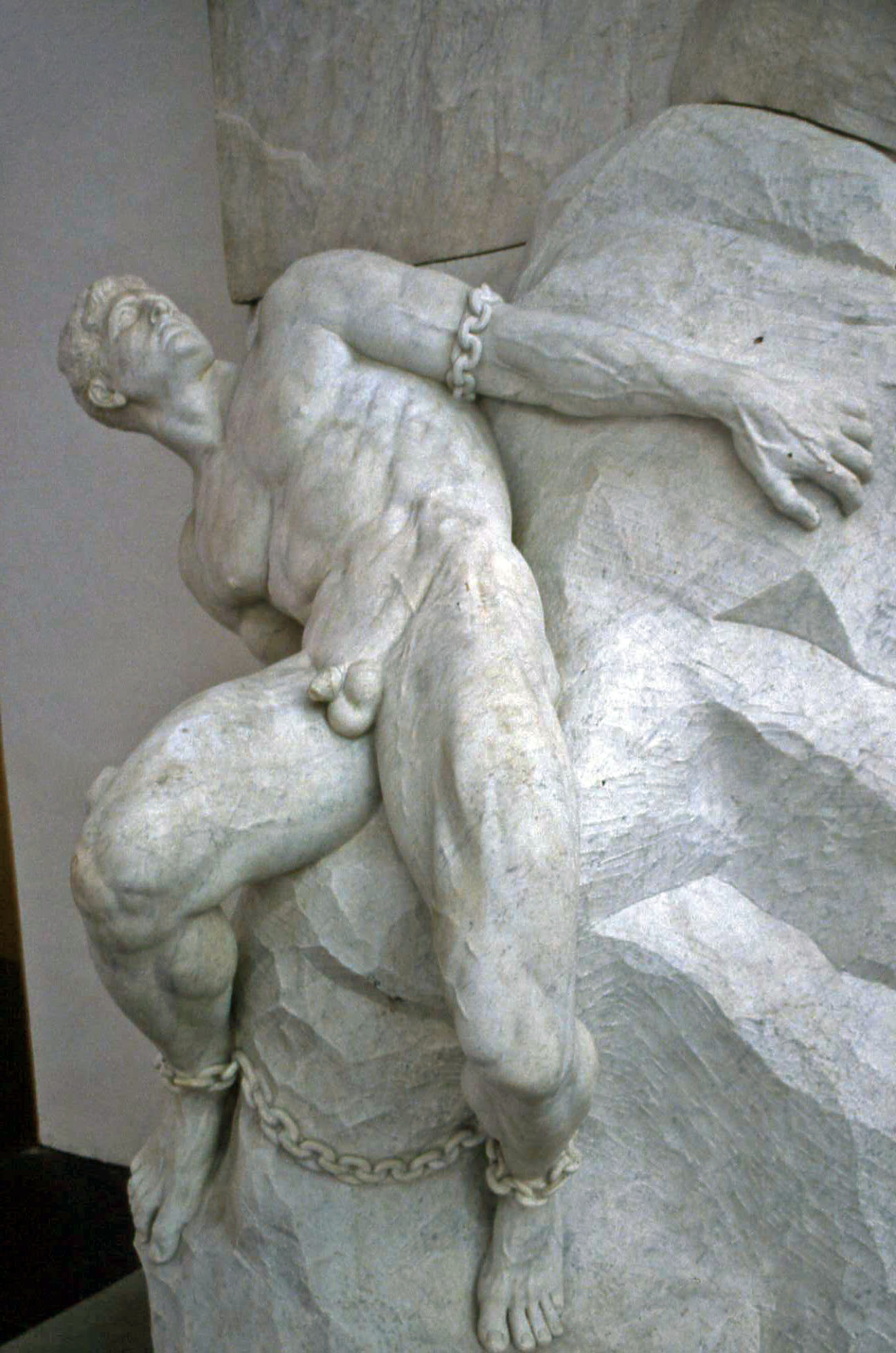
Prometheus Bound by Reinhold Begas. 
Photo by 
James Steakley [CC-BY-SA-3.0
(www.creativecommons.org/licenses/by-sa/3.0)
or GFDL (www.gnu.org/copyleft/fdl.html)],
via Wikimedia Commons
I promised myself not to get distracted, and particularly, not to let this blog get waylaid by Mary Shelley and her monster. Today's post is on the cusp, as it deals with the death of the woman known by that point as Mary Wollstonecraft Godwin, and with the birth of the girl introduced to the world by the same trinomial.

According to the Decator Minute, on Tuesday and Wednesday there will be dramatic readings in Georgia. (Not a million miles from North Carolina, which in 2009 put on a play called Rights and Wrongs.)
Atlanta playwright Marki Shalloe’s Promethea Unlaced, the story of the birth of Mary Shelley and the birth of her famous novel, Frankenstein. Shalloe is a local playwright with a penchant for finding stories in unusual places. “Of daydream and nightmare, always choose the nightmare. It makes the better tale,” says Shalloe in Promethea.

Shalloe said that once her research landed on Mary Shelley’s mother – Mary Wollstonecraft – everything changed. According to Shalloe, “This woman fought for the emancipation of women in the 18th century, believed in free love before anyone really knew what that was, and knew the most irreconcilable sin is the sin against oneself or self betrayal.” Shalloe knew then the story that needed to be told: the legacy of immortality through written expression.

Friday, September 23, 2011

Heroine of the high seas

Battery at Holmen, Risør -1814
In early summer I had the repeated pleasure of meeting Bee Rowlatt, who calls herself a "proper Wollstonecraft geek", and I wrote briefly of  her Scandinavian pilgrimage with baby under one arm and book proposal under the other. Remember the episode in Mary's life, when she returns to London from revolutionary France, babe in arms, to find the faithless Imlay shacked up with an actress? The American adventurer rescued her from a suicidal overdose of despair. She said, "What can I do to prove my devotion?" He said, "Well, there's this ship of mine that's gone missing, full of silver from French aristos who were liquidating their assets to stay a step ahead of the guillotine. Why don't you have a look for it? Last spotted in a Hanseatic port." (I paraphrase.) 


Bee's evocative and lively travel piece has finally appeared in The Telegraph:
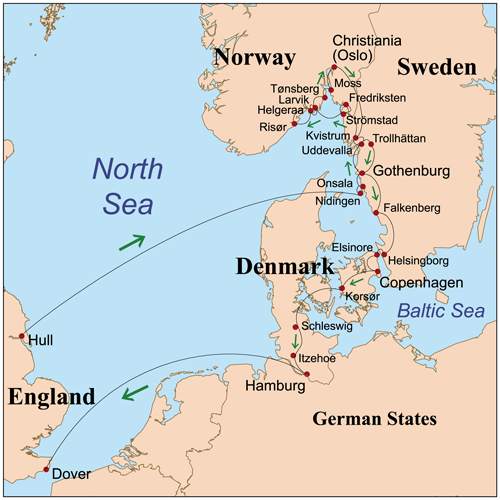
Wollstonecraft Letters map. Kmusser [CC-BY-SA-3.0]
She is a broken-hearted treasure-hunting single mum philosopher on the high seas, and I think I am a bit in love with her. So I am retracing her steps, on the part of her journey where she pursues a notorious Norwegian captain down the rocky coastline of the Skagerrak. Wollstonecraft undertook the voyage with her baby and a trusty maid. I am bringing my baby and a large rucksack but alas, no maid.
(I did offer my services, Bee, even before meeting your baby, and having done so, would gladly offer again.) Mother and infant journey from port to port:

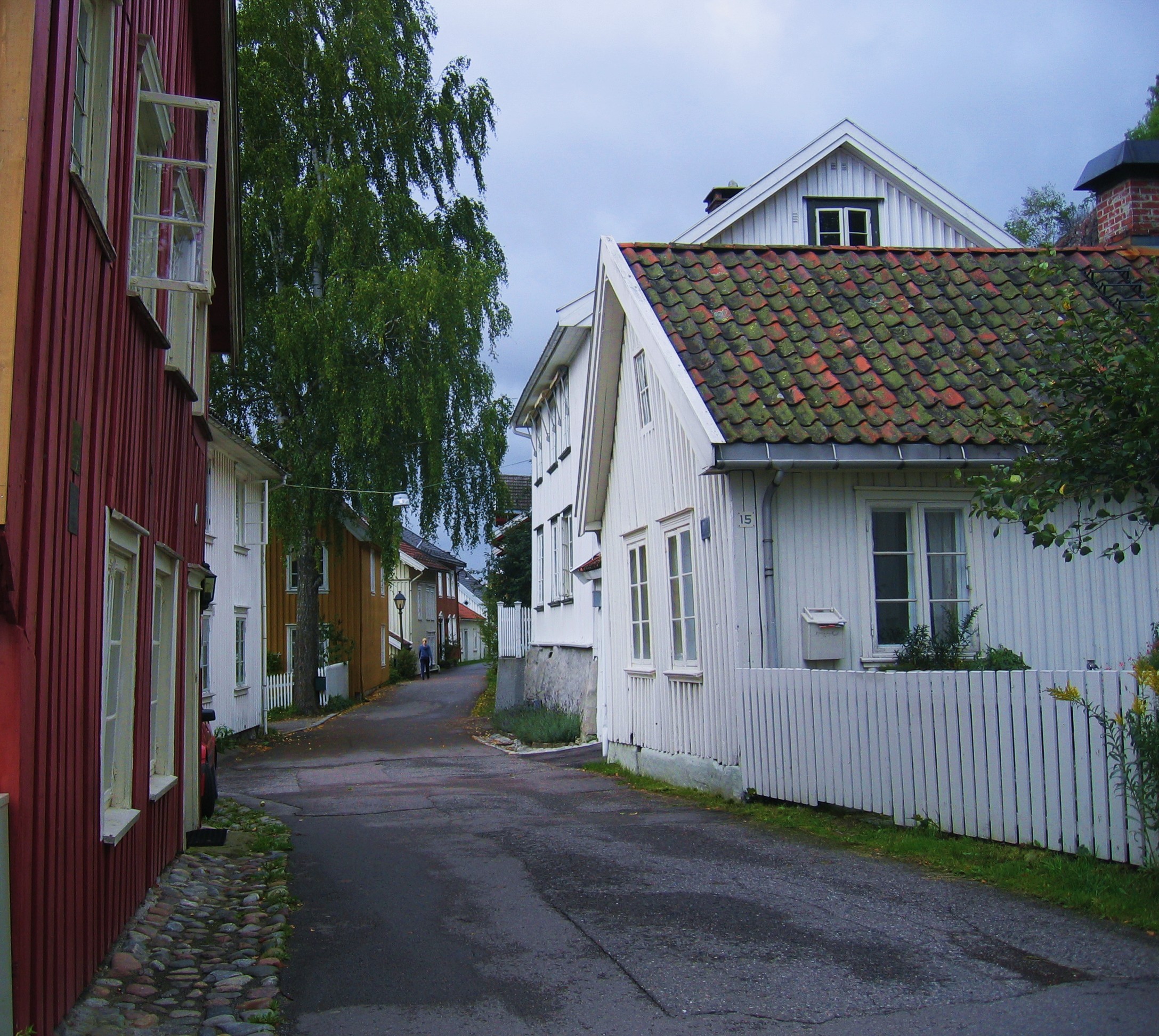
Tønsberg,by Karl Ragnar Gjertsen Krg.
[GFDL or CC-BY-3.0]
We begin in Tønsberg, a coastal town to the south of Oslo where Wollstonecraft made a base for her treasure hunt. It's a pretty town, a jumble of coloured wooden houses that look like attractive garden sheds.
(Some things have changed: in Mary's day there were about 1500 inhabitants, and now there are almost 40 000.)
With a delightful local guide, Ursula Houge, I visit the places where our heroine relaxed, posted many letters to the undeserving Imlay, and dined out with Tønsberg's finest.
Kragerø, Norway
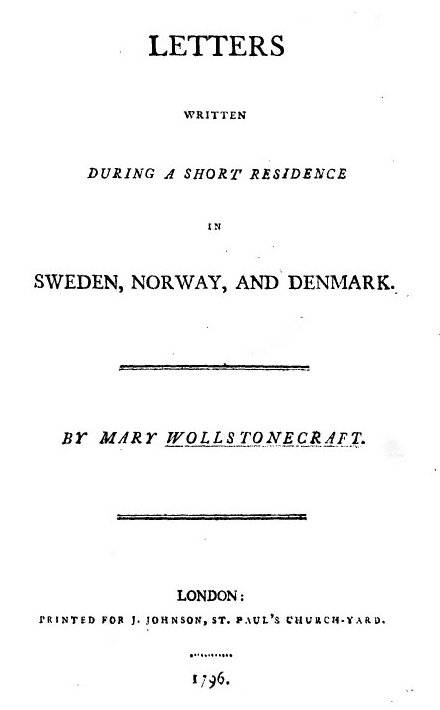
Some the ink spilled here became Letters Written in Sweden, Norway and Denmark, arguably Mary's best-known book after A Vindication of the Rights of Woman (though I suppose A Vindication of the Rights of Men ranks up there too). Bee told me that she discovered Mary through the Scandinavian letters. I've tended to come across feminists and democrats who know Mary through the more political angles to her life, but there must be many readers who found her first as a proto-Romantic. (And, of course, many would know her only as the mother of Mary Shelley, or, even more commonly, mistake her for the author of Frankenstein.) 
Wollstonecraft exclaims: "Norwegians enjoy all the blessings of freedom," but it's not just Norway's political possibilities that inspire her. Nature is hugely important. She responds to the sublime in the wilderness around her with abandon, and a lot of exclamation marks. Her new way of travel writing profoundly influenced subsequent Romantic writers; Coleridge's "Kubla Khan" has clear echoes of the book.
Let us not forget that those exclamation marks made William Godwin her husband: the anarchist philosopher had written against the institution of marriage, and was acquainted with Mary only somewhat unwillingly, but he fell head over bachelor heels on reading the newly published Letters. The only line of his that I can quote from memory is: "If ever there was a book calculated to make a man in love with its author, this appears to me to be the book." Phwoar! That's about as racy as dearest Wm ever got. Bee named her travelling companion William, by the way:
Will (the baby) and I are staying in a hostel just below the brow of the hill on which Wollstonecraft often sat, overlooking the town and the surrounding sea. She wrote: "the white sails… turned the cliffs, or seemed to take shelter under the pines which covered the little islands that so gracefully rose to render the terrific ocean beautiful. The fishermen were calmly casting their nets; whilst the seagulls hovered over the unruffled deep."
By Bilden är tagen av en amatörfotograf.Pihlbaoge
Doesn't it sound idyllic? 

Wollstonecraft travelled mostly by boat, heading westward in pursuit of the Norwegian captain who did a runner with Imlay's cargo of silver. I've enlisted the help of Gunnar Molden, a local historian and Wollstonecraft enthusiast, whose dogged research into this treacherous tale spans decades and countries. From Kragerø, Molden has arranged for a boat to take us on to Wollstonecraft's final stop. The moment we meet, we set about speculating on the missing silver and the Norwegian captain. Mick, the skipper, hadn't heard of Wollstonecraft's adventures here, but he's soon drawn in. We eat sugared cinnamon buns and I count jellyfish as we set sail. The sun is dazzling, there's a fair wind, and I'm so excited I can't sit still.

The article was months delayed by terrorist shooting and polar bear attack. By now the great British public has forgotten what a bad summer it has been for teenagers camping in Norway, and can turn again to the holiday fantasies of classic children's books, made real in the unreal blueness of Scandinavian seas: 
The lure of these islands is strong; there is magic in the notion of a miniature world, of setting foot on a child-sized kingdom. Watery adventures from childhood books spring to mind: Swallows and Amazons, The Famous Five, The Wind in the Willows.
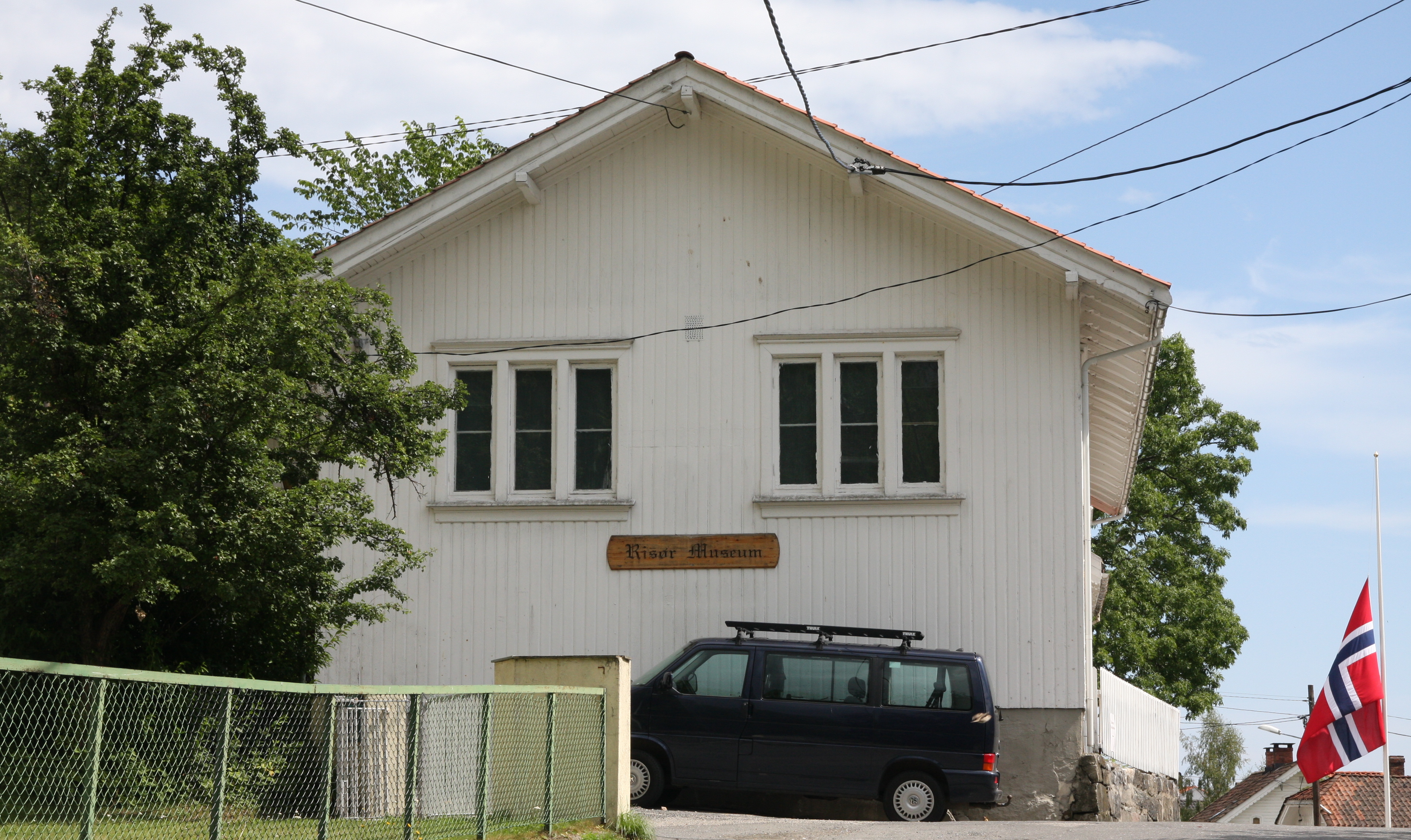
Visor Museum, by Jarvin - Jarle Vines [GFDL or CC-BY-3.0]
Book your holiday now, but do be aware that:
Norway is expensive.... Wollstonecraft remarked that "my bill at Tønsberg was ... much higher than it ought to have been" and the intervening 216 years have done nothing to change this. 
Speaking of dosh, Bee has very kindly donated her payment for Norway and Mary Wollstonecraft: My heroine of the high seas  to the campaign to raise a memorial statue. (I'm on the working group and have written about the project here.) In fact, Bee is offering more of her talents than mere money, and Mary on the Green can only benefit from her energy and enthusiasm. "She is a warm-hearted multi-mum writer/producer on the high seas, and I think I am a bit in love with her."


All images from Wikimedia Commons.

Sunday, July 3, 2011

An admirer returns from Norway

One of the highlights of the week was meeting Bee Rowlatt, who recently journeyed to Norway on a Mary Wollstonecraft pilgrimage. She is the one who I said had a baby under one arm and a book proposal under the other. Bee found Mary first through the Romantic letters rather than the rational essays, which is fitting, since her first book, Talking About Jane Austen in Baghdad, was about an epistolary friendship with an Iraqi academic. (More here.)

Bee got to experience Scandinavia at Solstice, or near enough, and met a Cockney ship's captain, and stayed in the garden of a Communist mayor, and had a fortnight alone with her almost year-old son William (a good name!), who proved to be a great ice-breaker.

Bee has an article coming up for the travel section of the Telegraph [edit: here], and then, more ambitiously, a book! I referred before to Melissa Benn and her Madonna and Child: towards a new politics of motherhood. Another book that came up in discussion was the recent How to be a Woman by Caitlin Moran: something zeitgeist-y. Bee uses the phrase "super lightweight" for what she has in mind, some sort of a meditation on Mary Wollstonecraft then and now, and being a woman and a mother, combined with a travel narrative. No book contract yet -- all offers considered.

Bee is a woman of many talents. For one thing, she had the determination necessary to get her new friend out of Iraq and to safety in England, and I know enough about the refugee process to know it is a long and spirit-sapping bureaucratic paper-chase. Bee works at the World Service, and rides a bicycle like many sensible Londoners, and is beautiful, in a healthy scrubbed effortless way, and can pronounce Tønsberg quite convincingly. Her children are charming -- at least, the 75% of them that I got to meet when she brought them to Mary's St Pancras graveside, where the kids ran around and she told me about her trip. What an adventure!

By Hesse1309 (Own work) [GFDL (www.gnu.org/copyleft/fdl.html) 
or CC-BY-SA-3.0 (www.creativecommons.org/licenses/by-sa/3.0/)], via Wikimedia Commons

Friday, April 22, 2011

Mary and the Undead

Fridays are for creativity. This blog likes to highlight some of the imaginative projects that people have come up with, that celebrate or spring from Mary Wollstonecraft and her life and works. We've seen a tattoo and a series of Wordles and a photomontage. And it's not just images: much of the creativity is of words too, written projects such as a cycle of poems.

Today we have the Undead. The teenage Mary not only meets and defeats them, she begins to formulate the fundamental concepts of equal rights that lay the groundwork for her masterpieces, A Vindication of the Rights of Men (1790), Woman (1792), and Zombies (179?). All this is channelled by Sandrine Berges, when she isn't teaching or writing serious philosophy. But don't worry; there's a higher purpose, e.g. "it's all about the social commentary and ethical reflection", or, what do zombies say about us.

A brief sample in the words of our precocious heroine. First, the trip to the North of England in difficult circumstances.
Our journey, from a village in the south of London, took three days - which was very good going – mostly because we were being chased by zombies for a large part of the way. There are no zombies where I come from, but I dare say that my own upbringing did much to prepare me for dealing with the foul beasts. I do not wish to trouble you with my complaints but let he be said that I believe that it is more remarkable that I should have survived living with such a family as I have for nearly sixteen years, than that I should have successfully fought off zombies for three weeks and three days.
After some unspecified time, the Wollstonecraft family goes back to London, leaving the zombies behind -- or so they think. This post explains the fate of Mary's younger brother Henry, who disappears from the canonical accounts.
We are not supposed to speak of him. If we are asked directly, we are to say that he was left behind in Yorkshire in apprenticeship. The people of London are not directly aware of the zombie infestation of the North. Of course there are stories, and people who travel to the North on business are sometimes maimed or killed, but they prefer to speak of it as highway men. 'Tis less fanciful and so less likely to put us in one of Hoxton's lunatics asylum (there are as many as three right by our doorstep, so we must be careful!) But it is respectability more than the fear of the lunatic asylum that motivates our lie. For Henry did not die at the hands of zombies. He has married one.
 All this leads nicely up to A Vindication of the Rights of Zombies:
It has long been my impression that our world is riddled with inequalities both in nature and in our treatment of each other. What has never been till now quite clear to me is how little those we treat as inferiors owe their inferiority to nature and not prejudice. In some cases at least it is obvious that it is our societies' treatment of them that has rendered them inferior. (I think that French manners, in particular, are much to blame for this.) Such is the case, I am now convinced, with zombies. Is a zombie by its nature a brain chomping, limb dropping fool, or has it been forced to become so by the prejudices of our society?
Sister to these posts is another Twitter account. Follow at your peril Mary the Hyena.

Tuesday, April 12, 2011

A philosophical translation

Last week I tried my hand at translating Mary Wollstonecraft into English, as she is spoke today. You can judge the results here. Sandrine Berges (whom I hope I may call this blog's resident philosopher, or at any rate our chief guest) pointed out in the comments that someone else had tried their hand at A Vindication of the Rights of Woman too. It turns out that this someone is none other than an academic philosopher, as kosher as they come, called Jonathan Bennett, who has devoted his talent and time to developing a site called Early Modern Texts. You can read all about him; but 'twould be more rational to skip directly to his explanation of the necessity for this project:
An average student, when required to read a stylistically difficult text, will either (1) confess defeat, or (2) glide along the surface of the text, getting a vague sense of having understood it. The greater disaster is (2). When so much in our world and indeed in our educational practices seduces people away from close and precise attention to the written word, it would be a sorry thing if this seduction were furthered by philosophy, which ought to be its most implacable enemy.
This explains how he translates these texts -- very methodically, and with a light but thorough hand. (These sound like the attributes of an excellent baker.) "The texts are not dumbed down. Where a change is made, it is to make the original thought more accessible than it is on the original page. In no case have I knowingly simplified or otherwise altered the intellectual content," he assures us. Jonathan Bennett is the further side of 80, and his efforts remind me of the so-called grandmother hypothesis -- the benefits to society of a body of people, willing and able to contribute their skills and knowledge, but no longer driven by necessities such as earning a living, getting the children to bed at a reasonable hour, and pleasing the department head.

Aside from his translation of A Vindication of the Rights of Woman, he gives us the works of several people who were important influences on Mary Wollstonecraft, including her mentor, the Dissenting minister Dr Richard Price, and the French philosopher and educationalist Jean-Jacques Rousseau. Also in his list is Anne Conway, who, according to the Stanford Encyclopedia of Philosophy, "was one of a tiny minority of seventeenth-century women who was able to pursue an interest in philosophy. She was associated with the Cambridge Platonists, particularly Henry More". I wonder if Mary knew of her Principles of the Most Ancient and Modern Philosophy?

Not the twilight of decrepitude, but the sunset of senescence: I feel a warm glow as I contemplate the wine he has bottled for our mutual delectation, from vinyards he has tended his whole life. His copyright statement is admirably clear. "There is no charge for any permitted use of the texts. No public money has supported the work of preparing the texts, or defrayed the costs of creating and maintaining this website." Is this not the epitome of generosity? The internet has given us new ways to be useful and to help each other. Long may it continue! 

It is a fantastic resource, no question. But without raining on anyone's parade, I have to point out that the passage I attempted to translate, he has left almost untouched. I ran his version through the readability calculator, and it came out with a US grade level of 12 to 27, take your pick. It's not easy material.

When students are introduced to the great philosophical works of the early modern period, it is usually in the hope that they will engage with the thoughts and arguments that the texts present. The teaching experience of many of us suggests that most students simply cannot understand these texts. The increasing rate of change in the English language ensures that fewer and fewer of today’s readers can cope with the writings of the 16th-18th centuries. There are difficulties of syntax, length and complexity of sentences, words that are no longer current, still-familiar words used in meanings that they now do not have, arcane references to other philosophers which today’s students will seldom understand or be required to follow up; these and other factors create forbidding obstacles to engaging with these early modern texts. 
I reduce the obstacles so that students can more easily come to grips with the philosophical thoughts the texts express. Once they do that, they still won’t have an easy time, because the material itself is hard; but their efforts will go into getting philosophical understanding, not decoding old prose. 
My versions are faithful to the content of the originals, but are plainer and more straightforward in manner. I could have made them even plainer, but that would have taken them further than I wanted to go from the stylistic feel of the originals. I love the original texts, and am glad to have spent years wrestling with them in their pristine form. I do wish, though, that through the years I could also have read them sometimes with all my energy going into the philosophy.

Monday, March 28, 2011

A Japanese historian muses

Last week we had the thoughts of a French philosopher in Turkey; this week, those of a Japanese historian on a research visit to London.  Chihiro Umegaki specialises in the history of the English Enlightenment and women writers in the 18th century; no surprise, then, that she has written extensively on Mary Wollstonecraft, bringing her to a Japanese audience. She came across this blog, and I promptly invited her along on my jaunt to Oxford to commune with Shelley's Ghost (which closed yesterday). Chihiro was the ideal companion; our obsessions tally nicely. We got out our maps and plotted where exactly Mary's dwelling places would have been, and how many of them might be visitable in a week in London. Plaques, and places without plaques, and Newington Green for the church as well, and the Museum of London for Hidden, not forgetting the National Portrait Gallery....I'll describe our peregrinations in several future posts. For now, let Chihiro introduce herself, and how she came to work with Mary.

**********************************************
Mary Wollstonecraft has been my idol for more than 15 years. I came across her Vindication when I was an undergraduate student in Tokyo. Of course there were a lot of phrases and expressions which I could not understand fully, but I found her arguments very authentic, and fancied that she personally supported me, unsure of my own future academic career in the still male-dominant society of Japan.

My first visit to London was in 2000, when I took my MA course in history in York. I remember how disappointed I was to learn that there were no proper memorial spots of Mary Wollstonecraft. I tried to find her plaques on buildings, but in vain. As an overseas student who spent only one year in Britain, I would be happy enough if I could take a picture of me standing side by side with her statue, and imagine that I was connected with her real life in London…

After finishing my MA, I came back home, and published some articles (in Japanese) about Mary Wollstonecraft and contemporary women writers. I have been teaching British history at a women's junior college in Tokyo for 8 years, and now I am writing an introductory book to A Vindication of the Rights of Woman for Japanese readers. We do have a Japanese translation (published in 1980), but I think ordinary readers still need some guidance to understand the full context of her arguments. My book is intended to be such a guide.

I came to London in March this year partly because I needed some fresh inspiration for the final phase of my writing. Unexpectedly, the Mary on the Green project caught my eyes. It was a very happy surprise, and convinced me that Mary Wollstonecraft’s voice is still heard. I will encourage my Japanese readers to support this project, and hope that some day I can take a picture of me holding my book, standing next to Mary's statue in Newington Green.

Monday, March 21, 2011

A (modern, female) philosopher muses

I am absolutely delighted to introduce the first guest post, from Sandrine Berges, an early supporter of this blog. Sandrine teaches philosophy in Turkey, and blogs for fun with her two sisters at http://paris-ankara.blogspot.com. Here she writes about how Mary Wollstonecraft fits into her professional life. 

*************************************************************
Four years ago, I barely knew who she was. Then a (male) colleague suggested we introduce the two Vindications to our survey course in political philosophy. It was love at first read - I found arguments and a style that I liked and that I could relate to. I sometimes wonder whether I saw in her writings what I wanted to see – I seemed to be able to extract from them most of what I wanted to say about most things – still do. Before that, I had spent years reading and writing on Plato. For a feminist, that is not always very satisfying. Also, I had been teaching for five years in a department in which I was the only woman, having graduated in a field in which there are very few of us already.

Wollstonecraft did not quite give me voice - I was already a published philosopher - she did not quite give me confidence - being a woman academic in a male department will do that for you - but she helped anchor me, become at peace with what I was: a woman philosopher, intermittently fighting for the cause of other women through my writings. 

Wollstonecraft also gave me success. The first article I wrote on her was accepted for publication in a very good journal. The second sent me to Tuscany for a conference, and of course, there is the book. The first book I wrote was a monograph: my own reflections on Plato's moral and political philosophy - very worthy, no doubt, but frankly, who reads it? The book I am writing now is an introduction. One of those you see in all university bookshops, that students buy whenever they want to find out something about someone. One of those books that people buy even if they're not philosophers, and even, sometimes, if they're not students! I shall be rich! Well, no, but I will enjoy seeing the number of copies bought when I receive my no-doubt measly royalty check.

But forget these misplaced fantasies of fame and riches. What is making me happy is the feeling that I have a chance of being useful, as Wollstonecraft herself would say. My book, when it is written, may encourage people to read the Vindications, its existence may trick some of them into thinking that Wollstonecraft is part of the canon of philosophers taught at university, and then, who knows? She might become just that.

In the meantime, I am struggling, for the first time in my life really trying to get something just right, and worrying about the consequences if I don't. Wish me luck.