We have been looking at the opportunities Jane Austen had to read Mary Wollstonecraft. The consensus is overwhelming that the opportunity was there: there are family connections, tenuous but real, as pointed out by Claire Tomalin, and access to circulating libraries during Austen's years in Bath. More importantly, though, is the textual evidence that the ideas laid out in
A Vindication of the Rights of Woman -- the need for rational education and a marriage of mutual respect -- find fictional flesh in the examples and counter-examples of the novels,
as we saw the other day. I even found a hidden clue,
a secret nod, embedded in the name of one of the most contentious characters.
The
first post of this series touched on the difference between Tory feminism and Enlightenment feminism, drawing on
Jane Austen, Feminism and Fiction by Margaret Kirkham, which we looked at in more detail i
n the second post. This book, in its 1983 original or its 1996 second edition, I'm not quite sure, was reviewed by
Margaret Doody. I haven't seen the review, but it was thoroughly picked
apart by one Arnie Perlstein, an unlikely, to put it mildly, contributor
to the discussion. There is no more passionate defender of Jane Austen as a radical feminist than this outsider. I think we can call him, as
Ms magazine called Bob Lamm when he
liberated Mary from the dungeons of the National Portrait Gallery, a male feminist.
The biography
on his blog:
I'm a 59 year old independent scholar (still) working on a book project
about the SHADOW STORIES of Jane Austen's novels (and Shakespeare's
plays). I first read Austen in 1995, an American male real estate
lawyer, i.e., a Janeite outsider. I therefore never "learned" that there
was no secret subtext in her novels. All I did was to closely read and
reread her novels, while participating in stimulating online group
readings.
Then, in 2002, I whimsically wondered whether Willoughby
stalked Marianne Dashwood and staged their “accidental” meeting. I
retraced his steps, followed the textual “bread crumbs”, and verified
my hunch. I've since made numerous similar discoveries about offstage
scheming by various characters.
In hindsight, it was my luck not only to
be a lawyer, but also a lifelong solver of NY Times and other difficult
American crossword puzzles. These both trained me to spot complex
patterns based on fragmentary data, to interpret cryptic clues of all
kinds, and, above all, not to give up until I’ve completed the
puzzle--and literary sleuthing Jane Austen's novels (and Shakespeare's
plays) is, bar none, the best puzzle solving in the world!
If you like fisking, take a look:
Margaret Doody's misguided review of Margaret Kirkham's Pioneering, Prescient & Spot-On 1982 book Jane Austen, Feminism and Fiction. I didn't see this until later. I first came across his forensic examination in November, when he claimed that
Jane Austen was haunted by the Ghost of Mary Wollstonecraft, and got in touch in the comments. (Dear reader - please do the same!)
He posts about once a day, essays or diatribes rich in iconoclastic
ideas and mad enthusiasm. I suspect the lawyering is a bit slow in
Florida at the moment, and I for one am glad of it, if that gives room
for
the flowering of amateurism (a term of high praise in Wollstonecraft Towers). Here is a fair flavour of his argument:
I think JA was haunted by the Ghost and the memory of Mary
Wollstonecraft, a woman who was brave enough to speak out on behalf of
women very publicly, and who, after her death, was vilified because she
had been so brave.
It's no accident, therefore, that JA alluded
SPECIFICALLY to the very radical polemical novel CALEB WILLIAMS (written
in 1809), which, after all, just happened to be written by Godwin, who
just happened to have been the husband of...............Mary
Wollstonecraft!
Here is an example of the sort of
convoluted crossword theory he favours. I'm not saying he's wrong; I'm
just saying you need to have a special sort of mind to follow the
thread. Ariadne and the Minotaur?
So it means that when I interpret Henry Tilney as
having an epiphany about his mother's death as a result of Catherine's
detective work at the Abbey, this is deeply connected to JA's allusion
to Godwin's 1809 novel, a novel written a few years AFTER Godwin had a
chance to see how the Far Right seized on his Memoir of his dead wife as
grounds for crucifying her reputation in the court of public opinion.
So
JA is telling us, covertly that (i) in a way, Godwin was Henry Tilney,
because he eventually "got it" that he had screwed up, and he wrote
Caleb Williams as penance, and (ii) in another way, Godwin was GENERAL
Tilney, who did regret the role he played in bringing about his wife's
death.
He speculates about Godwin's role:
And the most awful thing is that Godwin "killed" his wife
TWICE, and both times it was "involuntary womanslaughter"--the first
time, by getting her pregnant, leading to her physical death in
childbirth, and the second time by writing her Memoir (perhaps trying to
resurrect her), but having it backfire, and instead leading to the
public assassination of her character!
And he sums up his view of Jane Austen's feminism:
I believe that for a very
long time, maybe her whole adult life, JA played with the idea of going
public with her true feelings. But in the end of the day, every time she
put quill pen to paper, she chose to go undercover -- but I get the very
strong sense that she always felt ambivalent about that painful
decision. The regret that Catherine and Eleanor express when they talk
about Mrs. Tilney is, I think, JA's own regrets....
So Northanger Abbey is in a very real sense JA's eulogy to the greatest feminist "heroine" of her time.
He also speculates in
Jane Austen the radical but covert feminist Part 268 that Mary Bennet is Jane Austen's alter ego, named after Mary Wollstonecraft. He agreed that I was barking up the right tree as regards name clues, and commented that Mary Bennet is "the most important surrogate for Mary W in all of Jane Austen's fiction":
...what you have is Mary Bennet as JA's covert self portrait! JA has led
the reader down the garden path, seeing if we will take the bait and
join with the rest of the Bennet family in unjustly and at times cruelly
scorning Mary, but hoping that we will struggle with our inner Mr.
Bennet and instead realize that we've been guilty of a wrong first
impression of Mary, and reconsider.
So we have a surface parody
of Mary, but a veiled anti-parody which vindicates Mary (who I claim is
named after Mary Wollstonecraft). And I claim exactly the same sort of
anti-parody in Northanger Abbey which has a surface parody of Catherine,
but a covert anti-parody which vindicates Catherine's keen
perceptions.
Enough to make anyone dizzy.
Next time, a look at the post that kicked this all off, from historical novelist Lauren Gilbert.
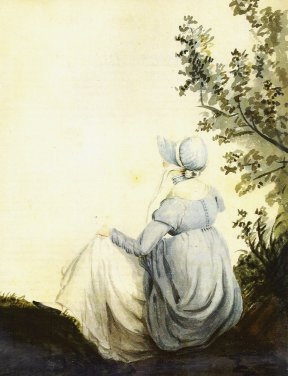
Jane Austen, by her sister Cassandra. (1773-1845) [Public domain], via Wikimedia Commons
-----------------------------
Part of a linked series:
Jane Austen: a lost daughter? Part one,
Part two: Kirkham and Ascarelli,
Part three: Gordon,
Part four: Perlstein,
Part five: Gilbert,
Part six: Russo and Broemel.
Part of a very loose series on lost daughters and sons: Margaret King (Mrs Mason) , Millicent Garrett Fawcett, C19 American women's rights advocates,
Claire Clairmont,
Voltairine de Cleyre,
William Gladstone,
Ayaan Hirsi Ali,
Amartya Sen