Showing posts with label religion. Show all posts

Sunday, March 17, 2013

A musical birthday


Mary Wollstonecraft's 254th birthday will be celebrated by Chorus of Dissent and the Elastic Band, "featuring music performed in London during her lifetime".

The venue is Stoke Newington, in her day a village known for its Quakers, just as Newington Green, where she had her school a mile away across the fields, was associated with the Rational Dissenters, now Unitarians. The difference is that Stokey was the centre of the Church of England parish: it had St Mary's. In the eighteenth century this was still the little medieval building, but the sprawl of the metropolis a century later necessitated the construction of a Victorian barn (unusually, directly opposite its predecessor). Now St Mary's Old Church is on the way to becoming an arts venue, and St Mary's New Church appears to be thriving.

The tickets have not yet been released, but pencil in 5:30 pm on Saturday 27 April 2013 for a "delightfully short concert from Stoke Newington’s very own choir and professional orchestra". We are promised "scenes from Handel’s Messiah ... juxtaposed with Haydn’s Creation, the whole presented in our inimitable and inclusive Dissenting style". And who are these singers?
Dissenters was set up by Ruth Whitehead to offer local, inclusive and excellent creative arts experiences, without one iota of dumbing down. Drawing on her background as a professional musician she set up Chorus of Dissent and the professional orchestra, the Elastic Band. All Dissenters’ events are sponsored by her company Ruth Whitehead Associates, your local investment advisers and IFAs.
Lots more about Chorus of Dissent on their website. Here's how they began:
The 21st Century Dissenters gathered under an urban apple tree in the garden of a Thomas Cubitt house in Albion Road, Stoke Newington London N16, to discuss following in the footsteps of the local nonconformist heritage. Shamelessly leaning on our distinguished history of freethinkers, philanthropists and artists, from famous feminist writer Mary Wollstonecraft to Champagne Charlie (musical hall artist George Leybourne), Dissenters London N16 came into being.

***************************
Photo of the two St Mary spires 
by Tarquin Binary via Wikimedia Commons, 
used under Creative Commons share-alike licence.

Friday, March 15, 2013

Hidden re-appears


With the kind permission of the artist himself, Red Saunders.

Red Saunders created Mary Wollstonecraft and the Dissenters of Newington Green 1781 as part of his Hidden from History series. Thanks to the Socialist Worker, I am pleased to report that it is visible once more, this time in the People's History Museum, until the end of September. I wrote about the creation of this elaborate photomontage here.

[This is my 200th post, over two and half years. Not bad going.]


Tuesday, May 17, 2011

Unitarian: Was she or wasn't she?

A fortnight ago we looked at the ancestry of Mary Wollstonecraft, particularly the pesky and confusing repetition of Edwards, and I congratulated Daphne Johnson on giving amateurs, in the true sense of the word, a good name.  Today we feature the work of another thoughtful amateur, Joan Wilkinson, a.k.a. Yorkshiregirl. Now of course Mary was a Yorkshire girl too -- at least, she spent the longest settled period of her girlhood (of her life, offhand, I think -- counting on my fingers) in Beverley, where she met Ardent Jane and her family library. In later life, down in smoky London, Mary referred to herself as a Yorkshirewoman -- but everyone in London is from somewhere else, or claims their parents were.

Joan has written a tidy essay on Mary and Unitarianism, describing the development of our lady's theological views on the oneness of God. (Joan has also written of a dozen mainly C18 and C19 women, particularly from the British Unitarian tradition, including two who crossed pens with Mary, namely Anna Laetitia Barbauld, who has a big memorial tablet in Newington Green Unitarian Church, and Mary Hays, who supported MW in Godwin's house during the deathbed days.)  We've already looked at Mary's views of the Divine (A Good Thing) and her views on Dissenters (Not Wholly A Good Thing).

Joan starts by asking, quite reasonably:
by what criteria do we judge someone to be a Unitarian? Is it by their contribution to a Unitarian group or movement or by a particular way of thinking?
She shows how Mary, who had previously worshipped only in the Church of England, changed her theological views when she moved to Newington Green, a village that had grown up just north of London, centred around its Dissenting chapel on the green. (Still there, still radical.) Richard Price, its much-loved minister, preached in an atmosphere of "ethical rigour":
Instead of a deity breathing hellfire, here was a benign supreme being. The vision of mankind as essentially good and inherently perfectible sat well with rational morality and reform politics. Price preached that no earthly power has authority over our private judgement and that liberty and reason constitute the capacity of virtue. We love God because He deserves our love, not because he demands it. Universal benevolence, public spirit, with love being God's agent of human liberation is beyond that of country and monarch.
She points out the theistic framework of A Vindication of the Rights of Woman, acknowledging that this is often overlooked in our day.
Wollstonecraft continually strove to define an authentic religious subjectivity. She asked what shape a woman's inner life took when forged in right relationship to her Maker? She wrote '…it is not philosophical to speak of sex when the soul is mentioned.' [...] The emphasis was on the democracy of God's grace rather than a hierarchical context and rational criticism considered essential when reading the Bible. 
As Mary travelled through Scandinavia, her soul was touched by her surroundings. Awe and wonder were appropriate responses to nature's majesty -- soaring mountains, tumbling waterfalls, endless fjords. (This, I think, is Mary's nearest approach to poetry, one of the few genres of writing she never turned her hand to.) On her return to London, her writings show that:
Her individualism and religious imagination had taken her beyond Unitarianism of that time. She considered their chapels to be too homely, their sectarianism too narrow and their reason too cold. Imaginative inspiration and adoration was crucial in the devotion given to God.
After her death, she continued to influence:
the rising generation of radical Unitarians and others teaching freedom, reason and tolerance. She also left a legacy of an individualist theological subjectivity that embraced imagination and lyrical pantheism that was influential in the next generation of Romantic poets.
Whether or not Mary Wollstonecraft would ever have considered herself, or been considered by her friends, a Unitarian, is a question that must remain unanswered. However, as Joan points out:
we can say that her writing was an expression of her own moral and religious journey, with her religious understanding fitting comfortably the spectrum of what many today consider Unitarianism to be. 
I can't wait to hear what biographer Lyndall Gordon will have to say this Sunday in Oxford, when she speaks "concerning the life and times and Unitarian connections of the 18th-century feminist".

Sunday, May 15, 2011

Mary and God

St Pancras Old Church
Mary Wollstonecraft took religion seriously. She was baptised into the established church, and when she decided to marry, made her vows at St Pancras, safe within the Church of England. Nonetheless, she hung out with Rational Dissenters at just the right time in her life, and was radicalised by the congregation of Newington Green, led by its minister Dr Richard Price. (And that Unitarian Church is still radical.) She criticised the Dissenters, as we have seen, but drew sympathetic parallels between their situation and that of women, denied full participation in civil society.

Newington Green Unitarian Church
Mary was something of an amateur theologian, using first her reason and later her sensibility to explore the divine. Feminists of our time skate merrily across the fact of her deeply theistic worldview. Much of A Vindication of the Rights of Woman deals with ethics, correct behaviour (in the Buddhist sense of right livelihood, rather than merely etiquette), and the nature of God.

Here's a chapter title you don't often hear cited: "Chap. XIII. Some Instances of the Folly Which the Ignorance of Women Generates; with Concluding Reflections on the Moral Improvement That a Revolution in Female Manners Might Naturally Be Expected to Produce." In other words, "Silly Things Ill-Educated Women Do, and How Much Better the World Would Be If Only They Behaved Themselves". It starts by entreating women to reflect on God, and telling them off at length for seeking out fortune-tellers and "fashionable deceptions, practised by the whole tribe of magnetisers" (sounds like the altmed crowd - note to self, another post another time). There is a list of rhetorical questions, to which she expects the answer "yes":
Do you believe that there is but one God, and that he is powerful, wise, and good?Do you believe that all things were created by him, and that all beings are dependent on him?Do you rely on his wisdom, so conspicuous in his works, and in your own frame, and are you convinced that he has ordered all things which do not come under the cognizance of your senses, in the same perfect harmony, to fulfil his designs?  
She also writes a long digression "considering the attributes of God":
Positive punishment appears so contrary to the nature of God, discoverable in all his works, and in our own reason, that I could sooner believe that the Deity paid no attention to the conduct of men, than that he punished without the benevolent design of reforming.  
To suppose only that an all-wise and powerful Being, as good as he is great, should create a being foreseeing, that after fifty or sixty years of feverish existence, it would be plunged into never ending woe—is blasphemy. I know that many devout people boast of submitting to the Will of God blindly, as to an arbitrary sceptre or rod, on the same principle as the Indians worship the devil. In other words, like people in the common concerns of life, they homage to power, and cringe under the foot that can crush them. Rational religion, on the contrary, is a submission to the will of a being so perfectly wise, that all he wills must be directed by the proper motive—must be reasonable.
This is one of the passages that makes it so unfair that the Victorians vilified her for being an atheist: she was a through-going deist all her life, as far as I can tell. It was dear William Godwin and his ill-considered memoir that inadvertently caused her to be seen as rejecting God on her deathbed. It's a bit like being "accused" of being gay. ( I put the verb in scare-quotes because it presumes that one or both parties perceive gayness to be a bad thing.) What if the answer is, yes I am - so what? Or what if the answer is, no I'm not actually, although there's nothing wrong with it? If that is the truth, further denials can become awkward, and anyway are impossible if one happens to be dead, and the distraught widower, as an avowed atheist, has no interest in protesting on one's behalf.
I can't wait to hear what Lyndall Gordon has to say about Mary Wollstonecraft and the Unitarians. 
Images via Wikicommons.

Friday, May 6, 2011

Speaking truth to power in Chichester Cathedral

Mary Wollstonecraft -- or at any rate A Vindication of the Rights of Woman -- will be heard in the very nave of Chichester Cathedral. Her magnum opus has been chosen by Canon Dr Anthony Cane, the Cathedral Chancellor, as one of four books that changed the world. Her admirers, and critics, are invited to gather this Thursday evening, 12 May, at 6:30. "Admission is free and all are welcome." More info here.
The translators of the King James Bible enabled the gospel to be heard in English (rather than Latin) not just in this country, but throughout the world.  Mary Wollstonecraft started the struggle for the equality of women.  Charles Darwin challenged long-held assumptions about God, human beings, and the nature of life.  Adam Smith set out the laws of market forces that dominate economies to this day.  All this through just four books, each of which had an immense impact when first published, and played a major part in shaping the world we live in today.  This lecture series will explore the stories of these very different books, and the people who produced them.
Image: By Willwal.Supercalafragiclisticexpialadotious at en.wikipedia [GFDL (www.gnu.org/copyleft/fdl.html) 
or CC-BY-SA-3.0 (www.creativecommons.org/licenses/by-sa/3.0/)], from Wikimedia Commons 

Sunday, April 24, 2011

Mary and the Dissenters

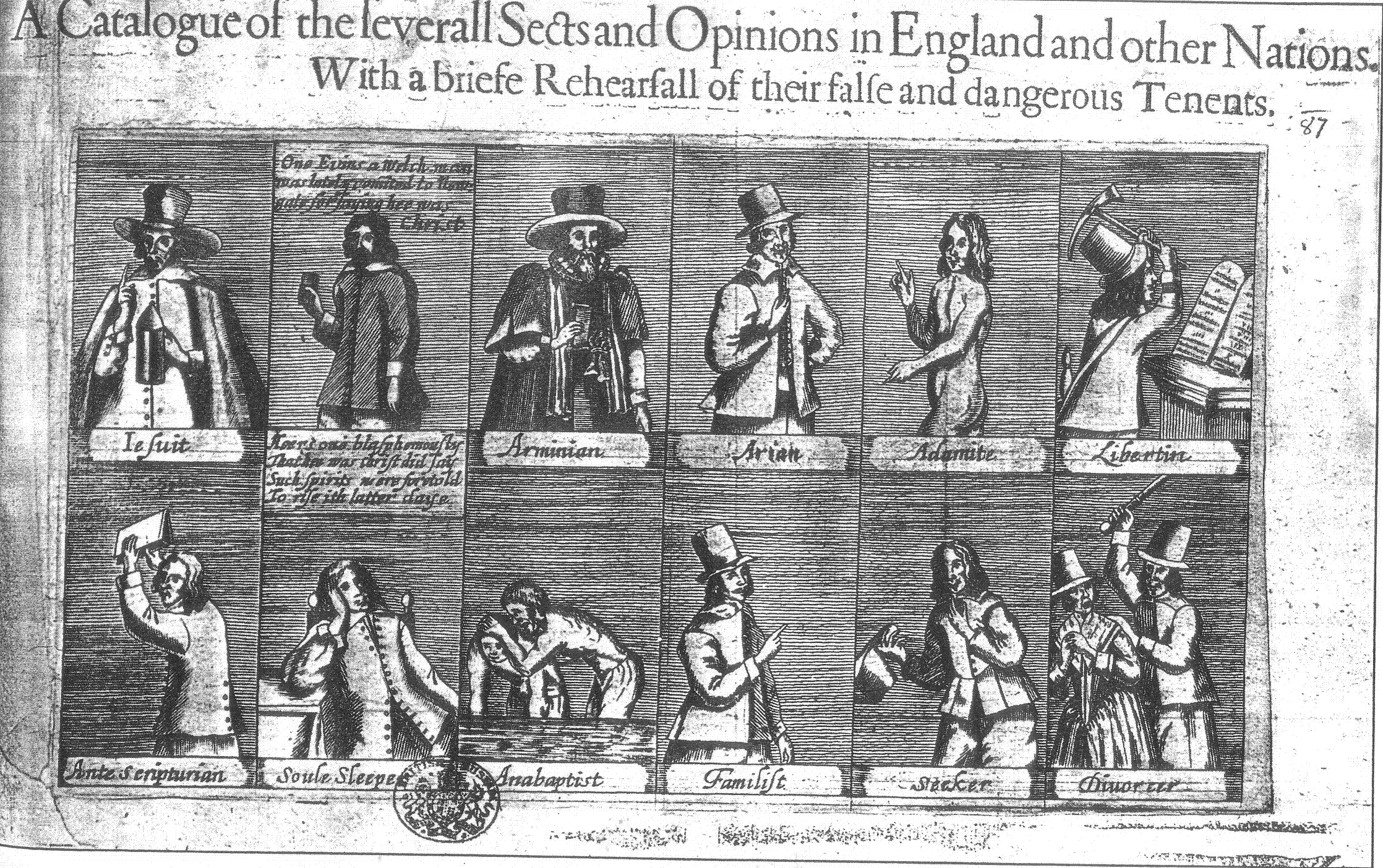
A Catalogue of the Severall Sects and Opinions
in England and other Nations
(1647).
Public domain, Wikimedia Commons.
One metaphor often called upon in the early days of arguing for the rights of women was the parallel situation of slaves, who were, by that point, recognised as human beings with souls, but not thought to have full powers of intellect and reason. At best, slaves and women were treated legally as children, minors under the control of their masters or men, who could chastise them physically and restrict their existence in the world. This comparison is well known.
Another parallel is less so. Mary Wollstonecraft compared the situation of women in her day to that of a religious minority, those we now look back on under the name of Rational Dissenters. They had split from the Church of England, or, as they saw it, the established church had split from them. Protestant non-conformists then, Socinians or Arians later, Unitarians now. Mary spent a few years in their midst at Newington Green, befriended by the Dissenting minister, Dr Richard Price, and that fairy godmother, the widow Burgh. From her time there, she drew these impressions, which later found their way into A Vindication of the Rights of Woman:
Were not dissenters, for instance, a class of people, with strict truth characterized as cunning? And may I not lay some stress on this fact to prove, that when any power but reason curbs the free spirit of man, dissimulation is practised, and the various shifts of art are naturally called forth? Great attention to decorum, which was carried to a degree of scrupulosity, and all that puerile bustle about trifles and consequential solemnity, which Butler's caricature of a dissenter, brings before the imagination, shaped their persons as well as their minds in the mould of prim littleness.  
I speak collectively, for I know how many ornaments to human nature have been enrolled amongst sectaries [how many great people have been found among those who belong to religious sects]; yet, I assert, that the same narrow prejudice for their sect, which women have for their families, prevailed in the dissenting part of the community, however worthy in other respects; and also that the same timid prudence, or headstrong efforts, often disgraced the exertions of both. Oppression thus formed many of the features of their character perfectly to coincide with that of the oppressed half of mankind; for is it not notorious that dissenters were, like women, fond of deliberating together, and asking advice of each other, till by a complication of little contrivances, some little end was brought about? A similar attention to preserve their reputation was conspicuous in the dissenting and female world, and was produced by a similar cause.
Both Dissenters and women were denied political power or full education. The parallels are intriguing, and despite her many good reasons for gratitude, Mary Wollstonecraft is not blind to their faults. I'll be waiting to hear what Lyndall Gordon has to say about the matter in Oxford on 22 May.

Thursday, April 21, 2011

Lost daughter: Ayaan Hirsi Ali

A couple of weeks ago I wrote about Mary Wollstonecraft's sons and daughters: those whom she influenced, often long after her death. These are her prime legacy. Many of these people are "lost", either in the sense that they did not acknowledge how Mary touched their lives and thinking, or because those who write about them haven't picked up what references were made.

Ayaan Hirsi Ali falls into the latter category. She is a multiple exile, born in Somalia to a rebel leader, but raised in Saudi and Ethiopia and Kenya; she escaped alone to the Netherlands to avoid an arranged marriage, where she reinvented herself, studied political science, and got elected MP; and now has another life as an exile once more, this time in the United States. In the aftermath of 9/11 she decisively rejected Islam, the religion of her birth, and took on the mantle of atheism. This rejection is largely due to the abuses she sees that religion perpetrating on women -- indeed, she is one of the world's most high profile critics of Islam. You may remember the case of the Dutch film-maker who was murdered in the street for his brief video about domestic violence justified by Koranic verses; his name was Theo van Gogh and Ayaan Hirsi Ali was working with him on that film, Submission.

She entitled her memoirs Infidel, and there discusses Mary Wollstonecraft. She was considering doing a PhD, and in a conversation with one woman, turned away from the idea and towards more direct politics. From page 295:
What was I trying to achieve? Three things: first, I wanted Holland to wake up and stop tolerating the oppression of Muslim women in its midst....Second, I wanted to spark a debate among Muslims about reforming aspects of Islam so that people could begin to question, and criticize, their own beliefs.... 
Third, I wanted Muslim women to realize just how bad, and how unacceptable, their suffering was. I wanted to help them develop the vocabulary of resistance. I was inspired by Mary Wollstonecraft, the pioneering feminist thinker who told women they had the same ability to reason as men did and deserved the same rights. Even after she published A Vindication of the Rights of Women [sic], it took more than a century before the suffragettes marched for the vote. I knew that freeing Muslim women from their mental cage would take time, too. I didn't expect immediate waves of organized support among Muslim women. People who are conditioned to meekness, almost to the point where they have no mind of their own, sadly have no ability to organize, or will to express their opinion. 
In 2007 she set up the AHA Foundation (Ayaan Hirsi Ali, geddit?) in the United States. The website strapline says simply "Women everywhere, of all cultures, merit access to education and basic human rights".
The AHA Foundation works to reinforce the following basic rights: the rights of women and girls to security and control of their own bodies, the rights of women and girls to an education, the rights of women to work outside the home and to control their own income, the rights of women and girls to freedom of expression and association, and the rights of women and girls to other basic civil rights of citizens and residents defined under the laws of Western democracies and the Universal Declaration of Human Rights, regardless of sexual identification.
And from a recent interview in the Guardian:
Why, she asks, are voices such as [Germaine] Greer's not speaking out against the subjugation of women in the Muslim world? She calls for a new feminism, "that is going to focus on issues faced by non-western women, because they are the biggest issues. To own your own sexuality, as an adult woman; to choose your own lifestyle; to have access to education.... These things, I think, are more basic than the stuff that current feminists are concerning themselves with – like shattering the glass ceiling or finding a balance between work and home life.... There is feminism that has evolved to a kind of luxury." 
Another blogging co-incidence: I'd had this post lined up for a while, and only a couple of hours ago discovered that today is Kartini Day, the national holiday of the world's most populous Islamic country, Indonesia. Is there anyone there who can comment on the situation?

Sunday, April 10, 2011

Lyndall Gordon on Mary and the Unitarians

Harris Manchester College, via WikiCommons

O frabjous day! Both the day I learned of this, and the day I am now looking forward to!

Biographer Lyndall Gordon will be speaking next month on Mary Wollstonecraft's "life and times and Unitarian connections". I am particularly intrigued by this, because it ties into the couple of years Mary spent at Newington Green, hanging out with the Rational Dissenters, indeed, being life-transformingly influenced by that community, but never actually joining them. Richard Price was the minister there, fantastically well-connected, and he took a shine to her. The fairy godmother who helped her set up in the first place was Mrs Burgh, widow of the educationalist. Through that network she met Joseph Johnson, who was to publish her for the rest of her curtailed life. Between those three and their dinner tables, Mary had the opportunity to meet  many Unitarian thinkers, social reformers, writers, and activists.

Lyndall Gordon, in case you are having trouble keeping your biographers straight, is the author of Vindication: A Life of Mary Wollstonecraft. That's the book that finally nails Imlay's missing treasure ship: what a researcher she is!

The place chosen for this talk is the chapel of Harris Manchester College, confusingly (because this is England, heavy with history) in Oxford. The college started life as a Dissenting Academy just about the same time as Mary was running her school on the green, and still trains people -- for the past century, women as well as men -- for ministry within the Unitarian Church.

Hope to see some of you there.
Sunday 22nd May After morning service at 11 am in the chapel of Harris Manchester College (Mansfield Road, Oxford, OX1 3TD), there will be a talk at 1 pm by Lyndall Gordon, the author of Vindication: A Life of Mary Wollstonecraft, concerning the life and times and Unitarian connections of the 18th-century feminist (wife of William Godwin, mother of Mary Shelley, and “the foremother of much modern thinking about education and human rights, as well as about women's rights, female sexuality and the institution of marriage"). Please bring your own sandwich lunch; for directions to the college, consult the Chapel Society website at www.ukunitarians.org.uk/oxford; for advice on parking, ring the Pulpit Secretary on 07879 488785.