Tuesday, January 31, 2012

Les Goddesses


Addendum: Saturday 18 and Sunday 19 August, 3pm, at the ICA London. Tickets.

Another artistic interpretation of Mary Wollstonecraft. Somehow I missed this when it was at greengrassi in London a few months ago, but here comes another opportunity: Moyra Davey's Les Goddesses will be shown at the Glasgow International Festival of Visual Art, 20 April to 7 May this year. The previous (longer?) manifestation of this, her third film, was was well and comprehensively reviewed by Gareth Bell-Jones in Art Agenda, with lots of stills: "With precise observation, this psychological self-portrait is a series of clues with no conclusion." Paul Teasdale of Frieze described the work in detail, saying it switches "between autobiography and historical inquiry". He found it:
disquieting in its simplicity. Using little more than a video camera and voice recorder, Davey films herself walking around her apartment with one earphone in, as she listens to and simultaneously repeats pre-recorded passages. At just over 100 minutes long, it’s the most sustained of her films and perhaps the richest. The set-up is clear: Davey recounts the lives of the writer and political activist Mary Wollstonecraft, her daughters Fanny Imlay and Mary Wollstonecraft Godwin (later Mary Shelley), and their stepsister Claire Claremont (the piece is fastidiously researched: errata appear twice as subtitles to correct factual errors). These then segue into reminiscences about Davey’s own family.
It's all here on the website of the Glasgow Festival.
Moyra Davey’s latest film “Les Goddesses” (2011) focuses on the life story of Mary Wollstonecraft, her daughters and her lovers. Wollstonecraft was an Eighteenth-century British writer, philosopher, and advocate of women’s rights and her daughters were Fanny Imlay, Mary Wollstonecraft Godwin (later Mary Shelley) and their stepsister Claire Claremont, nicknamed ‘Les Goddesses’. The daughters were all at some point romantically linked to Percy Bysshe Shelley leading to the tragic suicide of Fanny at 22, and in 1795 Mary Wollestonecroft also attempted suicide with laudanum following her failed romance to Fanny’s father Gilbert Imlay.

Sitting on the floor and pacing around a sunlit bedroom with a voice recorder and video, Davey adopts the tone of a researcher, recounting the biographies of the female lead Mary & her daughters with a forensic attention to detail. Gradually, however, narrative associations are introduced between the lives of the characters and the artists own family, as Davey divulges into anecdotes of her own youth and figures from her past. Whilst narrating Wollenstonecroft’s story with a cool objectivity, the artist punctuates the film with Black and white photographs of herself and her sisters as young women dressed in punk rock clothes, leading us to suspect that it is Davey who may be the true subject here.

In her own writing Davey has cited the ‘muse’ as an important idea and catalyst in her work and previous films, be it a person, a book, a place, or in Davey’s words “a floating abstraction that reveals itself unpredictably”. In this film the muse manifests in itself in all these forms, as Davey weaves together the characters who inhabit her external and inner worlds, both real and imagined, and her literary inspirations - at one point blowing the dust from books on her shelf by Anne Sexton, Mary Kelly and Sylvia Plath. Slowly through the piecing together images and language, and through the act of reading itself, a psychological portrait of the artist emerges.
It was Aaron Burr, sometime vice-president of the United States of America, latterly a wanderer in Europe, who gave the three girls of the Godwin household the collective label "les goddesses": Claire Clairmont, the earlier daughter of the second Mrs Godwin, Fanny Imlay, abandoned by the American adventurer, and Mary later Shelley, whose birth cost her mother's life. His epithet is a fortuitous link: tomorrow our attention turns to the United States.
--------------
Image courtesy greengrassi.

Monday, January 30, 2012

Swedish conference programme

On the 23 February 1792 Mary Wollstonecraft published a book that has become a milestone in the history of political philosophy and one of the founding texts of feminist political thought, A Vindication of the Rights of Woman. On this the 220th anniversary of the birth of the Vindication we welcome all to a symposium dedicated to the philosophy and intellectual context of this remarkable thinker.
-- From the official conference website, for Mary Wollstonecraft: Philosophy and Enlightenment.  

I found out about this philosophers' confab in September, and now its organiser, Lena Halldenius, has written with more information on the proceedings. She also expresses no amazement that I will be, instead, at the other academic conference commemorating the publication of A Vindication of the Rights of Woman, though honestly that decision had much less to do with the weather (I love proper snow!) and much more to do with networking for Mary on the Green, the project to raise a memorial sculpture. We'll have more on Mary Wollstonecraft: Legacies, and Gainsville FL, in another post soon.

As for the Lund symposium, there is full info at PhilEvents, a website compiling events in philosophy, brought to you by the Institute of Philosophy, at the University of London. The symposium has a Facebook event page, and though its organiser professes technological modesty (a repeating virtue, see below), there are high hopes of the talks being podcast. Watch this space! Would anybody attending like to tweet the day as it goes along?

Four of the five speakers have already provided their philosophical abstracts. There is Martina Reuter, of Helsinki and Jyväskylä, on "Rousseau, Macaulay and Wollstonecraft on Negative Education", and Alan Coffee, of Birkbeck, on "Freedom as Independence: Mary Wollstonecraft and the Grand Blessing of Life". I am particularly curious about the paper by Lena Halldenius herself, on "Drawing from the Original Source. Wollstonecraft on Morality and Nature":
My aim here is to analyze what acting morally means and requires in Wollstonecraft’s thought. This is usefully done partly by identifying what it is that makes moral agency so difficult. I argue that there are three components to Wollstonecraft’s theory of moral agency: an internal intellectual struggle, acting on a universal motive, and the activity of freely disposing of one’s person. The sometimes overwhelming difficulty of acting on the duty to be moral – despite a person’s very best intentions – makes up the stuff of Wollstonecraft’s novels. I will use her novels here to investigate how she lets ‘nature’ and its counterpoint ‘artifice’ serve to show of what this difficulty is made.
"The sometimes overwhelming difficulty of acting on the duty to be moral – despite a person’s very best intentions": yup, I can relate.

I am also interested in "Wollstonecraft on the Virtue of Chastity", as discussed by Sandrine Berges, who has been kind enough to write for this blog, and who I'll be sorry to miss.  Mary and the Slutwalk and Mary, molls, and modesty looked at the under-read chapter of A Vindication of the Rights of Woman that begins with a paean to that virtue:
MODESTY! Sacred offspring of sensibility and reason!—true delicacy of mind!—may I unblamed presume to investigate thy nature, and trace to its covert the mild charm, that mellowing each harsh feature of a character, renders what would otherwise only inspire cold admiration—lovely!
The Bilkent philosopher doesn't write like that.
In the Vindication of the Rights of Women, Wollstonecraft offers one of the very few existing philosophical discussions of the virtue of chastity.  I argue that her account is Aristotelian, focusing as it does on the idea that chastity is a firm character trait rather than a natural disposition, and that it is a mean between a vice of excess and one of deficiency. Her account is somewhat complicated by the fact that she explains chastity as a derivative of modesty, not understood as a sexual virtue, but a just understanding of one's own worth. In that sense her account is very close to an account of modesty offered by Irene McMullin in her 2010 paper. The linking of modesty and chastity enables Wollstonecraft to give an account of chastity different from those of her predecessors, such that a feminist would be comfortable accepting it, but it also raises some potential worries about whether concerns of chastity place an unreasonable burden on women. I will argue that responding to these worries by further developing the account in fact gives us some of the tools we need to combat oppressive prejudices and related practices traditionally born of concerns for chastity.
 [Addendum: the conference now has a poster to download.]

Friday, January 27, 2012

Bronze bell, death knell

I was more shocked than I should have been to learn that the statue of Dr Alfred Salter has been stolen from its bench by the Thames. There is little doubt that the metal has by now been melted down for scrap. For some time I had been meaning to write of sculptures; I have quite specific and personal preferences for my vision of Mary Wollstonecraft. Sadly, I no longer see a bronze statue of her gracing Newington Green. Mary on the Green will triumph, I have no doubt, but not in a semi-valuable metal.

I had wanted for her something along the heart-warming lines of John Betjeman, whom we visited at St Pancras station. He at least is overseen by many people walking about, bright lights, CCTV.  The First Wave, at the Women's Rights National Historical Park in Seneca Falls, upstate New York, is locked away securely. But what of the busts of Virginia Woolf, in Sussex and London? There are at least three versions of the Famous Five, outdoors in Canada: are they safe?

A little context on the mettle and the metal of the man. It sounds dry to say Alfred Salter (1873-1945) was a notable public health physician; it sounds idealistic to say he chose to live and practise in the dockers' slums of Bermondsey; it sounds heroic to say that he sacrificed his daughter to his principles. (She died of diphtheria, or was it scarlet fever, aged 11.) I first heard of the theft at Ian Bone's blog, where he reports that little Joyce and cat, also in bronze a few metres from the doctor on the bench, have been taken into care by the council, or, as London 24 put it, "Dr Salter feared stolen for scrap - daughter and kitten in hiding". The whole touching three-piece sculpture is (was?) called Dr Salter's Dream, created by Diane Gorvin, and beautifully set in place, like Betjeman, but in this case on the optimistically named Cherry Garden Pier. I had had it - and the sculptor - on my list of inspirations for Mary on the Green, and it would have appeared here next month anyway. But now it is gone.

In its account of the theft, the Evening Standard says the sculpture is worth £17 500, which seems odd. Perhaps that was the price paid to the sculptor, though given that it was only twenty years ago, the figure seems low. Surely it was insured for more? And in the end, it may only have been "worth" a couple of hundred quid to the thieves. What scrap merchant would accept a statue? The night theft the following month of a significant Barbara Hepworth bronze from gated Dulwich Park led to coverage of the issue by BBC news and the Wall Street Journal. The Daily Star of Lebanon chose to focus on Salter as the exemplar of the thefts:
For years a bronze statue of Alfred Salter sat on a bench looking out on a quiet bend of the River Thames, a memorial to a doctor who dedicated his life to a London district once infamous for Dickensian levels of poverty and disease. Now the bench is empty after his statue fell victim to a wave of metal thefts sweeping Britain, threatening artworks and ravaging infrastructure as thieves seek to capitalize on rising metal prices and a cash-in-hand scrap industry.
What would Mary say?

Next Friday I'll have more on sculpture, and I promise it will be just as inspiring, without the tragedy.

[Addendum: Sculptor Diane Gorvin got in touch, and alerted me to a nascent campaign to raise a new statue to Alfred Salter, and, this time, his wife Ada too, the first female mayor in London. "A committed pacifist and Quaker she was imprisoned for a short time during the First World War", and her legacy in Bermondsey is the trees she planted and the housing she established.]
-------------------------------------------------------
Images from Wikicommons: the six-penny doctor, By Teddychen81 (Own work) [CC-BY-3.0 (www.creativecommons.org/licenses/by/3.0)]; daughter and cat, Stephen Craven [CC-BY-SA-2.0 (www.creativecommons.org/licenses/by-sa/2.0)].

Thursday, January 26, 2012

Lost daughter: Jane Austen, part six (Russo and Broemel)


And now to a more formal analysis of the influence of Mary Wollstonecraft on Jane Austen, continuing on from our first look at the connection. By serendipity, this month sees Women in Revolutionary Debate: Female Novelists from Burney to Austen by Stephanie Russo of Macquarie University. (That is in Sydney, Australia, where there's a suburb named after Mary's nephew.) It has just been published by Hes & de Graaf, who describe it thus:
In the later 18th and earlier 19th centuries novels were believed to have the power to change behaviour, and affect the political landscape of society on a large scale. The English response to the French Revolution can be traced through a reading of the novels of the period. The French Revolution in itself was indelibly associated with the domestic arena, and, thus, by extension, with women. Again and again in novels of the period, and particularly in women’s novels, the stability, or otherwise, of the family reflects the stability of government and of the nation. It was through the medium of the novel that women could enter the debate on revolution, using their novels as means through which to explore many of the dominant social and political issues of the day.
The novel was a medium uniquely suited to an exploration of revolutionary ideologies in the late 18th and early 19th centuries. The emerging form of the novel offered a unique opportunity for women to present new, challenging perspectives on the revolutionary crisis of the 1790s. The works of Frances Burney, Charlotte Smith, Mary Wollstonecraft, Mary Robinson, Maria Edgeworth, Mrs Bullock and Jane Austen, all occupy an important place in this debate, and indeed, in the history of the novel. They demonstrate that women were at the forefront of development of the form of the novel itself.
 The International League of Antiquarian Booksellers says the monograph is
a very good read, and a highly important work for everyone who is interested in the history of ideas, culture and society, and, in particular, in the history of women who did not only embroider cushions while waiting in the parlour for Mister Darcy, but who took their opportunities to change their situation and to influence their society by means of literature.
So, a side by side comparison of the novels of Mary and Jane! Alas, the book-buying budget is not up to 60 euros. In fact, it is probably about 60 euros short of the sum needed. Still, there are libraries, are there not?

From the professional to the amateur (and how we love the enthusiasts): via the useful suggestion of a fellow blogger, I've begun to read the huge resources at www.theloiterer.org, a Jane Austen website set up in 1998, "Revised: September 1, 2001" and apparently not touched since then. It runs to long, detailed pages full of quotes from the Austen canon, biographies, history, other novelists' work - but not other bloggers. No comments or feedback and definitely no social buttons. This is (relatively) early web stuff, thinking things through for oneself and using a static website as a way to keep all those thoughts in one coherent, self-governed place. Self-publishing in the old sense. The "editor", who in fact seems to have written reams and reams, goes by the name of Sophia Sentiment, but also admits to Linda Broemel. She claims James Austen's words as self-description: 'eccentric by principle' and 'irregular by system', but this is an excess of modesty. She has given us Mary Wollstonecraft, Mary Shelley, and Other Contemporaries of Jane Austen and Women Writers and Other Influences In Jane Austen's Time
In this second page, we turn to the literature of Jane Austen's time. The emphasis is on those things that Jane Austen might have read - on possible Jane-Austen influences. We will discover that Jane Austen's time seems to have been a golden age for women writers. We also attempt to understand how the male voices of our Lady's time thought about women. - What were their attitudes?
Then The Gathering Storm: Godwin, Malthus and revolutions and a few dozen other long essays (Mary Shelley and Marxism ,Wollstonecraft on Dr Fordyce's sermons, Women and inheritance, Henry Fielding on love, Anti-Catholic riots in London 1780). There are tables of contents to whet the appetite.

My own Austen musings led me to discover her secret nod, in which she names a contentious protagonist after two of the most formative individuals in Mary Wollstonecraft's life. Since becoming aware of the theories of Arnie Perlstein and the others we've looked at earlier, I have re-read parts of Northanger Abbey. For those of you who haven't memorised the Janeite canon, that's the one that mocks or spoofs the gothic genre, and it contains the famous defence of novel-reading, by a man of marriageable age. (He also has certain telling things to say about the nature of men and women, character and reason.)  I note with interest that Isabella Thorpe, the young schemer who ensnares first Catherine Morland's brother and then Eleanor Tilney's, is said to live at Putney, a village long swallowed by the growth of Victorian London, as was Newington Green. Putney Bridge was the site of Mary's second suicide attempt. Why else would JA name-check it? But not only these facts set out the influence that the polemicist had on the novelist: even the prose style echoes it. When the heart-sore Henry James* writes to his sister to reveal the deception of her erstwhile friend, he says, "if ever man had reason to believe himself loved, I was that man." Cf. "If ever there was a book calculated to make a man in love with its author, this appears to me to be the book." OK, that's not Mary herself, but her husband, or I should say, widower. Quibble. It seems clear to me that Jane Austen was responding to Mary Wollstonecraft's life and work.

But really, that may be enough Austen for now: six servings in a row. Just one more thing: the wonderful Chawton House has a wealth of resources about female writers, and Valerie Patten has written a fine potted biography of Mary Wollstonecraft there, which you may prefer to mine.

Tomorrow, a new series, weekly, infinite, no rush: statues. Finally!

[*Slip of the pen. I wrote "heart-sore Henry", when of course it should have been "jilted James". I do know the difference, really, but was led by astray by alliteration. Thanks, commenters, for keeping me on my toes.]

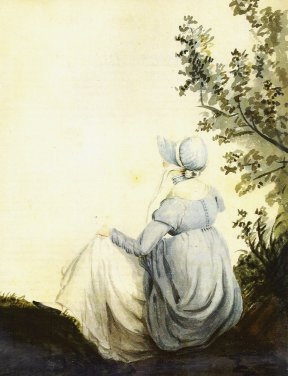
Jane Austen, by her sister Cassandra. (1773-1845) [Public domain], via Wikimedia Commons

Tuesday, January 24, 2012

Lost daughter: Jane Austen, part five (Gilbert)


And thus to the blog post by Lauren Gilbert, historical novelist, that started this whole series on the connections between Jane Austen and Mary Wollstonecraft. Did the former read the latter? She begins with some good old fashioned archival research, of the sort that turned up the father of Claire Clairmont:
I contacted Jane Austen’s House and Museum, Bath Central Library, Jane Austen Centre, and Chawton House Library. No catalog of Rev. George Austen’s library is known to exist. (Jane Austen’s House and Museum does have a copy of the inventory of the contents of the Steventon Rectory but no catalog of his books.) The Bath Central Library indicated that VINDICATION was on the catalog for Marshalls Circulating Library on Milsom Street dated 1808; it is the only one they have in Jane’s time frame. Since VINDICATION was published in 1792 and was a well-known work, this argues that the book was probably available via a circulating library when Jane Austen lived in Bath, or visited in London or other cities.
So far, this is more or less what we already knew from part two, Margaret Kirkham's research decades ago. But  it goes on to mention a Lost Son to add to my little list of people influenced by Mary.
Jane is known to have had a copy of HERMSPRONG, or man as he is not by Robert Bage (philosophically, Mr Bage embraced the idea of the superiority of the “natural man”, considered women the equal of man and supported women’s rights, and was known to have had a high regard for Mary Wollstonecraft; these ideals are demonstrated by the story in HERMSPRONG). Jane’s copy is in the Huntington Library (her signature in all 4 volumes). This would argue a mind open to the ideas expressed in VINDICATION. There is also a theory that Jane would not necessarily referred to Mary Wollstonecraft’s work or influence, due to Mary’s unconventional morals and lifestyle (see Claire Tomalin and Miriam Ascarelli).
Lauren Gilbert concludes that JA "was exposed to and affected by" and indeed "profoundly influenced by" the second Vindication. "That Mary Wollstonecraft’s work was known to Jane Austen is not a point of serious debate that I can find." This agrees with what Lyndall Gordon says (part three in our series). JA's novels serve as warnings of what happens when women are raised to be, as Mary put it, "alluring mistresses" rather "than affectionate wives and rational mothers". The blogpost ends by claiming "almost direct references" in the novels to the polemic. Everyone's favourite spinster novelist:
... with her light touch and subtle humor, highlighted the issues Ms. Wollstonecraft raised. While she could not very well have acknowledged this influence at the time she published, Ms. Wollstonecraft’s reputation being what it was, I think Jane Austen clearly carried Ms. Wollstonecraft’s ideas regarding the education of women, and a higher concept of marriage, forward.
This is in agreement, in more restrained form, with the enthusiastic theories of Arnie Perlstein, part four in our series, who holds JA to be a secret radical feminist: if you hold the texts up to the candleflame in the right way, the invisible lemon juice darkens, and the hidden message become legible.

Next up: a whole book on Women in Revolutionary Debate: Female Novelists from Burney to Austen.  And the Loiterers - like the current Idler, not dawdling at all.


Sunday, January 22, 2012

Lost daughter: Jane Austen, part four (Perlstein)

We have been looking at the opportunities Jane Austen had to read Mary Wollstonecraft. The consensus is overwhelming that the opportunity was there: there are family connections, tenuous but real, as pointed out by Claire Tomalin,  and access to circulating libraries during Austen's years in Bath. More importantly, though, is the textual evidence that the ideas laid out in A Vindication of the Rights of Woman -- the need for rational education and a marriage of mutual respect -- find fictional flesh in the examples and counter-examples of the novels, as we saw the other day. I even found a hidden clue, a secret nod, embedded in the name of one of the most contentious characters.

The first post of this series touched on the difference between Tory feminism and Enlightenment feminism, drawing on Jane Austen, Feminism and Fiction by Margaret Kirkham, which we looked at in more detail in the second post. This book, in its 1983 original or its 1996 second edition, I'm not quite sure, was reviewed by Margaret Doody. I haven't seen the review, but it was thoroughly picked apart by one Arnie Perlstein, an unlikely, to put it mildly, contributor to the discussion. There is no more passionate defender of Jane Austen as a radical feminist than this outsider. I think we can call him, as Ms magazine called Bob Lamm when he liberated Mary from the dungeons of the National Portrait Gallery, a male feminist.

The biography on his blog:
I'm a 59 year old independent scholar (still) working on a book project about the SHADOW STORIES of Jane Austen's novels (and Shakespeare's plays). I first read Austen in 1995, an American male real estate lawyer, i.e., a Janeite outsider. I therefore never "learned" that there was no secret subtext in her novels. All I did was to closely read and reread her novels, while participating in stimulating online group readings.
Then, in 2002, I whimsically wondered whether Willoughby stalked Marianne Dashwood and staged their “accidental” meeting. I retraced his steps, followed the textual “bread crumbs”, and verified my hunch. I've since made numerous similar discoveries about offstage scheming by various characters.
In hindsight, it was my luck not only to be a lawyer, but also a lifelong solver of NY Times and other difficult American crossword puzzles. These both trained me to spot complex patterns based on fragmentary data, to interpret cryptic clues of all kinds, and, above all, not to give up until I’ve completed the puzzle--and literary sleuthing Jane Austen's novels (and Shakespeare's plays) is, bar none, the best puzzle solving in the world!
If you like fisking, take a look: Margaret Doody's misguided review of Margaret Kirkham's Pioneering, Prescient & Spot-On 1982 book Jane Austen, Feminism and Fiction. I didn't see this until later. I first came across his forensic examination in November, when he claimed that Jane Austen was haunted by the Ghost of Mary Wollstonecraft, and got in touch in the comments. (Dear reader - please do the same!)

He posts about once a day, essays or diatribes rich in iconoclastic ideas and mad enthusiasm. I suspect the lawyering is a bit slow in Florida at the moment, and I for one am glad of it, if that gives room for the flowering of amateurism (a term of high praise in Wollstonecraft Towers). Here is a fair flavour of his argument:
I think JA was haunted by the Ghost and the memory of Mary Wollstonecraft, a woman who was brave enough to speak out on behalf of women very publicly, and who, after her death, was vilified because she had been so brave.

It's no accident, therefore, that JA alluded SPECIFICALLY to the very radical polemical novel CALEB WILLIAMS (written in 1809), which, after all, just happened to be written by Godwin, who just happened to have been the husband of...............Mary Wollstonecraft!
Here is an example of the sort of convoluted crossword theory he favours. I'm not saying he's wrong; I'm just saying  you need to have a special sort of mind to follow the thread. Ariadne and the Minotaur?
So it means that when I interpret Henry Tilney as having an epiphany about his mother's death as a result of Catherine's detective work at the Abbey, this is deeply connected to JA's allusion to Godwin's 1809 novel, a novel written a few years AFTER Godwin had a chance to see how the Far Right seized on his Memoir of his dead wife as grounds for crucifying her reputation in the court of public opinion.

So JA is telling us, covertly that (i) in a way, Godwin was Henry Tilney, because he eventually "got it" that he had screwed up, and he wrote Caleb Williams as penance, and (ii) in another way, Godwin was GENERAL Tilney, who did regret the role he played in bringing about his wife's death.
He speculates about Godwin's role:
And the most awful thing is that Godwin "killed" his wife TWICE, and both times it was "involuntary womanslaughter"--the first time, by getting her pregnant, leading to her physical death in childbirth, and the second time by writing her Memoir (perhaps trying to resurrect her), but having it backfire, and instead leading to the public assassination of her character!
And he sums up his view of Jane Austen's feminism:
I believe that for a very long time, maybe her whole adult life, JA played with the idea of going public with her true feelings. But in the end of the day, every time she put quill pen to paper, she chose to go undercover -- but I get the very strong sense that she always felt ambivalent about that painful decision. The regret that Catherine and Eleanor express when they talk about Mrs. Tilney is, I think, JA's own regrets....

So Northanger Abbey is in a very real sense JA's eulogy to the greatest feminist "heroine" of her time.
He also speculates in Jane Austen the radical but covert feminist Part 268 that Mary Bennet is Jane Austen's alter ego, named after Mary Wollstonecraft.  He agreed that I was barking up the right tree as regards name clues, and commented that Mary Bennet is "the most important surrogate for Mary W in all of Jane Austen's fiction":
...what you have is Mary Bennet as JA's covert self portrait! JA has led the reader down the garden path, seeing if we will take the bait and join with the rest of the Bennet family in unjustly and at times cruelly scorning Mary, but hoping that we will struggle with our inner Mr. Bennet and instead realize that we've been guilty of a wrong first impression of Mary, and reconsider.

So we have a surface parody of Mary, but a veiled anti-parody which vindicates Mary (who I claim is named after Mary Wollstonecraft). And I claim exactly the same sort of anti-parody in Northanger Abbey which has a surface parody of Catherine, but a covert anti-parody which vindicates Catherine's keen perceptions.
Enough to make anyone dizzy. Next time, a look at the post that kicked this all off, from historical novelist Lauren Gilbert.

Thursday, January 19, 2012

Lost daughter: Jane Austen, part three (Gordon)

We have been looking at whether Jane Austen was influenced by Mary Wollstonecraft.  Kirkham and Ascarelli think so. Today we look at the views of Lyndall Gordon, Mary's most recent biographer.

She contends that the young Jane very likely had the opportunity to read Mary's works. In the chapter "Vindication" of her 2005 Vindication, she points out that The Female Reader, an anthology which Mary compiled for Johnson, was published when Jane was 14, "reading at home, and the perfect recipient for this book". There are plenty of Austen parallels, examples in each of the six canonical novels, and the juvenalia as well, that show the folly of the miseducation of daughters and of unequal marriages. Her novella ''Catherine'' appeared within a year of Rights of Woman. "Wollstonecraft's ridicule of women's inflated gush and plaything eduction reappears in Austen's ridicule of Camilla" and her useless, ladylike accomplishments. "Wollstonecraft's voice sounds once more when Elizabeth Bennett will not grovel to imperious Lady Catherine de Burgh in Pride and Prejudice", in contrast to the vacuous Bingley sisters, who focus all their attention on marriage and men.  The biographer links the two women backwards as well, crediting Mary with an "infallible Austen eye for the tendency of able men to mate with inferiors". See also her essay on Persuasion: "Jane Austen is often co-opted for conservatism, but her novels question traditional authority and female artifice."
Front Cover
Here's a passing reference to the impact of Mary Wollstonecraft, and how she has become embedded in how we now read Austen, even had the author not intended it. Olwen Hufton's two-volume overview of women's history in Western Europe, The Prospect Before Her: 1500-1800, mentions Fanny Price "in her clear-sighted notions of the appropriate, and her eschewing of the trivial, [as] something of a spiritual legatee of The Vindication."

Coming up next: an outsider reads the canon. We meet Arnie Perlstein, and you won't forget him.